Key takeaways
- AI agent tools have moved from experimental to genuinely useful in 2026
- AutoGPT, CrewAI, LangChain, AgentGPT, and Zapier AI Agents are the five most talked-about right now
- Each tool suits a different type of user, from developers to complete beginners
- Some are free and open-source; others charge based on usage
- The right tool depends on your technical comfort level and what you want to automate
Who is this for? Entrepreneurs, content creators, developers, and small business owners who want to understand which AI agent tools are actually worth using in 2026, without wading through technical jargon.
A year ago, AI agents were a niche topic discussed mostly by developers and AI researchers. In 2026, they are one of the most searched topics in the tech world, and for good reason. These tools can plan tasks, browse the web, write and run code, and complete multi-step workflows without you needing to prompt them at every turn.
But the market is crowded and moving fast. New tools launch every month, and it is genuinely hard to know which ones are worth your time. This guide cuts through the noise and focuses on the five AI agent tools that have earned the most attention in 2026, what each one actually does, and who should use it.
What makes a tool an AI agent?
Before diving into the list, it helps to understand what separates an AI agent tool from a regular AI assistant. A standard AI chatbot waits for your prompt and responds. An AI agent receives a goal and figures out how to achieve it, breaking the task into steps, using external tools like web search or code execution, and working through the process with minimal hand-holding.
The tools below all share that core capability, but they differ significantly in how they are set up, what they connect to, how much coding they require, and what kinds of tasks they handle best. Think of autonomous AI systems, multi-agent frameworks, and AI workflow automation as the umbrella terms covering everything in this list.
1. AutoGPT
AutoGPT is the tool that put AI agents on the map. Released as an open-source project in 2023, it became one of the most starred repositories on GitHub almost overnight, and in 2026 it has matured into a genuinely capable autonomous AI framework.
You give AutoGPT a high-level goal, such as “research the top five competitors for my SaaS product and produce a comparison report,” and it breaks that down into tasks, browses the web for information, stores what it finds, writes code if needed, and iterates until it produces an output. It is not perfect, but for a developer or technically confident user, it is one of the most powerful free AI agent platforms available.
The main barrier is setup. AutoGPT requires access to the OpenAI API, some command-line comfort, and a degree of patience when things go wrong. If you can handle that, the ceiling of what it can do is genuinely impressive. It is best suited to research-heavy tasks, competitive analysis, data gathering, and content workflows that can tolerate some manual oversight.
Coding required – Yes, basic command-line setup
2. CrewAI
CrewAI takes a different approach to AI agent automation. Instead of one agent working through a task alone, CrewAI lets you build a team of agents, each with a defined role, that work together to complete a complex goal. You might have one agent assigned as a researcher, one as a writer, and one as an editor. Each does its job and passes the output to the next.
This multi-agent collaboration model makes CrewAI particularly effective for content pipelines, business research workflows, and any task that benefits from checks and specialisation at each stage. It is open-source and Python-based, which means it is free to use but does require a coding background to configure properly.
In 2026, CrewAI has built a strong community around it and is one of the most actively maintained open-source agent frameworks available. If you are a developer looking to build serious agentic workflows for a business use case, it is hard to look past. For non-technical users, the learning curve is steep enough to make other options on this list more practical.
Coding required – Yes, Python knowledge needed
3. LangChain
LangChain is less of a finished product and more of a building block. It is an open-source framework that developers use to connect large language models to external tools, data sources, memory systems, and other agents. If AutoGPT and CrewAI are the cars, LangChain is closer to the engine and chassis that you build them on.
What makes LangChain so widely used is its flexibility. You can connect it to virtually any data source, give it access to custom tools, and chain together sequences of AI actions in ways that more opinionated tools do not allow. In 2026, it underpins a significant portion of the commercial AI agent products that have launched over the past 18 months.
It is not for beginners. LangChain is aimed squarely at developers who want full control over how their AI agent behaves and what it connects to. If that describes you, it is one of the most powerful AI agent frameworks available, and the community support and documentation have improved considerably in 2026.
Coding required – Yes, advanced Python knowledge
4. AgentGPT
AgentGPT is the most accessible entry point on this list for non-technical users. It runs entirely in the browser, requires no installation, and lets you deploy an AI agent by simply typing a goal into a text box. It will then plan its approach, execute the steps it can, and show you the output in real time.
The experience is closer to watching an AI think out loud than managing a complex workflow. For someone who wants to experiment with what AI agents can do without committing to any setup, it is an ideal starting point. Tasks like drafting a research report, planning a content strategy, or summarising a topic from multiple sources work well.
The limitations are real, though. AgentGPT does not have access to as many tools as the developer-focused options, and it can lose its way on longer or more complex tasks. Think of it as a proof of concept with genuine practical use for everyday tasks, rather than a production-ready system for serious business automation.
Coding required – None
5. Zapier AI Agents
Zapier AI Agents is the tool on this list most likely to deliver immediate practical value to a small business owner or non-technical professional. Built on top of Zapier’s existing automation infrastructure, it lets you describe what you want an agent to handle and it sets up the logic, connects to your existing apps, and runs the workflow without you needing to touch code.
You can tell it to monitor your inbox for leads, qualify them using a set of criteria you define, and add the ones that meet the criteria to your CRM. Or to post a summary of each week’s blog content across multiple platforms. Or to pull data from a form submission, format it, and send it to a Google Sheet. The possibilities are broad because Zapier connects to thousands of apps.
The cost is higher than the free open-source options, and the depth of customisation is lower than what a developer could achieve with LangChain or CrewAI. But for a business owner who wants AI agent productivity tools without a steep learning curve, Zapier AI Agents is the most plug-and-play option in 2026.
Coding required – None
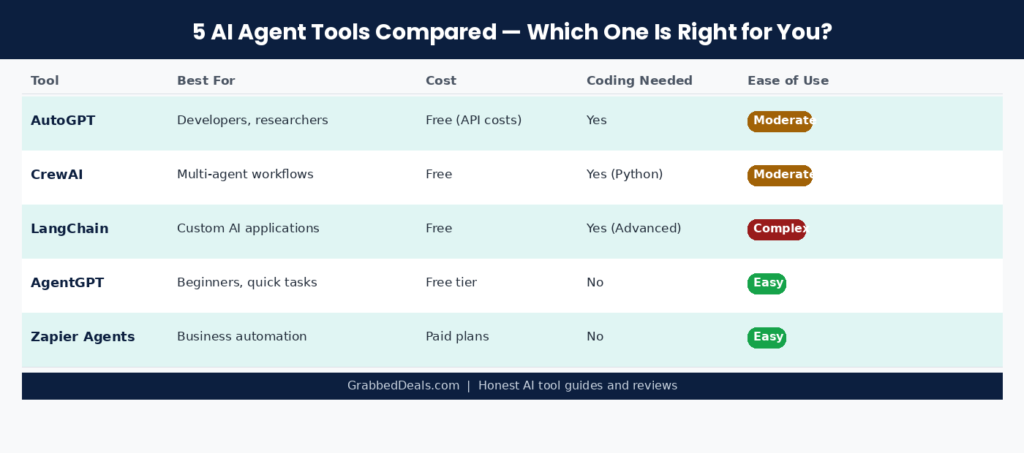
How they compare at a glance
| Tool | Best for | Cost | Coding needed | Ease of use |
|---|---|---|---|---|
| AutoGPT | Developers, researchers | Free (API costs) | Yes | Moderate |
| CrewAI | Multi-agent workflows | Free | Yes | Moderate |
| LangChain | Custom AI applications | Free | Yes (advanced) | Complex |
| AgentGPT | Beginners, quick tasks | Free tier | No | Easy |
| Zapier AI Agents | Business automation | Paid | No | Easy |
Which one should you start with?
If you have never used an AI agent before and want to understand what they can do, start with AgentGPT. It requires nothing to set up and gives you a real feel for how autonomous AI task automation works in practice.
If you run a small business and want to automate actual workflows without touching code, Zapier AI Agents is the most practical choice. The cost is justified by the time it saves on repetitive tasks.
If you are a developer who wants to build something serious, the choice between AutoGPT, CrewAI, and LangChain depends on your goal. AutoGPT is best for general autonomous tasks. CrewAI is best when you want specialised roles collaborating on a single output. LangChain is best when you want maximum flexibility and control.
Quick tip: Whichever tool you choose, start with a small, well-defined task rather than a broad goal. AI agents perform best when they have a clear, specific target. “Write a 500-word blog introduction on sustainable packaging for an e-commerce audience” will produce a better result than “help me with my blog.”
FAQ
Zapier AI Agents is the most beginner-friendly option in 2026. It requires no coding, connects to tools you already use, and lets you set up automated workflows in plain English. AgentGPT is also a good starting point if you want a free browser-based option to experiment with first.
Several options offer free access. AutoGPT is fully open-source and free to self-host, though you will need OpenAI API credits. AgentGPT has a free browser-based version. CrewAI and LangChain are open-source and free. Zapier AI Agents charges a subscription fee based on usage.
A chatbot responds to individual prompts one at a time. An AI agent can plan a multi-step task, use external tools like web search or code execution, and work towards a goal autonomously without being prompted at every step. Agents act on goals; chatbots respond to messages.
Not in 2026. AI agents are best used to handle specific, repeatable tasks that do not require human judgement or relationship management. They can save significant time on research, data gathering, content drafting, and workflow automation, but they still need oversight and are not a substitute for skilled people.
The bottom line
AI agent tools are no longer a curiosity. In 2026, they are practical, accessible, and capable of saving real time on real tasks. The five tools covered here represent the best of what is available right now, from the developer-focused power of LangChain and CrewAI to the no-code accessibility of AgentGPT and Zapier.
Pick the one that matches your technical comfort level and start small. The learning curve is shorter than it looks, and the payoff in time saved is genuine. If you want to understand the broader concept before diving into a specific tool, our plain-English guide to agentic AI is the best place to start.
Explore our more pages – AI Tools & Productivity | Smartphone Ecosystems | Laptop & PCs | Audio & Sound Systems | Gaming | Photography & Videography | EV & Green Tech | Digital Marketing & SEO | Smart Home & Wearables | Tech Deals & Buying Guides |
Related posts
- What Is Agentic AI? A Plain-English Guide for 2026
- Claude AI Review 2026: Honest Take After 2 Weeks of Daily Use
- ChatGPT vs Claude in 2026: Which One Is Actually Better?