Key takeaways
- Agentic AI systems can plan, take actions, and complete multi-step tasks without constant human input
- Regular chatbots respond to prompts; agentic AI acts on goals
- Tools like AutoGPT, CrewAI, and OpenAI Operator are already running real business tasks autonomously
- Agentic AI makes mistakes and still needs human oversight
- Understanding this concept now gives you a serious head start
Who is this for? Anyone who keeps hearing “agentic AI” and wants a clear, honest explanation of what it actually means and why it matters.
What is agentic AI?
Agentic AI is an AI system that can take actions and make decisions on its own to complete a goal, without you needing to guide it step by step.
You give it a task. It figures out what needs to happen, breaks it into steps, and gets on with it. If something goes wrong along the way, it adjusts. If it needs to use a tool, search the web, or run a piece of code, it does that too.
That is the core idea. Agentic AI does not just answer questions. It acts.
The word “agentic” comes from the concept of agency, the ability to make independent decisions and take initiative. Applied to AI, it means a system that can pursue objectives, not just respond to prompts.
How it differs from a regular chatbot
This is where most explanations get confusing, so let’s keep it simple.
A regular chatbot like early ChatGPT works like this: you type something in, it types something back. Every response starts from scratch. It has no memory of what you asked before unless you’re in the same conversation window. It does not do anything in the real world. It does not open your files, send your emails, or check today’s news. It just generates text based on what you gave it.
Agentic AI works completely differently. Here is a side-by-side comparison:
| Regular chatbot | Agentic AI |
|---|---|
| Responds to one prompt at a time | Pursues a goal over multiple steps |
| You lead the conversation | It leads the process |
| No access to external tools by default | Can use tools, browse the web, run code |
| Forgets previous turns unless in the same chat | Maintains memory across a session or task |
| You do the work; it helps you think | It does the work; you review the output |
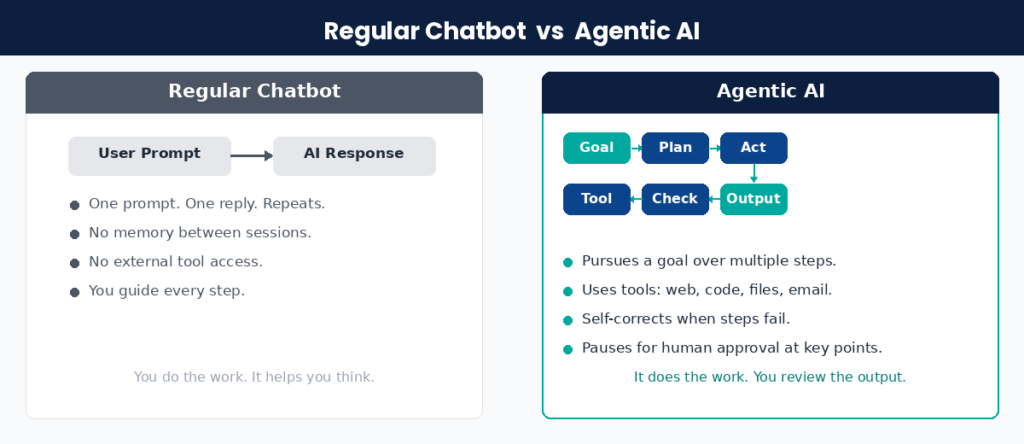
Think of it this way. A chatbot is like a knowledgeable friend you can text questions to. Agentic AI is like hiring someone to actually do a job for you.
How agentic AI actually works
You do not need to understand the technical details to use agentic AI, but knowing the basic mechanics helps you trust it and know when not to.
Planning
When you give an agentic AI system a goal, it first breaks that goal into smaller steps. If you say “research the top five electric bikes under £1,000 and write a comparison table,” it works out that it needs to search the web, gather product data, compare specs, and format the output. It plans before it acts.
Tool use
Agentic AI systems are connected to tools. A web search tool, a code interpreter, a calendar, a document editor, an email client. When the agent needs information it does not have, it reaches for the right tool and uses it. This is what makes it genuinely useful rather than just impressive.
Memory
Within a task, the agent remembers what it has already done. It does not ask you the same question twice. Some systems also have long-term memory across sessions, so they can build on previous work.
Self-correction
When something does not work, a well-designed agent tries again with a different approach. If a web search returns nothing useful, it rephrases the query. If a tool fails, it routes around it. This is what makes it feel less like software and more like a capable assistant.
Human handoff
Most agentic systems pause at certain points to check in with you. This is called a “human in the loop” design. It is not a weakness. It is a safeguard, and in 2026, it is still very much needed.
Real examples of agentic AI in 2026
This is not theoretical. Agentic AI is already running real tasks for real people and businesses.
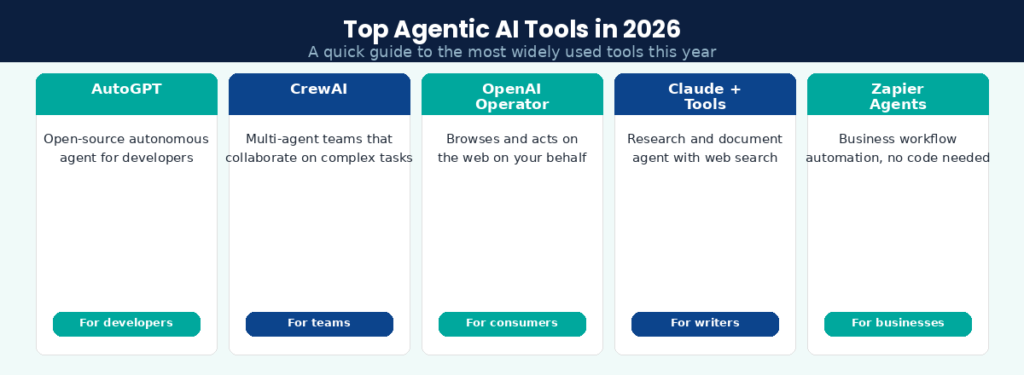
One of the earliest and most popular agentic AI systems. You give it a goal and it plans its own steps, uses tools, browses the web, writes code, and iterates until it reaches the outcome. Open-source and best suited to developers and technically-minded users. Find AutoGPT on GitHub.
Lets you build teams of AI agents, each with a specific role, that collaborate on complex tasks. One agent researches, one writes, one reviews. It mimics how a real team works, but everything runs automatically.
Takes agentic AI into your web browser. It can log into websites, fill in forms, make bookings, and complete tasks directly in Chrome on your behalf. One of the most practical consumer-facing examples to date. See OpenAI’s official Operator page.
Allows Claude to search the web, run analysis on documents, and take sequential actions within a task. The difference between using Claude as a chatbot and using it with tools enabled is significant. See our full Claude AI review 2026 for a deep dive.
Brings agentic behaviour to business workflows. You describe what you want your agent to handle automatically, and it sets up the logic, connects your apps, and runs the process without you touching it again.
The risks and limitations
Agentic AI is impressive. It is also not magic, and you should know its real limitations before you build any important process around it.
It makes mistakes. Agentic AI can misunderstand your goal, take the wrong action, or use a tool incorrectly. The more steps involved, the more chances for an error to compound.
It can go off-track. Without a clear, specific goal, an agent can go in unhelpful directions. Vague instructions produce vague results, or worse, a lot of wasted activity.
It does not know what it does not know. An agent will confidently attempt a task it cannot actually complete. It may produce plausible-looking output that is factually wrong. You still need to review the results.
Permissions matter. An agentic system that has access to your email, calendar, and files can do a lot of good. It can also accidentally send something it should not, or delete something you needed. Be careful what access you grant.
Cost adds up. Most agentic AI tools charge per action, per API call, or per task. A single complex goal can cost significantly more than a simple chat session.
It still needs oversight. The best use of agentic AI in 2026 is as an assistant with oversight, not a fully autonomous replacement for human judgement. The technology is improving fast, but we are not there yet.
Should you start using it?
Yes, if you have a clear use case. No, if you’re hoping it will just figure things out for you.
Agentic AI works best when you give it a specific, well-defined task with a clear endpoint. “Research and summarise the top ten project management tools for remote teams under £20 per user per month” is a great agentic task. “Sort out my business” is not.
Start small. Try one tool, one task, and see how it performs. The best entry points in 2026 are AutoGPT if you’re comfortable with some technical setup, CrewAI for multi-agent workflows, Zapier AI Agents for business process automation without coding, and Claude with tools for capable research without a steep learning curve.
The people who get the most value from agentic AI right now are those who understand what it can and cannot do, and use it accordingly. Next step: read our guide to the five AI agent tools everyone is talking about in 2026 for a full breakdown of which one suits your situation. We also compare these models head-to-head in our ChatGPT vs Claude in 2026 guide.
FAQ
Generative AI creates content, text, images, and code in response to a prompt. Agentic AI takes action. Most agentic AI systems use generative AI as their core reasoning engine, but they are built on top of it with the ability to plan, use tools, and complete tasks over multiple steps. Generative AI is the engine. Agentic AI is the car.
In its current form, agentic AI is safe when used carefully. The main risks come from giving agents too much access to sensitive systems, from not reviewing their outputs, or from relying on them for high-stakes decisions without human checks. For most everyday tasks, the risk is low. For anything important, keep a human in the loop.
Not in 2026. What it does is take over specific, repeatable tasks that do not require human judgement. Research, formatting, scheduling, and data gathering are all good candidates. Creative decisions, relationship management, and anything requiring real-world accountability still need people.
A human in the loop means the system pauses at key points and asks you to confirm before it proceeds. If an agent is about to send an email or delete a file, a well-designed system shows you what it plans to do and asks for approval. This is a necessary safeguard while the technology matures.
Claude with tools enabled is the most accessible starting point. You interact naturally, and Claude uses web search and document tools on your behalf. For more autonomous multi-step tasks, Zapier AI Agents requires no coding and connects to tools you already use. AutoGPT and CrewAI offer more power but suit people with some technical comfort.
The bottom line
Agentic AI is not just another chatbot feature. It is a fundamentally different way of using AI, one where you set the goal and the system figures out how to get there.
In 2026, it is still early. The tools are powerful but imperfect. They work best with clear goals, appropriate oversight, and realistic expectations. If you start experimenting now, you will be ahead of most people by the time agentic AI becomes mainstream.
Explore our more pages – AI Tools & Productivity | Smartphone Ecosystems | Laptop & PCs | Audio & Sound Systems | Gaming | Photography & Videography | EV & Green Tech | Digital Marketing & SEO | Smart Home & Wearables | Tech Deals & Buying Guides |
Related posts
- 5 AI Agent Tools Everyone Is Talking About in 2026
- Claude AI Review 2026: Honest Take After 2 Weeks of Daily Use
- ChatGPT vs Claude in 2026: Which One Is Actually Better?

1 comment