Key takeaways
- Local SEO is completely doable without paying for any tools or agencies
- Your Google Business Profile is the single highest-impact thing you can optimise
- Local citations, on-page signals, and reviews work together to push your ranking up
- Most local businesses are doing less than 20% of what this guide covers
- You can rank on the first page in your local area within 4 to 12 weeks if you follow these steps consistently
Who is this for? Small business owners, freelancers, and local service providers who want to rank higher on Google without hiring an agency or paying for expensive SEO software.
What is local SEO and why it matters
Local SEO is the process of getting your business to appear in Google search results when someone nearby searches for what you offer.
When someone types “plumber near me” or “best coffee shop in Leeds,” Google shows them a map pack of three local results before anything else. Those three spots are determined entirely by local SEO signals. If your business is not there, you are invisible to people who are ready to spend money right now.
This is not the same as regular SEO. You do not need to compete with national brands or write content for a global audience. You just need to rank in your town, your city, or your area. That makes it far more achievable than most people think.
The majority of what moves the needle in local SEO costs nothing. No agency fees. No £200-per-month software subscriptions. Just your time and this guide.
Set up and optimise your Google Business Profile
Your Google Business Profile (GBP) is the single most important factor in local SEO. Full stop.
It is the listing that appears in Google Maps, in the map pack, and in the knowledge panel on the right side of the screen when someone searches your business name. If it is not set up, you do not exist in local search. If it is set up poorly, you rank far lower than you should.
Go to the Google Business Profile dashboard and either claim your existing listing or create a new one.
Once you’re in, here is everything you need to complete:
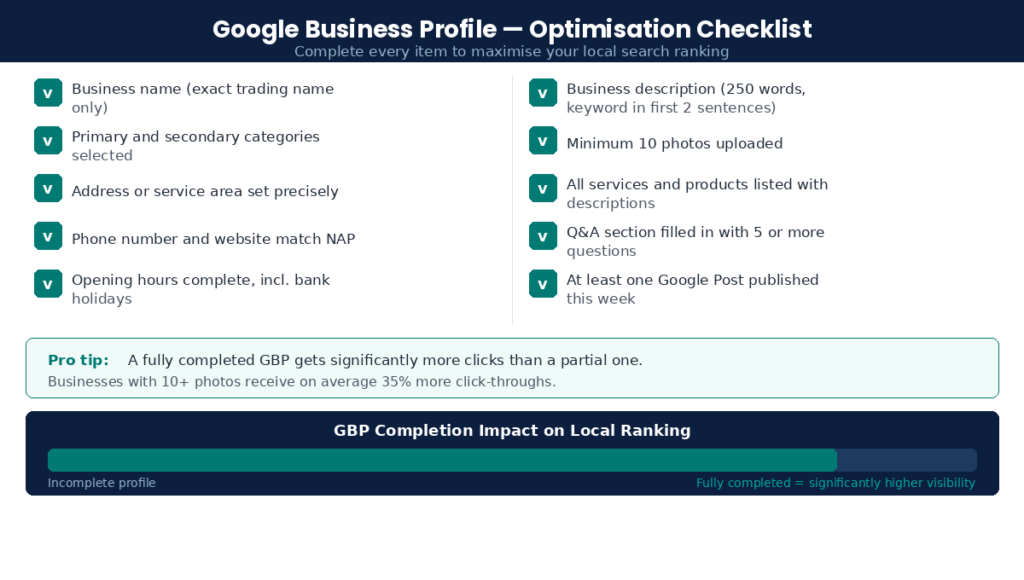
Business name. Use your exact trading name. Do not stuff keywords in here. Google penalises this and it looks unprofessional.
Category. Choose the most specific category that matches your business. Your primary category carries the most weight. Add secondary categories too if they apply.
Opening hours. Keep these accurate and update them for bank holidays. Google surfaces businesses that are currently open more prominently in some searches.
Business description. Write 250 words maximum. Include your primary keyword naturally in the first two sentences. Describe what you do, who you serve, and what makes you worth choosing.
Photos. Upload a minimum of ten photos: your exterior, interior, team, products or services in action, and a logo. Businesses with photos get significantly more clicks than those without.
Posts. Google Business Posts let you share updates, offers, and events directly on your profile. Post at least once per week. It signals that your business is active.
Step 2 of 7
Get your NAP consistent everywhere
NAP stands for Name, Address, and Phone number.
Google cross-references your business details across hundreds of websites to verify that you are a legitimate, established business. If your name is “Smith & Sons Plumbing” on Google but “Smith and Sons Plumbing Ltd” on Yell.com, that inconsistency weakens your local authority.
Before you do anything else, decide on the exact format of your business name, address, and phone number. Write it down. Use that exact format everywhere, every time, without exception.
Your website is the most important place to start. Your NAP should appear in the footer of every page. It should also appear on your Contact page in plain text, not embedded in an image. Google cannot read image text.
Important: Check existing listings by searching your business name on Google. Find any old listings with wrong information and update or remove them before building new citations.
Step 3 of 7
Build local citations for free
A local citation is any mention of your business’s NAP on another website. The more high-quality citations you have, the more Google trusts that you are a real, established local business.
You do not need to pay for this. Here are the most valuable free directories to list your business on:
Thomson Local / Scoot – Additional UK coverage. Consistent NAP across all of them.
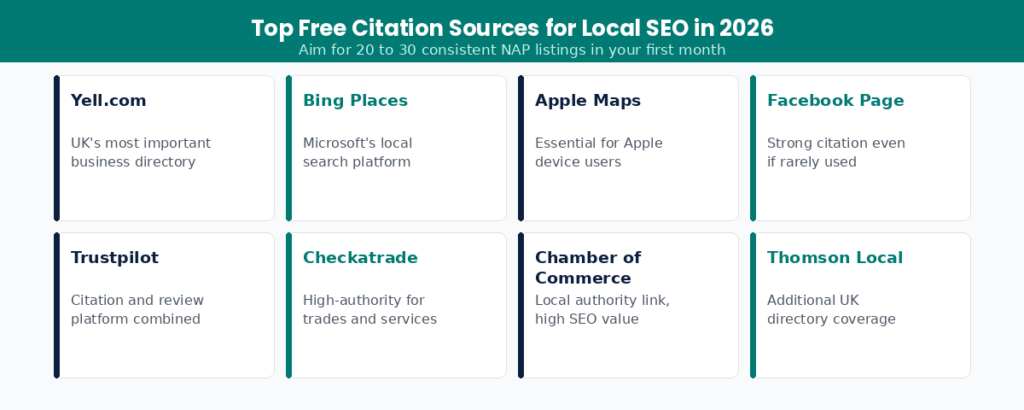
Aim to build 20 to 30 consistent citations in your first month. After that, the incremental benefit of adding more decreases significantly.
Step 4 of 7
Optimise your website for local search
Your Google Business Profile and your website work together. Google looks at your website to confirm that your business is legitimate and relevant to local searches.
Add your location to your page titles. Instead of “Accountant Services,” use “Accountant in Bristol.” Include your primary keyword and location in the title tag of your homepage.
Write a dedicated location page if you serve multiple areas. A page titled “Plumber in Sheffield” targeting Sheffield searches is more effective than a generic Services page.
Add schema markup. Local business schema is structured data you add to your website’s code that tells Google exactly what your business is and where it is. You can generate it for free at schema.org and paste it into your site. This is one of the highest-impact technical improvements you can make.
Embed a Google Map on your Contact page. Go to Google Maps, find your listing, click Share, and embed the map. This reinforces your location signal.
Make sure your site loads fast on mobile. Over 60% of local searches happen on mobile. A slow site costs you customers before they even contact you. Test your speed for free using Google’s free PageSpeed test.
Step 5 of 7
Get more Google reviews
Reviews are the third most important local ranking factor after your GBP optimisation and your links.
More reviews, and more recent reviews, push you up the rankings. A business with 50 reviews also wins far more clicks than a business with 5, even if your ranking position is the same.
Create a direct review link. Go to your Google Business Profile, click “Get more reviews” and copy the link. Shorten it with bit.ly if you want.
Ask at the right moment. The best time to ask is right after you have done a good job and the customer has said something positive. Then send the link immediately.
Add the link to your email signature so every email you send becomes a passive request.
Respond to every review. Reply to your 5-star reviews with a personalised thank-you. Reply to negative reviews calmly and constructively. This signals to Google that you are an active business.
Do not: Pay for reviews. Ask friends to write fake reviews. Google detects patterns and removes them, and getting caught can result in your listing being suspended.
Step 6 of 7
Build local backlinks without spending anything
A backlink is a link from another website to yours. In local SEO, backlinks from websites relevant to your area carry particular weight.
You do not need hundreds of them. Five or ten good local backlinks can make a meaningful difference.
Get listed in your local newspaper’s online directory if they have one. Many local news sites have a business directory section you can contact them about directly.
Sponsor a local event or community group. Many clubs, school fairs, and charity events list their sponsors online with a link. The sponsorship does not need to be large.
Write a guest article for a local blog or news site. Offer a useful piece on your area of expertise. A Bristol-based accountant writing a piece on tax returns for local businesses earns a relevant backlink.
Join your local business association or networking group. Most have member directories with links.
Step 7 of 7
Track your results with free tools
You do not need paid software to track your local SEO progress. These free tools give you everything you need:
Google Search Console shows you which search queries bring people to your website, how many impressions you get, and how your rankings change over time. Connect it at search.google.com/search-console.
Google Analytics 4 shows you where your website traffic comes from, what pages people visit, and how long they stay. Free at analytics.google.com. Read our guide on how to set up Google Analytics 4 in 10 minutes to get started.
Google Business Profile Insights is built into your GBP dashboard. It shows how many people searched for your business, how many clicked for directions, and how many called you.
Check your Search Console once a week. Review your GBP Insights every month. Look for which keywords drive the most impressions and create more content around those topics.
FAQ
For most local businesses starting from scratch, you can expect to see movement in your rankings within 4 to 8 weeks if you complete your GBP fully, build 20 or more citations, and start gathering reviews. Competitive areas take longer. Some businesses see changes in as little as 2 to 3 weeks, particularly when they claim a previously unclaimed or poorly-optimised GBP.
No, but it helps significantly. Your Google Business Profile alone can rank you in the map pack without a website. However, having a website gives Google more signals to verify your business and lets you target additional keywords through on-page content. If you do not have a website, Google Sites is a free starting point.
Your Google Business Profile is the single highest-impact factor. Specifically: how complete it is, how active it is through posts and photo uploads, and how many recent positive reviews you have. After that, NAP consistency and local citations matter most.
Yes. Each location needs its own Google Business Profile with a verified address. On your website, create a separate page for each location with unique content. Do not copy and paste the same page with just the location name changed, as Google treats duplicate content negatively.
Yes. Regular SEO targets national or global audiences and often involves significant content production and high-authority link building. Local SEO is more about trust signals: verified listings, consistent citations, local reviews, and on-page location signals. The competition is much smaller, which is why it is accessible to any business willing to put in the work.
The bottom line
Local SEO is not complicated. It is mostly a matter of being thorough and consistent.
Complete your Google Business Profile properly. Get your NAP consistent everywhere. Build 20 to 30 citations. Optimise your website for local search. Gather reviews steadily. Build a handful of local backlinks.
Do all of that and you will outrank most of your local competitors, because most of them are not doing even half of it. Start with your Google Business Profile today. It takes about two hours to complete properly and it is the single highest-return task on this entire list.
Explore our more pages – AI Tools & Productivity | Smartphone Ecosystems | Laptop & PCs | Audio & Sound Systems | Gaming | Photography & Videography | EV & Green Tech | Digital Marketing & SEO | Smart Home & Wearables | Tech Deals & Buying Guides |
Related posts
- Best Free SEO Tools for Small Businesses in 2026
- How to Set Up Google Analytics 4 in 10 Minutes
- What Is AI SEO? How Artificial Intelligence Is Changing Search
