Key takeaways
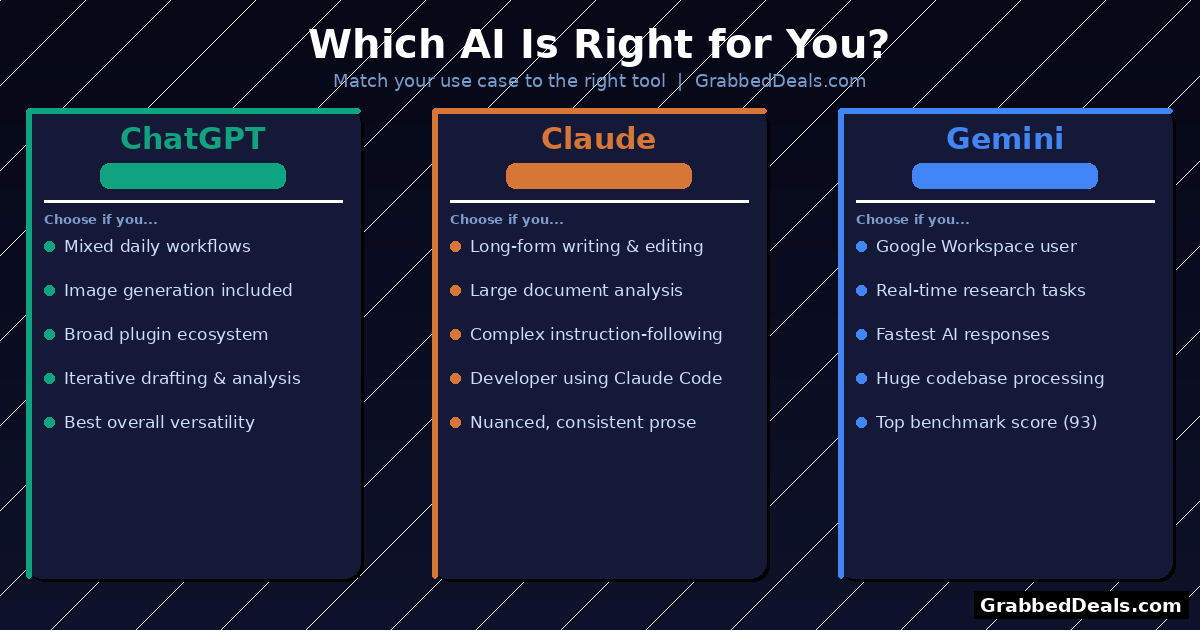
- Claude wins for long-form writing, document analysis, and nuanced instruction-following.
- ChatGPT leads for versatility, plugin ecosystem, and mixed-task workflows.
- Gemini is the best pick for Google Workspace users, multimodal tasks, and speed.
- All three cost around £16 to £20 per month at the Pro tier, so cost alone shouldn’t decide this.
- No single AI dominates every category. The right answer depends on what you actually do every day.
Who is this for? Anyone deciding whether to subscribe to ChatGPT Plus, Claude Pro, or Gemini Advanced in 2026. Or anyone paying for all three and wondering if they can trim down.
Why this comparison is different
Most AI comparison articles run a few prompts, pick a headline winner, and call it done. That’s not useful in 2026, because the honest answer is that each of these tools is genuinely excellent at something specific.
The question isn’t which AI is “best.” The question is which one fits what you’re actually doing. This article gives you a clear, task-by-task verdict so you can stop guessing and start choosing.
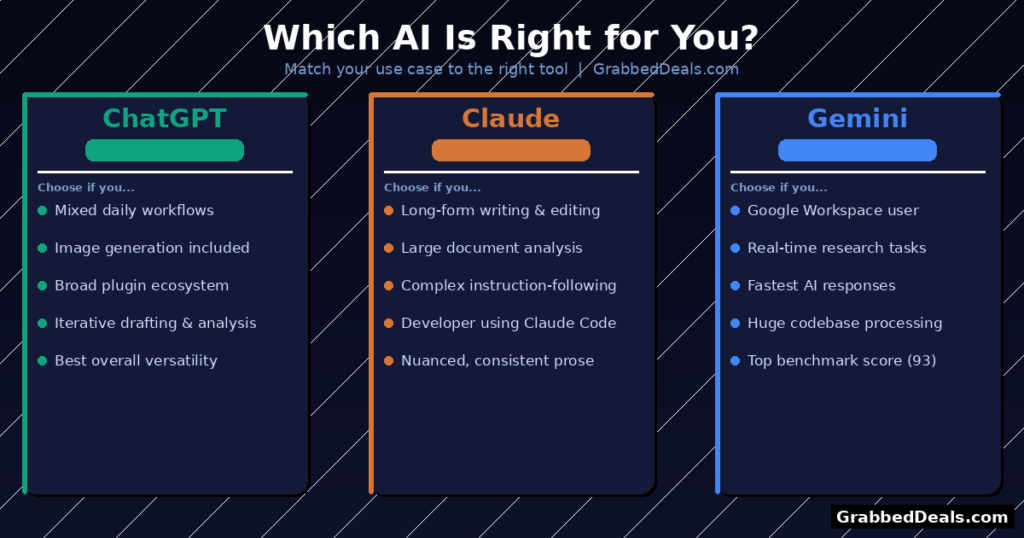
We tested ChatGPT (GPT-5.4), Claude (Opus 4.6 / Sonnet 4.6), and Gemini (3.1 Pro) across writing, coding, research, long-document analysis, and pricing. Here’s what we found.
ChatGPT vs Claude vs Gemini: the models in 2026
Before diving into the tests, here’s where each platform stands right now.
ChatGPT runs on GPT-5.4 at the paid tier. It’s the most widely used AI tool in the world, and the product has matured significantly. The interface handles writing, data analysis, code, image generation, and tool integrations all in one place. It’s the Swiss Army knife of AI assistants.
Claude is Anthropic’s flagship model. Opus 4.6 is the top-tier option, with Sonnet 4.6 as the faster, more cost-efficient version for most everyday tasks. Claude has built a strong reputation for writing quality, long-form document handling, and following detailed instructions without drifting. Anthropic recently released Opus 4.6 with a one million token context window in beta, which is significant for enterprise users.
Gemini 3.1 Pro is Google’s answer. It’s deeply embedded in Google Workspace, which gives it a meaningful advantage for anyone whose work lives in Docs, Sheets, or Gmail. The model also leads on raw benchmark scores right now, sitting at 93 overall on BenchLM’s current leaderboard, ahead of both GPT-5.4 and Claude Opus 4.6, which both sit at 88.
That benchmark gap is real, but benchmarks don’t tell the whole story. Let’s look at what actually matters.
Writing and content creation
This is where the real differences show up most clearly.
Claude is the strongest writer of the three. It produces prose with a natural rhythm, follows multi-part instructions without losing track of earlier constraints, and handles tone shifts well across long documents. For blog posts, essays, reports, and anything that needs multiple revision passes, Claude is the most consistent performer.
ChatGPT writes well but tends to drift on complex, multi-constraint prompts. It sometimes misses formatting rules set earlier in a conversation or produces output that’s technically accurate but lacks personality. For quick first drafts, it’s excellent. For polished, brand-consistent writing, it needs more shepherding.
Gemini can write competently, but it often produces wordier output than necessary and has a tendency to over-rely on bullet points. For factual, structured content it works well. For narrative or nuanced writing, it’s the weakest of the three.
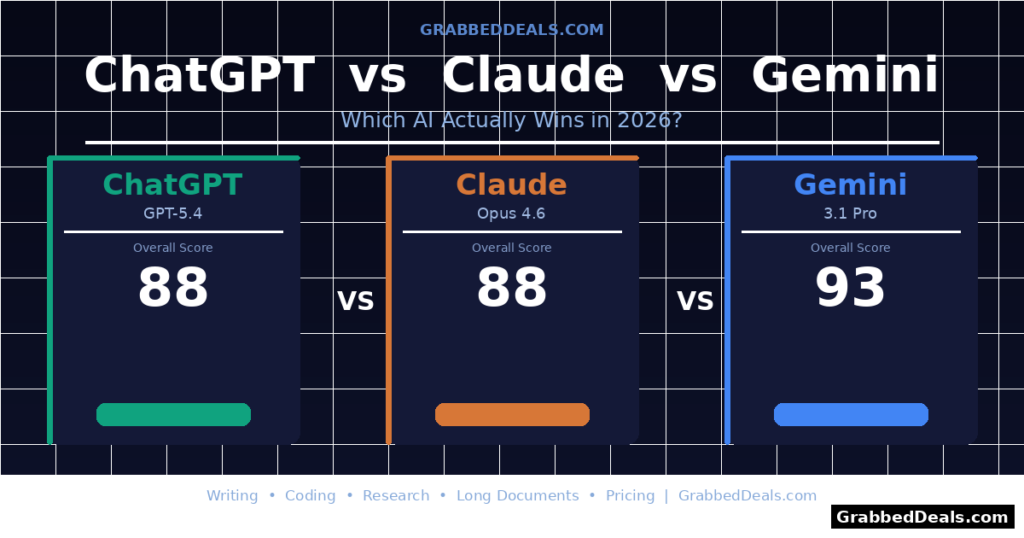
Winner for writing: Claude. If content creation is your primary use for AI, Claude Pro is the subscription to start with.
Coding and technical tasks
This category is more competitive than most people expect.
ChatGPT is the most versatile coding assistant. It knows virtually every programming language, generates working code quickly, and its Code Interpreter can actually run Python in-browser. For developers who need fast solutions across a wide range of technologies, ChatGPT remains the most practical choice.
Claude leads on complex logic and debugging. In head-to-head tests on the same problems, Claude makes fewer errors on tricky algorithms and produces cleaner, better-typed code. Anthropic’s Claude Code (the command-line agentic tool) has also become a genuine standout for developers working on large codebases.
Gemini is fast and offers the largest context window, which matters when you’re feeding in entire repositories. But it’s the weakest on complex reasoning tasks. It finds bugs and fixes them, but it doesn’t flag edge cases or offer the depth of explanation that Claude and ChatGPT do.
According to BenchLM’s current coding leaderboard, Gemini 3.1 Pro scores 95, GPT-5.4 scores 89.3, and Claude Opus 4.6 scores 86.9. Gemini leads on benchmarks here. But in real debugging sessions, Claude’s explanations and reasoning are often more useful than Gemini’s faster but shallower answers.
Winner for coding: depends on your workflow. Gemini for speed and large codebases. Claude for complex logic and debugging. ChatGPT for breadth and versatility.
Research and real-time information
Gemini has a structural advantage here. Its tight integration with Google Search means it pulls current, accurate information naturally. For research tasks where real-time data matters, particularly anything that’s happened in the last few months, Gemini is the most reliable.
ChatGPT has web browsing built into GPT-5.4, which closes the gap significantly. It searches well and synthesises information clearly. The difference compared to Gemini is mostly in how naturally the tool feels when you need live data, since Gemini is built around Google’s infrastructure from the ground up.
Claude is the weakest at real-time research out of the box, though it does have web search capability. Its strength lies in analysing and synthesising information you provide, not in proactively fetching it. If you’re researching a topic and feeding in documents or articles yourself, Claude analyses them brilliantly. If you want the AI to go and find current information independently, Gemini or ChatGPT handle this more naturally.
Winner for research: Gemini, with ChatGPT as a close second.
Handling long documents
This is one of the most underrated differences between the three.
Claude leads on reliable long-context processing. The standard context window is 200,000 tokens, which translates to hundreds of thousands of words. You can paste in a full contract, a lengthy research paper, or a large dataset and Claude will hold all of it in context reliably. For knowledge workers who regularly deal with long documents, this is Claude’s biggest practical advantage.
Gemini offers a massive one million token context window, which beats Claude on paper. In practice, quality can vary at extreme lengths, but for processing large codebases or very long files, Gemini is impressive.
ChatGPT offers up to 128,000 tokens on GPT-5.4, which is competitive but shorter than both Claude and Gemini for document-heavy work.
Winner for long documents: Claude for reliability, Gemini for sheer capacity.
Pricing compared
All three platforms sit at roughly the same price point at the Pro tier.
| Plan | Price |
|---|---|
| ChatGPT Plus | $20 / month |
| Claude Pro | $20 / month |
| Gemini Advanced | $19.99 / month |
For API access, the pricing difference is more significant. Gemini 3.1 Pro is considerably cheaper than Claude Opus 4.6 on the API, which matters if you’re building applications rather than using the consumer product.
If you’re a consumer subscriber choosing one tool for personal or professional use, price shouldn’t be the deciding factor. The three tools cost the same.
Which AI wins for your use case
Here’s the clearest breakdown, without hedging.
Choose ChatGPT if: You need a single AI for a wide variety of tasks, you use the plugin ecosystem or image generation regularly, or your workflow involves frequent switching between drafting, analysis, and file work in the same session.
Choose Claude if: Writing quality matters most to you, you regularly work with long documents, you want an AI that follows detailed multi-part instructions without drifting, or you’re a developer using Claude Code for agentic coding tasks.
Choose Gemini if: Your work is built around Google Workspace, you need real-time search integration as part of your workflow, you’re processing very large files or codebases, or you want the fastest response times.
If you can only choose one: Claude is the best default for most knowledge workers who care about writing, analysis, and document quality. ChatGPT is the best default if you need breadth and want one tool for everything.
The overall verdict
After testing all three properly in 2026, there isn’t one universal winner. There is a clearest answer for each type of user.
Gemini 3.1 Pro leads on raw benchmark scores and is the most natural fit for research and Google Workspace users. Claude Opus 4.6 is the strongest writing and long-document tool. ChatGPT remains the most versatile all-rounder with the broadest feature set.
The most useful thing this comparison revealed isn’t which tool won overall. It’s that each AI has carved out a specific lane, and the wrong choice costs you time every single day. Pick the one that fits your primary workflow. If you do a lot of writing, that’s Claude. If you need a generalist, that’s ChatGPT. If you live in Google’s ecosystem, that’s Gemini.
All three are excellent. The gap between them is smaller than it’s ever been. But the differences are real enough to matter.
FAQ
Is ChatGPT still the best AI in 2026?
ChatGPT (GPT-5.4) remains the most versatile AI assistant in 2026, but it’s no longer the clear leader across every category. Claude Opus 4.6 outperforms it for long-form writing and document analysis. Gemini 3.1 Pro leads on benchmark scores and real-time search. ChatGPT’s strength is its breadth and tool ecosystem, which still makes it the best all-rounder for most general users.
Is Claude better than ChatGPT for writing?
Yes. Claude consistently produces more natural, nuanced prose and follows complex multi-part instructions more reliably than ChatGPT. For content creators, writers, and knowledge workers producing long-form material, Claude is the stronger choice in 2026. That said, ChatGPT is more than capable for first drafts and quick copy.
Which AI is cheapest in 2026?
At the consumer Pro tier, all three cost approximately $20 per month, so there’s no meaningful difference for personal subscribers. For API usage, Gemini is the most affordable option, particularly Gemini 2.5 Flash, which is considerably cheaper per token than Claude Opus 4.6 or GPT-5.4.
Can Gemini beat Claude and ChatGPT?
On benchmark scores, Gemini 3.1 Pro currently leads this comparison at 93 overall, ahead of GPT-5.4 and Claude Opus 4.6, both at 88. In practice, Gemini is the best option for speed, real-time search, and Google Workspace integration. It’s not as strong as Claude for writing or as broad as ChatGPT for mixed workflows, so “beating” them depends entirely on the task.
Do I need to subscribe to all three AI tools?
Most users don’t need all three. Pick one based on your primary use case and stick with it. If you write a lot, start with Claude. If you need a generalist, start with ChatGPT. If you’re a Google Workspace user, Gemini is the obvious choice. The cost of subscribing to all three adds up quickly, and the overlap is large enough that most users will find one subscription covers the majority of their needs.
Related posts you might find useful:
- Claude AI Review 2026: Honest Take After 2 Weeks of Daily Use
- How to Use ChatGPT for Blogging Without Sounding Like a Robot
- 5 AI Agent Tools Everyone Is Talking About in 2026
External sources:
- BenchLM AI Leaderboard 2026 — benchmark scores for GPT-5.4, Claude Opus 4.6, and Gemini 3.1 Pro
- Anthropic Claude documentation — official context window and model specs
- Google Gemini product page — Gemini Advanced features and pricing
Author bio: The GrabbedDeals editorial team tests AI tools, tech products, and software so you don’t have to. Every review and comparison on this site is written after hands-on testing with real tasks.
Explore our more pages – AI Tools & Productivity | Smartphone Ecosystems | Laptop & PCs | Audio & Sound Systems | Gaming | Photography & Videography | EV & Green Tech | Digital Marketing & SEO | Smart Home & Wearables | Tech Deals & Buying Guides |







4 comments