Key Takeaways
- There are 7 genuinely free email marketing tools in 2026, each suited to a different type of sender.
- Brevo gives you unlimited contacts but caps daily sends at 300 emails.
- MailerLite offers the best automation on a free plan, with 500 subscribers and 12,000 emails per month.
- Sender is the most generous free plan overall, covering 2,500 subscribers and 15,000 emails per month.
- Mailchimp’s free tier shrank significantly in 2025: now just 250 subscribers and no automation.
- Kit (formerly ConvertKit) is the top choice for newsletter creators, with up to 10,000 subscribers free.
- The right tool depends on your list size, your goals, and whether you need automation from day one.
Who is this for?
This guide is for bloggers, freelancers, small business owners, and content creators who want to start email marketing without paying a penny upfront. If you’ve been putting off building a list because you assumed the tools were expensive, this article will change that. Every tool on this list offers a genuinely free plan, not a free trial, not a freemium bait-and-switch. Free, for real.
Why email marketing still matters in 2026
Social media reach is shrinking. Algorithm changes at Instagram, Facebook, and TikTok mean that even large accounts reach a fraction of their followers on any given post. Email is different. When someone joins your list, you own that connection. No algorithm decides whether your message gets seen.
Email marketing consistently delivers the highest return on investment of any digital channel. For every £1 spent, the average return sits around £36. And the tools required to start haven’t just stayed affordable, several of them are now genuinely free.
The challenge in 2026 isn’t whether to do email marketing. It’s picking the right free tool to start with, given that the landscape changed significantly in the second half of 2025.
What to look for in a free plan
Not all free plans are created equal. Here’s what actually matters before you commit to one.
Subscriber limit. Some tools cap you at 250 contacts, others give you 10,000. Know your current list size and where you expect to be in six months.
Monthly send limit. A tool that allows 500 subscribers but only 500 emails per month isn’t very useful if you want to send a weekly newsletter. Check the maths.
Automation. Free plans often strip out automation entirely. If you want welcome sequences or drip campaigns without paying, this matters more than anything else.
Branding removal. Almost every free plan adds the tool’s logo to your emails. Some are subtle; others are distracting. Check what it actually looks like before signing up.
Landing pages. Several free tools now include landing pages, which is useful if you’re collecting subscribers without a full website.
With those filters in mind, here are the seven best free email marketing tools in 2026.
1. Brevo: best for large contact lists
Free plan: 300 emails per day, unlimited contacts, drag-and-drop editor, basic CRM, basic automation
Brevo does something no other tool on this list does: it lets you store unlimited contacts on its free plan. If you’ve already built a large list somewhere else and want to migrate without paying immediately, Brevo is your first stop.
The catch is the daily sending cap. You get 300 emails per day, which adds up to roughly 9,000 per month if you send every day. For a list of a few hundred active subscribers, that’s workable. For bulk newsletter sends to thousands of people at once, you’ll hit a wall fast.
What makes Brevo stand out beyond the contact limit is its free automation access. Most tools strip automation from their free tiers entirely, but Brevo gives you basic workflow capability even on the free plan. You can build a welcome sequence, set up basic triggers, and manage contacts in a way that feels more like a real marketing platform than a beginner tool.
The drag-and-drop editor is clean and modern. Templates are included. Campaign analytics show you open rates, click rates, and basic audience behaviour. The CRM features are light but functional for small operations.
What you don’t get: A/B testing, landing pages, advanced reporting, and branding removal. The Brevo logo appears in your emails on the free plan, and removing it requires upgrading to Starter at $9 per month.
Best for: Businesses with a large contact database who email infrequently, or anyone migrating a list from another platform and wanting to evaluate the tool before paying.
2. MailerLite: best automation on a free plan
Free plan: 500 subscribers, 12,000 emails per month, automation included, 10 landing pages, A/B testing
MailerLite is the most fully featured free plan available for small lists in 2026. The subscriber cap dropped from 1,000 to 500 in September 2025, which stings, but the rest of the plan remains strong.
You get full automation on the free tier. That means welcome sequences, drip campaigns, and time-based triggers without paying a penny. Most competing tools lock automation behind their first paid plan. MailerLite doesn’t. For a solo creator or small business just starting out, that’s a genuine advantage.
The 12,000-email monthly limit without a daily cap is also more practical than Brevo’s daily restriction. You can send a campaign to all 500 subscribers at once and do it multiple times in the same month without stressing about daily quotas.
Landing pages are included, up to 10, which is generous for a free plan. The editor is one of the cleaner ones in the market: straightforward, well-designed, and fast to learn. The MailerLite logo appears in your emails on the free plan, and custom domain sending is locked to paid tiers.
The subscriber limit is the main frustration. Once you pass 500 contacts, you need to start paying. Growing Business starts at $10 per month. For anyone expecting rapid list growth, that ceiling arrives quickly.
Best for: Solopreneurs, bloggers, and small businesses who want full automation from day one without spending anything upfront.
3. Sender: most generous free tier overall
Free plan: 2,500 subscribers, 15,000 emails per month, automation, pop-ups, drag-and-drop editor
Sender doesn’t get the same level of press as Mailchimp or MailerLite, but its free plan is the most generous on this list by the numbers. 2,500 subscribers and 15,000 emails per month puts it ahead of every major competitor at the free tier.
Automation is included on the free plan, which makes Sender a serious option for anyone starting out. The drag-and-drop editor covers the basics well. Pop-up forms and landing pages are also available. The interface isn’t as polished as MailerLite’s, but it’s functional and fast.
Where Sender falls short is brand awareness and integrations. It connects with fewer third-party tools than Brevo or Mailchimp, and the template library is smaller. If you’re running a Shopify store or using a specific CRM that expects integrations with big-name tools, Sender might not connect as smoothly.
The deliverability is solid. The Sender branding in emails is subtle compared to some competitors. For a purely numbers-based decision, Sender wins the free tier comparison outright.
Best for: Anyone who wants the highest free subscriber and send limit without compromising on automation.
4. Kit: best for newsletter creators
Free plan: Up to 10,000 subscribers for newsletters, landing pages, basic automations, digital product sales
Kit, formerly known as ConvertKit, rebuilt its free plan for newsletter creators specifically. The headline number is hard to ignore: 10,000 subscribers for free. For pure newsletter use, that’s the most generous subscriber allowance on any free email marketing plan in 2026.
The catch is that this plan is designed around the newsletter model. You can’t remove Kit’s branding from emails on the free tier, and you’re required to display other recommended newsletters to your subscribers. For a personal newsletter or early-stage creator, that’s a reasonable trade. For a business newsletter where brand control matters, it’s a problem.
Beyond the subscriber count, Kit includes basic automation on the free plan, a landing page builder, and a monetisation feature that lets you sell digital products directly to subscribers. That last one is unique at the free tier and makes Kit a natural home for creators selling ebooks, courses, or templates.
Customer support on Kit is notably responsive, which matters when you’re starting out and running into setup questions. The tagging system for subscriber management is also well-designed, giving you flexible segmentation without complexity.
Best for: Independent newsletter writers, content creators, and anyone building an audience around a personal brand or digital product.
5. Mailchimp: best for absolute beginners
Free plan: 250 subscribers, 500 emails per month, drag-and-drop editor, basic reporting, no automation
Mailchimp is the tool most people have heard of first, and it’s still a reasonable starting point for complete beginners. The interface is well-designed and beginner-friendly. The template library is large. The setup process is one of the fastest on this list.
But the 2025 free plan changes made Mailchimp significantly less competitive. The subscriber cap dropped to 250, the monthly email limit sits at 500, and automation was removed entirely from the free tier in June 2025.
To put those limits in context: 250 subscribers means you can only send one campaign of 500 emails every month without hitting any cap. That’s enough to test the platform and send an occasional newsletter, but it’s not enough to build a serious email marketing strategy without quickly needing to pay.
The Essentials plan starts at around $13 per month for up to 500 subscribers. It’s not expensive, but when free alternatives like Sender and Kit offer far more generous limits at no cost, Mailchimp’s free tier is harder to recommend than it was two years ago.
Where Mailchimp still earns its place is the learning curve. If you’ve never used email marketing software before, the interface walks you through everything clearly. There’s a large community, extensive documentation, and a familiar name that gives some users confidence during the setup phase.
Best for: First-time email marketers who want a familiar, well-documented platform and aren’t yet ready to commit to higher-volume sending.
6. GetResponse: best for unlimited sends
Free plan: 500 contacts, unlimited emails per month, one landing page, basic automation, no time limit
GetResponse does something unusual at the free tier: it doesn’t cap your monthly email sends. You can email your 500 contacts as many times as you want, every day if needed, without any monthly send limit getting in the way.
That’s a meaningful difference for businesses that send frequent campaigns, daily digests, or high-frequency newsletters. Most competitors impose a monthly send ceiling that limits how often you can reach your list. GetResponse removes that ceiling entirely.
The rest of the free plan is serviceable. One landing page is included. Basic automation lets you set up welcome emails and simple sequences. The drag-and-drop editor does the job without being as polished as MailerLite’s.
The 500-contact limit still applies, so you’re not getting a large list for free. But for a focused, high-frequency sender with a small active list, GetResponse is the right choice. The upgrade path is clear: paid plans start at around $19 per month and scale with contact count.
Best for: High-frequency senders with a small but engaged list who want to email without worrying about monthly send caps.
7. HubSpot: best free CRM and email combo
Free plan: Up to 2,000 emails per month, 1,000,000 contacts in CRM, forms, landing pages, live chat, basic reporting
HubSpot’s free plan is unlike any other on this list because it’s built around a CRM first and an email tool second. The contact storage is enormous: up to one million contacts in the CRM at no cost. For a small business tracking customer relationships alongside email activity, that’s a powerful combination.
The 2,000-email monthly send limit is the main constraint. For a list of 200 active subscribers receiving a weekly newsletter, that’s just about workable. For anything more frequent or higher-volume, the limit bites quickly.
What you get beyond email is extensive. Landing pages, forms, live chat, a deal pipeline, contact management, and detailed reporting all come free. If you’re running a business where sales and marketing need to work together in one place, HubSpot’s free CRM and email bundle is genuinely competitive against paid alternatives from smaller companies.
The onboarding is comprehensive, sometimes overwhelmingly so. HubSpot is a large platform and the free plan reflects that scope. There’s a learning curve that’s steeper than MailerLite or Sender, but the payoff is a single tool that handles more of your business operations than any other free option here.
Best for: Small businesses that want sales CRM and email marketing in the same platform without paying for two separate tools.
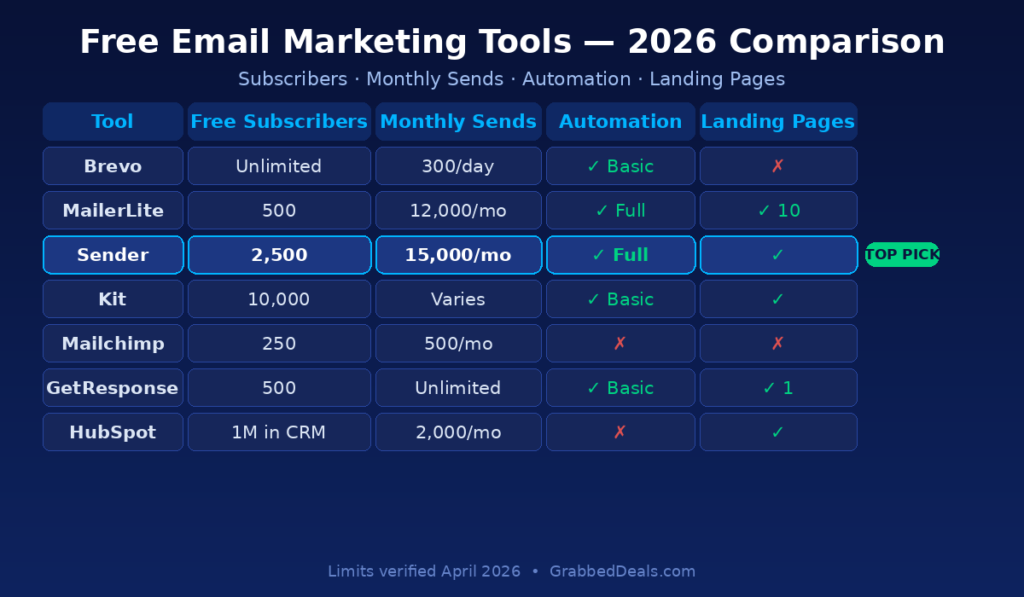
Quick comparison table
| Tool | Free Subscribers | Free Sends | Automation | Landing Pages |
|---|---|---|---|---|
| Brevo | Unlimited | 300/day | Basic | No |
| MailerLite | 500 | 12,000/month | Yes | 10 |
| Sender | 2,500 | 15,000/month | Yes | Yes |
| Kit | 10,000 | Varies | Basic | Yes |
| Mailchimp | 250 | 500/month | No | No |
| GetResponse | 500 | Unlimited | Basic | 1 |
| HubSpot | 1M in CRM | 2,000/month | No | Yes |
Which one should you choose?
The honest answer is that the best free email marketing tool in 2026 depends entirely on what you’re building and where you are right now.
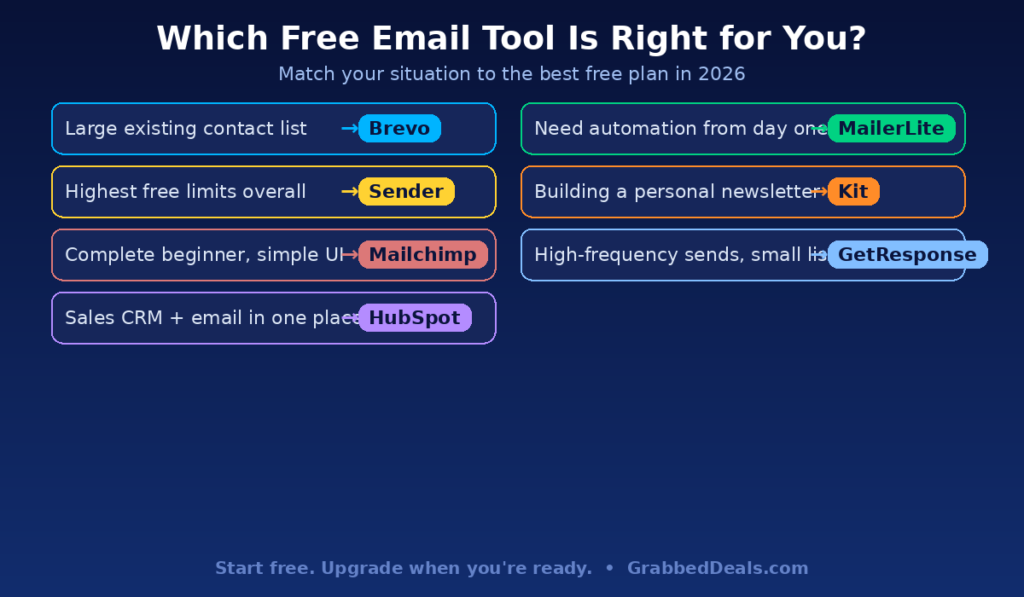
If you’re starting from zero with a small list and want to learn the basics, Mailchimp gives you a clean, familiar environment. If you outgrow it quickly, migrate to Sender or MailerLite.
If automation matters from day one, MailerLite wins at the free tier. The subscriber cap is tight at 500, but the platform itself is strong enough to build on.
If you want the highest raw numbers for free, Sender is the clear winner: 2,500 subscribers and 15,000 emails per month beats every other option outright.
If you’re a newsletter creator building a personal brand, Kit’s 10,000-subscriber free plan is the obvious starting point.
If you have a large existing contact list and want to evaluate a platform without a daily send cap being your only constraint, Brevo’s unlimited contacts make it the right migration option.
If you need sales CRM and email marketing in the same tool, HubSpot’s free plan is the most complete package on this list for business use.
Start with the tool that matches where you are today. You can always migrate later. The important thing is that you start.
FAQ
Are these email marketing tools really free, or do they become paid after a trial? Every tool on this list offers a genuinely free plan with no time limit, not a free trial. Brevo, MailerLite, Sender, Kit, Mailchimp, GetResponse, and HubSpot all maintain free tiers indefinitely. The limits don’t disappear after 14 or 30 days. You can use them at no cost for as long as you stay within the free plan’s restrictions.
Which free email marketing tool has the best automation? MailerLite offers the most fully featured automation on a free plan in 2026. You can build multi-step welcome sequences, time-based drip campaigns, and automated follow-ups without paying anything. Sender and Brevo also include basic automation for free, but MailerLite’s workflow builder is the most flexible at this tier.
How many subscribers can I have for free? It depends on the tool. Kit allows up to 10,000 subscribers for newsletter use. Sender covers 2,500 subscribers. Brevo stores unlimited contacts. MailerLite and GetResponse allow 500 subscribers. Mailchimp has the smallest free allowance at just 250 subscribers following changes made in 2025.
Can I use a free email marketing tool for my business? Yes, as long as you stay within the tool’s free plan limits and comply with email marketing regulations including GDPR and CAN-SPAM. Most free plans are suitable for small businesses, freelancers, and side projects. As your list grows and your sending requirements increase, you’ll likely need to upgrade to a paid plan, but the free tier is a legitimate starting point for business use.
What’s the difference between a free plan and a free trial? A free plan gives you access to a limited set of features indefinitely at no cost. A free trial gives you full access to a paid product for a set period, typically 14 or 30 days, after which you need to pay or lose access. Every tool on this list offers a free plan rather than just a free trial, though some also offer separate free trials of their premium features.
Conclusion
The email marketing tool market in 2026 is more generous at the free tier than most people realise. You don’t need a budget to start building and emailing a list. You just need to pick the right tool for your situation.
Sender is the best all-round free plan for raw generosity. MailerLite is the best for automation. Kit is the best for newsletter creators. Brevo is the best if you have a large existing contact database. Mailchimp is the best starting point for complete beginners. GetResponse suits high-frequency senders. HubSpot is the best if you need sales CRM built in.
Pick one, set up your first form, and start collecting subscribers today. Email marketing builds value over time, and the best time to start is before you feel ready.
Start with MailerLite for free → | Try Sender for free → | Sign up to Brevo for free →
Related Posts
- How to Start a Blog in 2026 and Actually Make Money from It
- Local SEO Guide for Small Businesses: How to Rank Without Spending a Fortune
- Best AI Tools for Digital Marketers in 2026: Tested and Ranked
Explore our more pages – AI Tools & Productivity | Smartphone Ecosystems | Laptop & PCs | Audio & Sound Systems | Gaming | Photography & Videography | EV & Green Tech | Digital Marketing & SEO | Smart Home & Wearables | Tech Deals & Buying Guides |
Author bio: The GrabbedDeals team covers AI tools, smartphones, laptops, and tech deals for readers across the UK, US, and Europe. Our reviews are independent, hands-on, and updated regularly.