Key Takeaways
- The best camera for beginners in 2026 is the Canon EOS R50 for most new photographers: simple menus, sharp autofocus, and 4K video in a lightweight body.
- Mirrorless cameras have replaced DSLRs as the go-to starting point. They’re lighter, smarter, and teach you photography faster thanks to real-time exposure previews.
- You don’t need to spend over £800 to get a genuinely capable first camera. Three of our top six picks land under that mark.
- The Sony ZV-E10 II is the best pick if you care as much about video and vlogging as you do about photos.
- The Fujifilm X-T30 III is the one to buy if you want to learn proper photography without relying on auto mode.
- Budget pick: The Canon EOS R100 at around £389 body-only is the best entry point if price is your priority.
Who is this article for?
This guide is for anyone buying their first standalone camera in 2026. Maybe you’re tired of your phone’s limits in low light. Maybe you want to start a YouTube channel. Maybe you just want better photos of your kids, your travels, or your dog. Whatever brought you here, this guide cuts through the noise and gives you six cameras that are actually worth buying, with honest takes on who each one suits best.
Why mirrorless cameras are the right starting point in 2026
DSLRs aren’t dead, but they’re no longer the sensible recommendation for beginners. Mirrorless cameras have matured to the point where entry-level models now offer autofocus speeds, image quality, and video specs that would have cost three times as much five years ago.
The biggest advantage for new photographers is the electronic viewfinder (EVF). Unlike a DSLR’s optical viewfinder, the EVF shows you exactly what your photo will look like before you press the shutter. That means you see the exposure in real time. You see the effect of adjusting your aperture or shutter speed before the shot is taken. It’s one of the most effective ways to actually learn photography, because the feedback loop is instant.
Mirrorless cameras are also lighter and more compact than DSLRs. That matters, because a camera you take everywhere is infinitely more useful than a camera you leave at home because it’s too heavy to bother with.
The switch is settled. Every major camera brand has shifted its focus to mirrorless, and that’s where lens development is happening. Buying into a mirrorless system in 2026 is the future-proof choice.
What to look for in your first camera
Before we get into the picks, here’s what actually matters for a beginner camera.
Autofocus quality. The best beginner cameras have autofocus systems good enough that you can focus on composition and timing instead of worrying about sharpness. Eye-detection and subject tracking are the features to prioritise here.
Sensor size. Almost every camera on this list uses an APS-C sensor. That’s the right choice for beginners: smaller and lighter than full-frame, but significantly better than a phone’s sensor in terms of low-light performance and background blur.
Video capability. Even if you’re primarily a photographer, having at least 4K 30fps gives you room to grow. Most beginner cameras include it now.
Guided modes and menus. Some cameras actively help you learn by explaining what each setting does. Canon’s Creative Assist mode is the gold standard here.
Lens ecosystem. The body is just the beginning. A camera with a well-supported lens mount means you can upgrade your glass as your skills improve, without switching systems.
Budget. Body-only prices below are a useful guide, but always factor in the cost of at least one lens. Most entry-level kit lenses (typically an 18-45mm or 18-55mm zoom) add £100 to £200 on top of the body price.
The top 6 best cameras for beginners in 2026
1. Canon EOS R50: Best overall
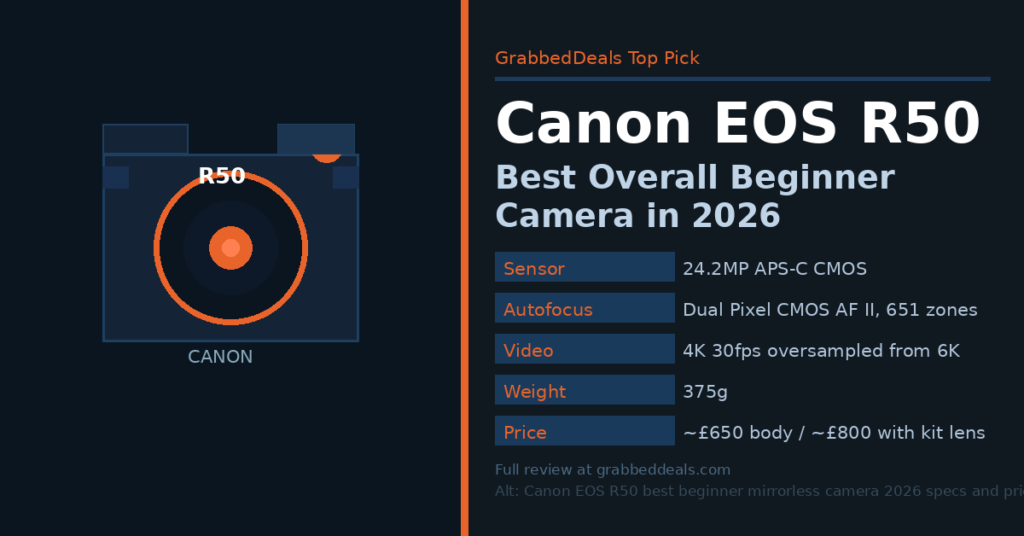
Price: Around £650 body-only / £800 with 18-45mm kit lens Sensor: 24.2MP APS-C Video: 4K 30fps (oversampled from 6K) Weight: 375g
The Canon EOS R50 is the easiest recommendation for most people buying their first camera in 2026. It earns that position through a combination of genuinely smart autofocus, a beginner-friendly menu system, and a lightweight body that you’ll actually want to carry around.
The Dual Pixel CMOS AF II system is the star feature. It covers 100% of the frame across 651 zones and tracks people, animals, and vehicles using deep learning. For a beginner, that means one less thing to worry about. You can focus on your composition while the camera keeps your subject sharp.
The guided menus and Creative Assist mode are genuinely useful for new photographers. They don’t just give you options, they explain what adjusting each setting will do to your image. You can see the effect on a live preview before you commit to the shot.
The vari-angle touchscreen is another win. It flips out and rotates fully, which makes shooting from awkward angles, including straight towards yourself for vlogs, much easier.
The R50’s 4K video is oversampled from 6K, which means it’s sharper and cleaner than most cameras at this price point. That oversampling matters: you get a genuine quality step up over a phone without needing to touch any complicated settings.
The weaknesses? The RF-S lens ecosystem is still growing, which means your upgrade options for lenses are more limited than on Sony’s E-mount. The grip is compact, which some shooters with larger hands will find fiddly. And there’s no in-body image stabilisation (IBIS), so for shaky handheld video you’ll want an optically stabilised lens.
Despite those caveats, the R50 is the best balance of capability, ease of use, and price in this category right now.
Best for: New photographers who want great photos and solid 4K video without a steep learning curve.
2. Sony ZV-E10 II: Best for vloggers and content creators
Price: Around £900 body-only / £999 with 16-50mm kit lens Sensor: 26MP APS-C BSI CMOS Video: 4K 60fps Weight: 293g
Sony built the ZV-E10 II specifically for creators who put video on equal footing with photos, and it shows in every design decision. The fully articulating screen, the front-facing microphone that tracks your voice, the product showcase mode that shifts focus from you to objects you hold up to the camera: all of it is optimised for people making content, not just capturing memories.
The sensor is a step up from the original ZV-E10. The 26MP BSI CMOS chip (shared with the more expensive Sony A6700) delivers noticeably better performance in low light, and the faster readout eliminates most of the rolling shutter issues that plagued the original when shooting 4K.
The 4K 60fps is the headline spec here. Most cameras at this price cap out at 4K 30fps, so the ZV-E10 II’s ability to shoot 4K at 60 frames gives you buttery smooth footage and genuine slow-motion options in post.
Sony’s E-mount lens ecosystem is one of the strongest in the industry. You get access to Sony’s own lenses plus a wide range of third-party options from Sigma, Tamron, and others. That gives you significantly more affordable upgrade paths than Canon’s RF-S system.
The trade-off is price and the absence of an electronic viewfinder. At around £900 body-only, it costs more than the R50. And if you prefer to shoot through a viewfinder rather than a screen, you’ll need to look elsewhere. But for creators who live through the screen anyway, neither of those is a serious issue.
Best for: YouTubers, vloggers, and creators who want the best video performance under £1,000.
3. Nikon Z50 II: Best for ergonomics and handling
Price: Around £820 body-only / £980 with 16-50mm kit lens Sensor: 20.9MP APS-C Video: 4K 30fps Weight: 385g
The Nikon Z50 II doesn’t win on headline specs. Its 20.9MP sensor sits below the R50 and ZV-E10 II in megapixel count, and its 4K caps at 30fps. What it does exceptionally well is handling. The grip is deep, the controls are proportioned like a professional body, and the whole thing feels substantially more confident in your hand than cameras this price have any right to.
For beginners who find small mirrorless cameras fiddly or uncomfortable, the Z50 II is the answer. The layout is intuitive, the buttons are easy to find without looking, and Nikon’s colour science produces images that look natural and well-balanced straight out of camera, with minimal need for editing.
Nikon’s autofocus has improved significantly in recent years. Subject detection for people, pets, and vehicles works reliably, and continuous tracking during burst shooting is consistent enough that you won’t miss moments waiting for the camera to reacquire focus.
The Z-mount lens ecosystem is solid for standard shooting, with good options at the kit level. It’s not as expansive as Sony’s E-mount for wide-angle options, but for the typical beginner shooting portraits, travel, and everyday moments, you’re not going to hit those limits quickly.
Best for: Photographers who want a camera that feels serious to hold from day one, and who prioritise a natural shooting experience over video specs.
4. Fujifilm X-T30 III: Best for learning photography properly
Price: Around £1,000 body-only / £1,200 with kit zoom Sensor: 26.1MP APS-C X-Trans CMOS 5 HR Video: 4K 30fps Weight: 383g
The Fujifilm X-T30 III is the camera on this list most likely to make you fall in love with photography as a craft. Physical aperture dials, a dedicated shutter speed dial, a film simulation dial: the controls are front and centre, not buried in menus. You adjust settings the way analogue photographers did, and the effect on your learning is significant. You develop an instinct for exposure faster when you’re physically turning dials rather than navigating a touchscreen menu.
The X-Trans sensor produces images with a film-like quality that Fujifilm users are famously devoted to. The film simulations (Provia, Velvia, Classic Chrome, and many others) are processed in-camera and produce results good enough that many photographers share them straight out of camera without any editing. For beginners who don’t want to spend hours in Lightroom, that’s a genuine time-saver.
The 26.1MP X-Trans CMOS 5 HR sensor (shared with the more expensive X-T5) delivers excellent detail and dynamic range. Low-light performance is strong, and the camera’s autofocus, while not quite at Canon’s level for tracking fast subjects, is more than capable for most beginner shooting scenarios.
The X-T30 III costs more than the R50 and the R100. It’s the most expensive option on this list. But it’s also the camera most likely to keep you engaged and curious as a photographer, because using it teaches you things that shooting in auto mode never will.
Best for: Photography enthusiasts who want to properly understand exposure and composition, and who appreciate image quality and style over headline specs.
5. Canon EOS R100: Best budget pick
Price: Around £389 body-only / £479 with 18-45mm kit lens Sensor: 24.2MP APS-C Video: 4K 30fps (with crop) Weight: 356g
If your priority is spending as little as possible while still getting a proper mirrorless camera, the Canon EOS R100 is the honest answer. At around £389 body-only, it’s the most affordable interchangeable-lens mirrorless camera from a major brand in 2026.
The R100 uses the same 24.2MP APS-C sensor family as the more expensive Canon models. Still shots in good light are excellent, and the Dual Pixel autofocus, while not as fast or feature-rich as the R50’s Dual Pixel CMOS AF II, reliably locks onto faces and tracks subjects through a scene.
The concessions for the lower price are clear. The 4K video is cropped (which narrows your field of view). The burst rate is slower. The autofocus is less capable in difficult lighting. There’s no vari-angle screen, just a tilting panel. And the menu system, while clear, lacks the guided modes of the R50.
But none of those weaknesses will bother you in your first year of shooting. The R100 teaches you the same fundamentals, produces genuinely good photos, and costs hundreds less. If budget is the deciding factor, this is the camera.
Best for: Complete beginners who want a capable mirrorless camera at the lowest possible price, particularly for portraits and everyday photography.
6. Sony ZV-E10 (original): Best value on a tight budget
Price: Around £520 body-only / £620 with 16-50mm kit lens Sensor: 24.2MP APS-C Video: 4K 30fps Weight: 343g
The original Sony ZV-E10 sits in an interesting position now that its successor exists. The ZV-E10 II is genuinely better in most areas, but the original has dropped in price to around £520 body-only, which puts Sony’s E-mount system, and all the lens options that come with it, in reach of buyers who can’t stretch to the newer model.
The 24.2MP APS-C sensor produces sharp, detailed images. The autofocus is reliable for stills and competent for video, though the rolling shutter in 4K can be noticeable in situations with a lot of lateral camera movement. The fully articulating screen remains one of the best features for self-shooting.
As a gateway to Sony’s E-mount ecosystem, the original ZV-E10 makes a lot of sense. You get access to one of the widest ranges of third-party lenses available for any mirrorless system, at every price point. When you’re ready to upgrade the body, your lenses move with you.
Best for: Budget-conscious buyers who want access to Sony’s lens ecosystem without paying for the ZV-E10 II.
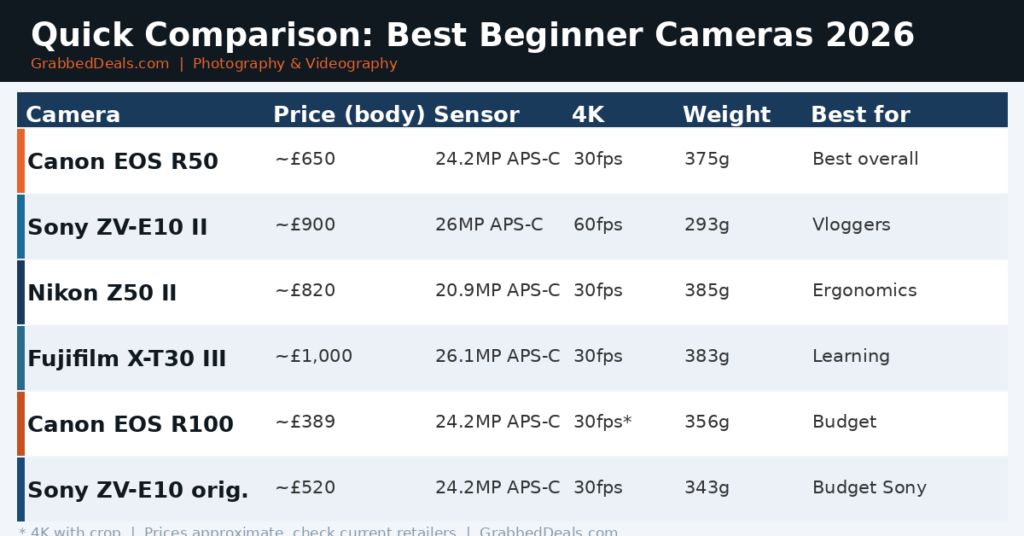
Quick comparison: all six cameras at a glance
| Camera | Price (body) | Sensor | 4K | Weight | Best for |
|---|---|---|---|---|---|
| Canon EOS R50 | ~£650 | 24.2MP APS-C | 30fps | 375g | Overall best beginner pick |
| Sony ZV-E10 II | ~£900 | 26MP APS-C | 60fps | 293g | Vloggers and creators |
| Nikon Z50 II | ~£820 | 20.9MP APS-C | 30fps | 385g | Handling and ergonomics |
| Fujifilm X-T30 III | ~£1,000 | 26.1MP APS-C | 30fps | 383g | Learning photography properly |
| Canon EOS R100 | ~£389 | 24.2MP APS-C | 30fps (crop) | 356g | Tightest budget |
| Sony ZV-E10 (original) | ~£520 | 24.2MP APS-C | 30fps | 343g | Budget Sony entry point |
How to choose the right camera for your situation
You mostly want to take better photos of everyday life (family, travel, pets). Start with the Canon EOS R50 or the Canon EOS R100. Both have excellent autofocus for moving subjects, produce great results in auto mode while you’re learning, and are compact enough to take everywhere.
You want to start a YouTube channel or create content on social media. The Sony ZV-E10 II is built for exactly this. Its 4K 60fps, front-facing microphone, and articulating screen solve the practical problems creators actually face. If the budget doesn’t stretch that far, the original ZV-E10 does a solid job at a lower price.
You want to learn photography as a proper hobby. Get the Fujifilm X-T30 III. The physical dials force you to engage with your settings, and the film simulations give you a creative reward for that engagement. It costs more, but it’s an investment in actually developing as a photographer.
You want the best-feeling camera to hold. The Nikon Z50 II has the best ergonomics on this list by a significant margin. If you’ve handled DSLRs before and want something with that solid-in-hand feeling, the Z50 II is the one.
Price is the single biggest factor. The Canon EOS R100 at around £389 body-only is the answer. It makes very few compromises that will actually matter in your first year of shooting.
What about lenses?
Your kit lens (the zoom that comes bundled with the camera) is a capable starting point. Don’t dismiss it. Modern kit lenses are optically decent and cover the focal lengths you need for most everyday shooting.
When you’re ready to expand, the most useful first upgrade for most beginners is a fast prime lens. A 35mm or 50mm f/1.8 prime gives you much better low-light performance and a more natural background blur than any kit zoom. For Canon RF-S mount, the RF 50mm f/1.8 STM is a great starting point at around £200. Sony E-mount users get even more options, with Sigma and Tamron both offering affordable alternatives alongside Sony’s own range.
You can read our guide to the best lenses for beginner photographers for a full breakdown of upgrade paths for each system.
FAQ
What is the best camera for beginners in 2026? The Canon EOS R50 is the best overall camera for beginners in 2026. It offers a 24.2MP APS-C sensor, Dual Pixel CMOS AF II autofocus with subject tracking, 4K video oversampled from 6K, and a user-friendly menu system with Creative Assist mode that helps new photographers understand each setting. At around £650 body-only, it hits the right balance of price and capability for most first-time camera buyers.
Should a beginner buy a mirrorless camera or a DSLR in 2026? A mirrorless camera is the better choice for beginners in 2026. Mirrorless models are lighter, have electronic viewfinders that show real-time exposure previews (which helps you learn faster), and represent the future of lens development from all major brands. DSLRs are still capable cameras, but buying into a DSLR system in 2026 means investing in a technology that’s being phased out, with shrinking lens selection and no new body releases from Canon or Nikon.
How much should a beginner spend on their first camera? A realistic budget for a beginner mirrorless camera in 2026 is between £400 and £1,000 for the body, plus £100 to £200 for a kit lens. The Canon EOS R100 at around £389 body-only is the most affordable entry point from a reputable brand. The Canon EOS R50 at around £800 with a kit lens is the sweet spot for most buyers. You don’t need to spend more than that in your first year of photography.
What is the difference between APS-C and full-frame sensors? APS-C sensors are smaller than full-frame sensors. They produce slightly narrower fields of view (roughly 1.5x the focal length multiplied for most APS-C cameras), which can work in your favour for telephoto shooting. Full-frame sensors generally perform better in very low light and give you more natural background blur at equivalent apertures. For beginners, APS-C is the right choice: the cameras are smaller, lighter, and significantly cheaper, while still producing excellent image quality in the vast majority of shooting situations.
Can I use my old lenses on a new mirrorless camera? In most cases, yes, with an adapter. If you own Canon EF or EF-S lenses, they work on Canon RF-mount cameras via Canon’s EF-EOS R adapter. Nikon F-mount lenses work on Nikon Z-mount cameras via the Nikon FTZ adapter. Sony A-mount lenses work on Sony E-mount cameras via an LA-EA adapter. Autofocus performance through adapters varies: most modern lenses work well, while older lenses may have slower or less reliable AF. Adapters typically cost between £50 and £200 depending on the brand and specification.
Final verdict
The best cameras for beginners in 2026 are genuinely good cameras, not compromised entry-level options designed to get you spending more as quickly as possible. The Canon EOS R50 is the clearest all-round recommendation for most new photographers. The Sony ZV-E10 II takes the top spot for content creators who prioritise video. And the Fujifilm X-T30 III is the pick for anyone who wants photography to become a serious hobby rather than a casual one.
Start with the camera that fits your actual situation rather than the most impressive spec sheet. The best camera for you is the one you’ll take out and use.
If you want to read more about specific camera options and how they stack up in real-world use, the team at Digital Camera World and Amateur Photographer both publish regularly updated beginner guides with hands-on testing.
Check the Canon EOS R50 price on Amazon | Check the Sony ZV-E10 II price on Amazon | Check the Fujifilm X-T30 III price on Amazon
You might also like
- Fujifilm X-T30 III vs Sony ZV-E10 II: Which Beginner Camera Wins in 2026?
- Best Lenses for Beginner Photographers: Where to Start for Every Budget
- Best Mirrorless Cameras Under £1,000 in 2026: Full Comparison
Explore our more pages – AI Tools & Productivity | Smartphone Ecosystems | Laptop & PCs | Audio & Sound Systems | Gaming | Photography & Videography | EV & Green Tech | Digital Marketing & SEO | Smart Home & Wearables | Tech Deals & Buying Guides |
Author bio: The GrabbedDeals team covers AI tools, smartphones, laptops, and tech deals for readers across the UK, US, and Europe. Our reviews are independent, hands-on, and updated regularly.
