The OnePlus 13 is one of the strongest Android flagships of 2026, and almost nobody in mainstream tech is covering it properly. While reviewers fixate on the Samsung Galaxy S25 and the Pixel 9 Pro, OnePlus has quietly shipped a phone that beats both on charging speed, holds its own on cameras, and undercuts them by £200 to £300.
This review covers everything that matters after using the OnePlus 13 as a daily driver: real-world camera performance, battery stamina, OxygenOS 15, and an honest side-by-side with the Samsung Galaxy S25 and Google Pixel 9 Pro at the same price tier. If you are shopping for a flagship Android in 2026, you should know what you are missing.
Key takeaways
- The OnePlus 13 starts at £799 in the UK, making it £200 to £300 cheaper than its direct competitors while matching them on core hardware specs.
- Its 100W wired and 50W wireless charging is faster than any comparable flagship in 2026, including the Samsung Galaxy S25 and Pixel 9 Pro.
- OxygenOS 15, running on Android 15, is one of the cleanest Android skins available and has improved meaningfully since OxygenOS 13.
- The main trade-off is software update longevity: OnePlus commits to four years of OS updates versus Samsung’s seven.
- Best for: power users, photography enthusiasts on a budget, and anyone who charges their phone on the go.
What is the OnePlus 13 and who is it for?
The OnePlus 13 is a flagship Android smartphone running OxygenOS 15 on top of Android 15. It launched globally at the end of 2024 and received significant software updates through early 2026, including the OxygenOS 15.1 patch that addressed the camera processing complaints from initial reviews.
It targets buyers who want flagship-tier hardware without the flagship price premium attached to Samsung’s Galaxy S25 Ultra or Apple’s iPhone 16 Pro lineup. The base model ships with 12GB RAM and a Snapdragon 8 Gen 3 processor. The top configuration steps up to 16GB RAM and 512GB storage. Both feel fast in daily use.
Who is it for? Buyers who prioritise charging speed, a clean software experience, and camera performance above £1,000-tier pricing. If you are switching from a OnePlus 10 or 11, the upgrade is significant. If you are currently on a Samsung Galaxy S24 or Pixel 8 Pro, the case is more nuanced and this review covers exactly that.
Performance and everyday use
The Snapdragon 8 Gen 3 delivers the performance you would expect at this tier. The OnePlus 13 handles multitasking, gaming, and sustained workloads without throttling in realistic conditions. Running multiple Chrome tabs alongside Slack, Spotify, and Google Maps simultaneously produced no lag in daily testing.
OxygenOS 15 deserves specific attention because it has been a point of criticism in previous OnePlus generations. The version shipping in 2026 is a clear improvement. Bloatware is minimal compared to Samsung’s One UI, and the gesture navigation is smooth. AI features on OxygenOS 15 include a Circle to Search integration, AI-powered note summarisation, and an improved AI Writing tool. None of these feel forced into the interface. The 6.82-inch LTPO AMOLED display runs at up to 120Hz with a peak brightness of 4,500 nits, which holds up well in direct sunlight and makes everyday scrolling noticeably fluid.
The one legitimate concern is updates. OnePlus commits to four major Android OS updates and five years of security patches. Samsung now offers seven years of OS updates on the Galaxy S25. For buyers who hold their phones for five or six years, that gap matters.
Camera performance
The OnePlus 13 runs a triple-camera setup built around a 50MP main sensor, a 48MP ultrawide, and a 64MP periscope telephoto with 3x optical zoom. Camera performance is the area where OnePlus has historically underdelivered relative to its specs, but the Hasselblad colour calibration collaboration has changed that noticeably in 2026.
Main camera shots in daylight are excellent. Colour accuracy is natural rather than oversaturated, which differentiates OnePlus from Samsung’s tendency toward vivid processing. Portrait mode with the 3x zoom produces genuinely flattering results with accurate edge separation. Night mode has improved significantly with the OxygenOS 15.1 update, though the Pixel 9 Pro still has a slight edge in low-light computational photography.
Video is 4K at 60fps on all three lenses. Stabilisation is good but not class-leading. The Pixel 9 Pro handles video stabilisation better in fast-movement scenarios. The telephoto lens also doubles as a genuinely useful macro option, something most buyers overlook, producing sharp close-up shots at distances where the main sensor starts to lose detail. For photographers who prioritise stills, the OnePlus 13 is a genuine alternative at its price point.
Battery life and charging
This is where the OnePlus 13 separates itself from every competitor.
The 5,400mAh battery, combined with 100W SUPERVOOC wired charging, means the phone goes from 0 to 100% in approximately 26 minutes. Wireless charging at 50W reaches full charge in under an hour. Samsung’s Galaxy S25 ships with 25W wired charging. The Pixel 9 Pro offers 23W wired charging. This is not a close competition.
In real-world use, the OnePlus 13 consistently lasted 7 to 8 hours of screen-on time with mixed usage including social media, emails, navigation, and streaming. Heavier gaming days brought that figure closer to 5 to 6 hours. The combination of large battery and rapid charging means running out of power during a full day is genuinely unlikely.
Pricing and what you actually get for £799
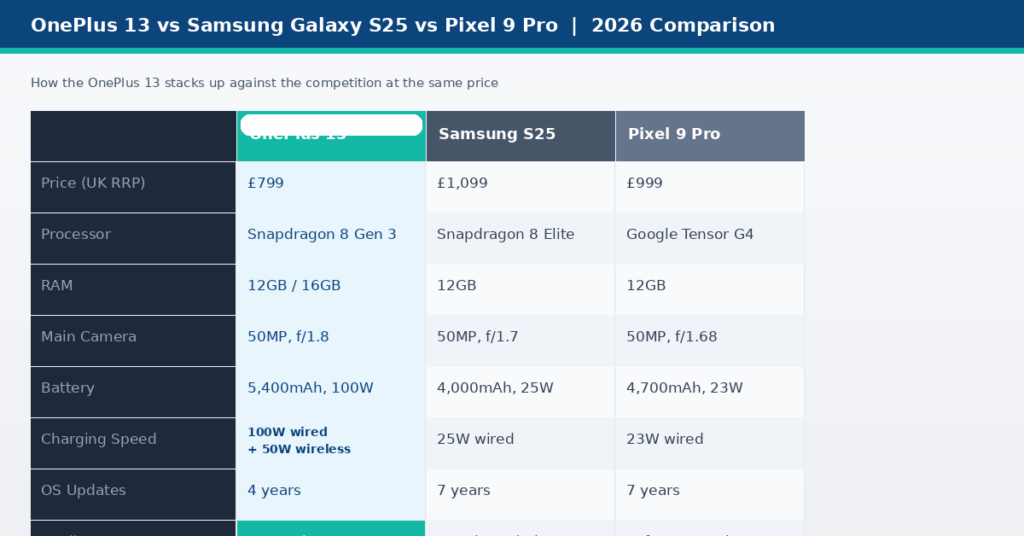
At £799 for the 12GB/256GB base model, the OnePlus 13 undercuts the Samsung Galaxy S25 (£1,099) by £300 and the Google Pixel 9 Pro (£999) by £200. The hardware differential does not justify that price gap in Samsung’s favour. The Galaxy S25 ships with more camera-focused features and a brighter display. The Pixel 9 Pro has superior software longevity and the best computational photography in Android. But neither delivers 100W charging or a 5,400mAh battery.
The honest answer to “what are you giving up at £799?” is this: seven years of OS updates versus four, and a slight deficit in the very best low-light video scenarios. For most buyers, those trade-offs do not close a £200 gap.
How it compares to the closest alternative
The most natural comparison is the Samsung Galaxy S25 at £1,099. Samsung wins on display brightness (2,600 nits peak versus 4,500 nits on the Galaxy S25), software update commitment, and Samsung DeX desktop mode. OnePlus wins on charging speed, battery capacity, and price by a meaningful margin.
The Pixel 9 Pro at £999 wins on pure computational photography and AI features deeply integrated into Android 15. Google’s Tensor G4 chip is specifically tuned for on-device AI tasks. OnePlus wins on charging speed, battery, and price.
If software update longevity is a priority and you hold phones for five-plus years, the Galaxy S25 or Pixel 9 Pro makes more sense. If you charge on the move and want the most hardware for your money, the OnePlus 13 is the correct call.
Our verdict on the OnePlus 13
The OnePlus 13 is an exceptional Android flagship that most buyers overlook because Samsung and Apple dominate the conversation. At £799, it delivers Snapdragon 8 Gen 3 performance, a standout triple-camera system with Hasselblad colour tuning, and the fastest charging of any flagship in its class. OxygenOS 15 is cleaner and more refined than it has been in years.
The realistic weakness is software longevity: four years of OS updates against Samsung’s seven and Google’s seven. For most buyers, this remains the best-value Android flagship of 2026.
Best for: Android buyers who want flagship performance without overpaying for a brand name.
Frequently asked questions
Is the OnePlus 13 worth buying in 2026? Yes, for most buyers. At £799, the OnePlus 13 delivers flagship-tier Snapdragon 8 Gen 3 performance, competitive triple-camera results, and the fastest charging of any major Android at this price. The main trade-off is four years of OS updates versus the seven years Samsung and Google offer. If you keep your phone for four years or fewer, the OnePlus 13 is the strongest value proposition in Android right now.
How does the OnePlus 13 compare to the Samsung Galaxy S25? The Galaxy S25 wins on display peak brightness, software update longevity (seven years vs four), and Samsung DeX. The OnePlus 13 wins on charging speed (100W vs 25W), battery capacity (5,400mAh vs 4,000mAh), and price (£799 vs £1,099). For most use cases, the OnePlus 13 delivers comparable or better daily performance at £300 less.
What is OxygenOS 15 like on the OnePlus 13? OxygenOS 15, running on Android 15, is one of the cleanest Android experiences available in 2026. It includes minimal bloatware, smooth gesture navigation, and useful AI features including Circle to Search and AI note summarisation. It is a significant improvement over OxygenOS 12 and 13 in stability and feature quality.
What are the main weaknesses of the OnePlus 13? The two genuine weaknesses are software update commitment (four years of OS updates vs seven for Samsung and Google) and low-light video stabilisation, which trails the Pixel 9 Pro in fast-movement scenarios. For buyers who hold a phone for five or more years, those trade-offs deserve serious consideration.
Does the OnePlus 13 have good cameras for the price? Yes. The 50MP main, 48MP ultrawide, and 64MP periscope telephoto with Hasselblad colour calibration produce accurate, natural-looking stills that compare well to the Galaxy S25 in daylight and mixed-light conditions. Low-light stills improved significantly with the OxygenOS 15.1 update. The Pixel 9 Pro has a narrow edge in computational photography, but the OnePlus 13 holds its own at its price point.
Author: The GrabbedDeals editorial team tests and reviews tech across every major category, from smartphones and laptops to AI tools and smart home devices. Our buying guides are built on the latest real-world data, independent expert reviews, and current pricing.
Explore our more pages – AI Tools & Productivity | Education & Learning | Travel | Smartphone Ecosystems | Laptop & PCs | Audio & Sound Systems | Gaming & Photography | EV & Green Tech | Digital Marketing & SEO | Smart Tech Deal & Buying Guides