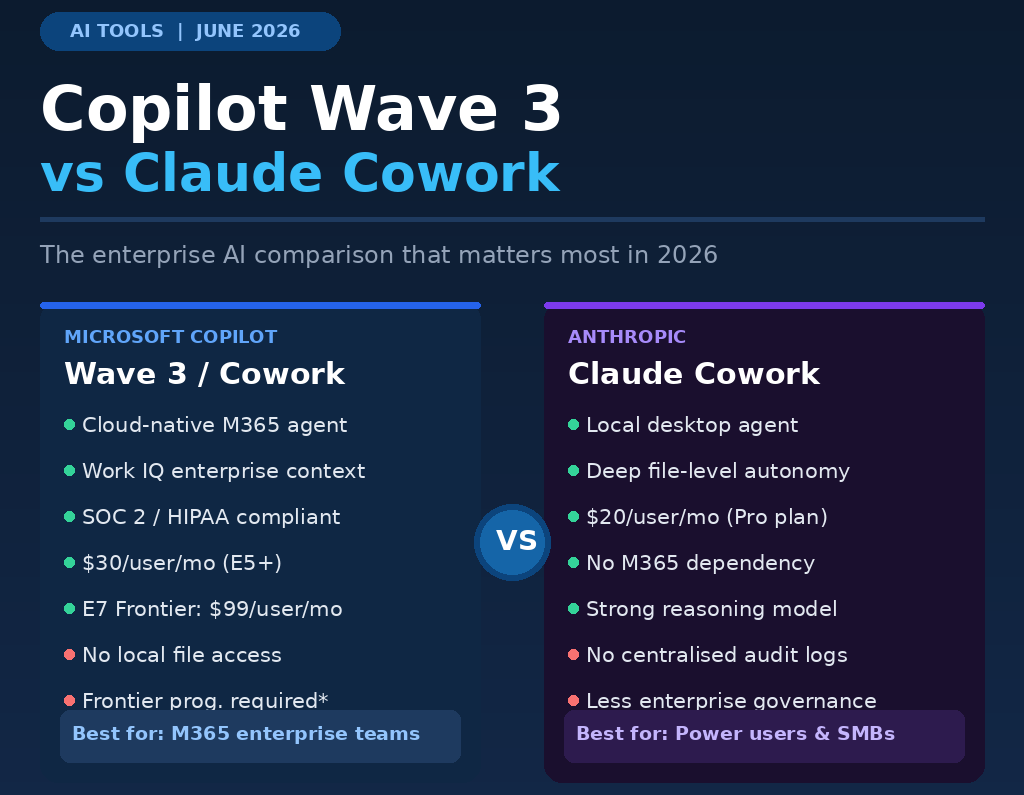
Both Microsoft Copilot Wave 3 and Claude Cowork run on Anthropic’s Claude model, yet they are built for completely different buyers. If your organisation is already inside Microsoft 365, Copilot Cowork gives you governed, cloud-native agentic AI without changing a single workflow. If you need deep desktop autonomy without enterprise lock-in, Claude Cowork is the stronger standalone tool. This comparison breaks down pricing, architecture, security, and real-world use cases so you can pick the right one for your team.
Key takeaways
- Copilot Wave 3 and Claude Cowork share the same underlying Anthropic model but serve fundamentally different deployment contexts.
- Copilot Cowork is cloud-native, governed by Microsoft 365 security policies, and best for organisations already paying for M365 E5 or above.
- Claude Cowork runs locally on-device at $20/month per user and suits individual power users and smaller teams without M365 lock-in.
- The M365 E7 Frontier Suite bundles Copilot Cowork at $99/user/month; standalone Claude Cowork adds $100 to $200/month for your highest-leverage knowledge workers.
- The strongest enterprise strategy in 2026 is deploying both: Copilot Cowork as the organisational backbone, Claude Cowork for deep analytical work.
Overview of Microsoft Copilot Wave 3
Microsoft announced Copilot Wave 3 on 9 March 2026. It represents the most significant architectural shift the product has seen since its 2023 launch, moving from a sidebar chat assistant to a full task engine that operates across the entire Microsoft 365 graph.
The centrepiece of Wave 3 is Copilot Cowork, which became generally available as part of the M365 E7 Frontier Suite on 1 May 2026. It can plan and execute multi-step tasks across Outlook, Teams, SharePoint, Word, Excel, and PowerPoint simultaneously, without the user manually linking context between applications. Ask it to prepare you for a Monday client meeting and it reads your calendar, pulls recent emails from the client, retrieves the latest deck from SharePoint, checks the Teams channel, and delivers a synthesised briefing, all in one run.
Wave 3 also introduced multi-model support, bringing Claude directly into mainline Copilot Chat for Frontier programme participants alongside OpenAI’s GPT-5.x models. Microsoft’s Critique feature pairs GPT as drafter and Claude as auditor, which scored 13.8% higher than any single competing research tool on the third-party DRACO benchmark. That is the clearest signal yet that enterprise AI is moving toward multi-model orchestration rather than single-provider lock-in.
Overview of Claude Cowork
Anthropic launched Claude Cowork in January 2026 as a standalone desktop agent. It runs locally on the user’s machine inside a sandboxed virtual machine, capable of executing long, multi-step tasks across applications without requiring a browser. The release dropped Microsoft’s stock more than 14% in the weeks that followed, a reaction that prompted Microsoft to license the underlying technology and ship Copilot Cowork two months later.
Claude Cowork is available to anyone on a Claude Pro subscription at $20/month. There are no additional enterprise licensing requirements, no IT provisioning, and no Microsoft ecosystem dependency. This makes it immediately accessible for freelancers, consultants, and smaller teams where IT governance is not a blocking requirement.
Where Claude Cowork consistently pulls ahead is deep analytical and file-level work. Building a financial model, bulk-processing data files, drafting a research report from scattered local documents: these are tasks where local desktop autonomy matters more than cloud-integrated context. For regulated industries, however, the lack of centralised audit logging is a genuine friction point that enterprise CISOs are watching carefully.
Pricing compared
Microsoft Copilot Wave 3
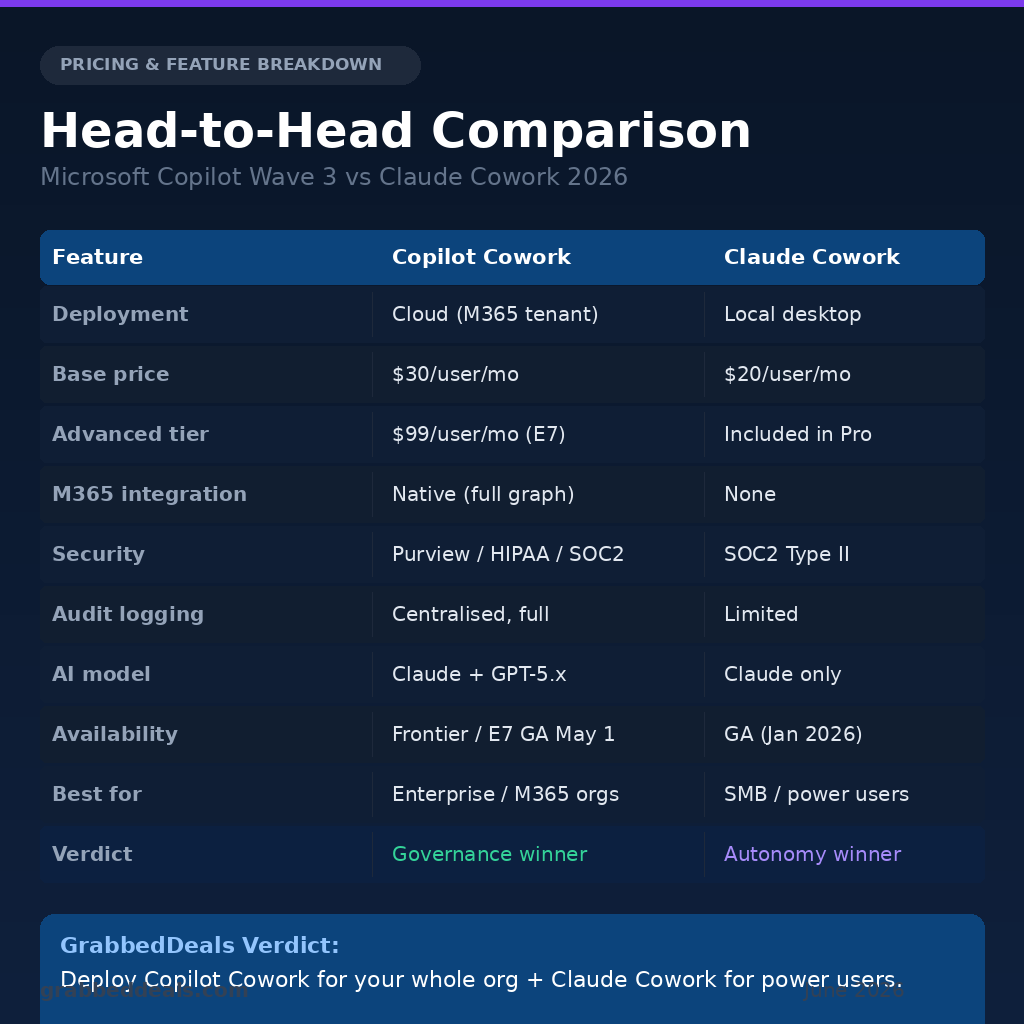
Copilot Wave 3 features roll out automatically to existing Microsoft 365 Copilot subscribers at no additional SKU cost. The M365 E7 Frontier Suite, which bundles Copilot Cowork and Agent 365, is priced at $99/user/month. Agent 365, the platform for building and managing AI agents across the organisation, is also available separately at $15/user/month.
The practical implication: if your organisation already pays for Microsoft 365 Copilot at $30/user/month, many Wave 3 capabilities arrive as a free update. The step up to E7 at $99/user/month is significant, but it includes governance, compliance, and agentic task execution across the full M365 stack.
Claude Cowork
Claude Cowork is included with Claude Pro at $20/user/month. For a 100-person firm deploying it to 15 high-leverage knowledge workers, that is $18,000 to $36,000 per year alongside a Copilot Cowork deployment. Analysis from Lumetric puts the combined AI stack for a 100-person firm at $54,000 to $72,000 annually, which is less than the fully-loaded cost of a single junior analyst.
Security and compliance compared
This is where the two products diverge most clearly for enterprise buyers.
Copilot Cowork inherits the entire Microsoft 365 compliance posture. SOC 2, ISO 27001, HIPAA, and FedRAMP certifications apply within the existing tenant. Data residency is controlled by existing Azure geography settings. Microsoft Purview policies enforce data loss prevention. For regulated industries including financial services, healthcare, and government, Copilot Cowork is often the only option that passes the CISO’s review without additional negotiation.
Claude Cowork processes files locally in a sandboxed environment, with only the necessary tokens sent to Anthropic’s API. Anthropic holds SOC 2 Type II certification and offers enterprise data processing agreements. The local architecture is arguably more private for individual tasks, since files never leave the device. But the absence of centralised audit logging and tenant-level enforcement is a genuine gap for organisations that need to demonstrate compliance at scale. Microsoft’s own comparison page highlights that Claude Cowork created local files during testing, which introduced security risks and version sprawl in environments where Microsoft Purview policies were expected to apply.
Performance and best-use cases
Where Copilot Cowork wins
Copilot Cowork wins on cross-app orchestration within Microsoft 365. Email triage, meeting summaries, document discovery across SharePoint, and scheduling automation are high-frequency tasks where Work IQ, its enterprise intelligence layer, gives it context that no external tool can match. It already knows your org chart, your active projects, and your communication patterns.
Where Claude Cowork wins
Claude Cowork wins on deep, file-level autonomous work. Organising large project folders, converting bulk data, drafting reports from local documents, and executing long analytical workflows are areas where local desktop execution and Claude’s reasoning model produce faster, more accurate results than the cloud-integrated alternative. Multiple analyses, including benchmarks from enterprise buyers in consulting and investment banking, confirm Claude as the stronger model for complex reasoning tasks.
Which one should your business use?
For enterprise teams already on Microsoft 365, Copilot Cowork is the default choice. The governance, security, and cross-app context advantages make it the safer, more scalable option for organisations that need accountability at the tenant level. The Wave 3 upgrade is meaningful and, for existing Copilot subscribers, largely free.
For individual power users, smaller teams, or anyone without M365 as the organisational backbone, Claude Cowork at $20/month is the more accessible, more flexible, and analytically stronger tool. It does not require IT provisioning, does not need a Microsoft licence, and performs better on the deep reasoning tasks that knowledge workers care about most.
The strongest strategy for mid-to-large enterprises in 2026 is both: Copilot Cowork as the organisational backbone for all knowledge workers, Claude Cowork deployed to the 10 to 20 highest-leverage individuals doing the most complex analytical work.
Final verdict
Copilot Wave 3 vs Claude Cowork is not a straightforward head-to-head. They share the same underlying AI model but serve completely different deployment contexts. Choose Copilot Cowork if your organisation runs on Microsoft 365 and needs governed, auditable, cross-app agentic AI. Choose Claude Cowork if you need powerful desktop autonomy without enterprise overhead. If budget allows, deploy both.
Frequently asked questions
Is Microsoft Copilot Wave 3 available to all Microsoft 365 users?
Not yet. Advanced features including Copilot Cowork and multi-model support are available through the Frontier programme first. The M365 E7 Frontier Suite became generally available on 1 May 2026. Existing Copilot subscribers receive some Wave 3 capabilities automatically as part of the standard update.
Does Claude Cowork work inside Microsoft 365 applications?
No. Claude Cowork is a standalone desktop agent that runs locally on the user’s machine. It does not integrate natively with Outlook, Teams, or SharePoint, and has no access to the Microsoft 365 data graph that gives Copilot Cowork its cross-app advantage.
Is Claude Cowork secure enough for enterprise use?
Claude Cowork holds SOC 2 Type II certification and processes files locally in a sandboxed environment. For smaller teams, this is solid. For regulated industries that require centralised audit logging and Purview policy enforcement, Copilot Cowork is the safer choice until Claude Cowork’s enterprise governance tooling matures.
How much does Microsoft Copilot Wave 3 cost in 2026?
Standard Microsoft 365 Copilot stays at $30/user/month. Copilot Cowork and Agent 365 are bundled in the M365 E7 Frontier Suite at $99/user/month. Agent 365 is also available separately at $15/user/month. Many Wave 3 features roll out to existing subscribers at no extra charge.
Can a business use both Copilot Cowork and Claude Cowork simultaneously?
Yes, and enterprise analysts recommend it. Deploy Copilot Cowork for all knowledge workers and Claude Cowork for your highest-leverage individuals doing complex analytical work. For a 100-person firm, the combined cost of roughly $54,000 to $72,000 per year is less than the fully-loaded cost of one junior analyst.
Author: The GrabbedDeals editorial team tests and reviews tech across every major category, from smartphones and laptops to AI tools and smart home devices. Our buying guides are built on the latest real-world data, independent expert reviews, and current pricing.
Explore our more pages – AI Tools | Smartphone | Laptop & PCs | Audio & Sound Systems | Gaming & Photography | EV & Green Tech | Digital Marketing | Smart Tech Deal & Buying Guides