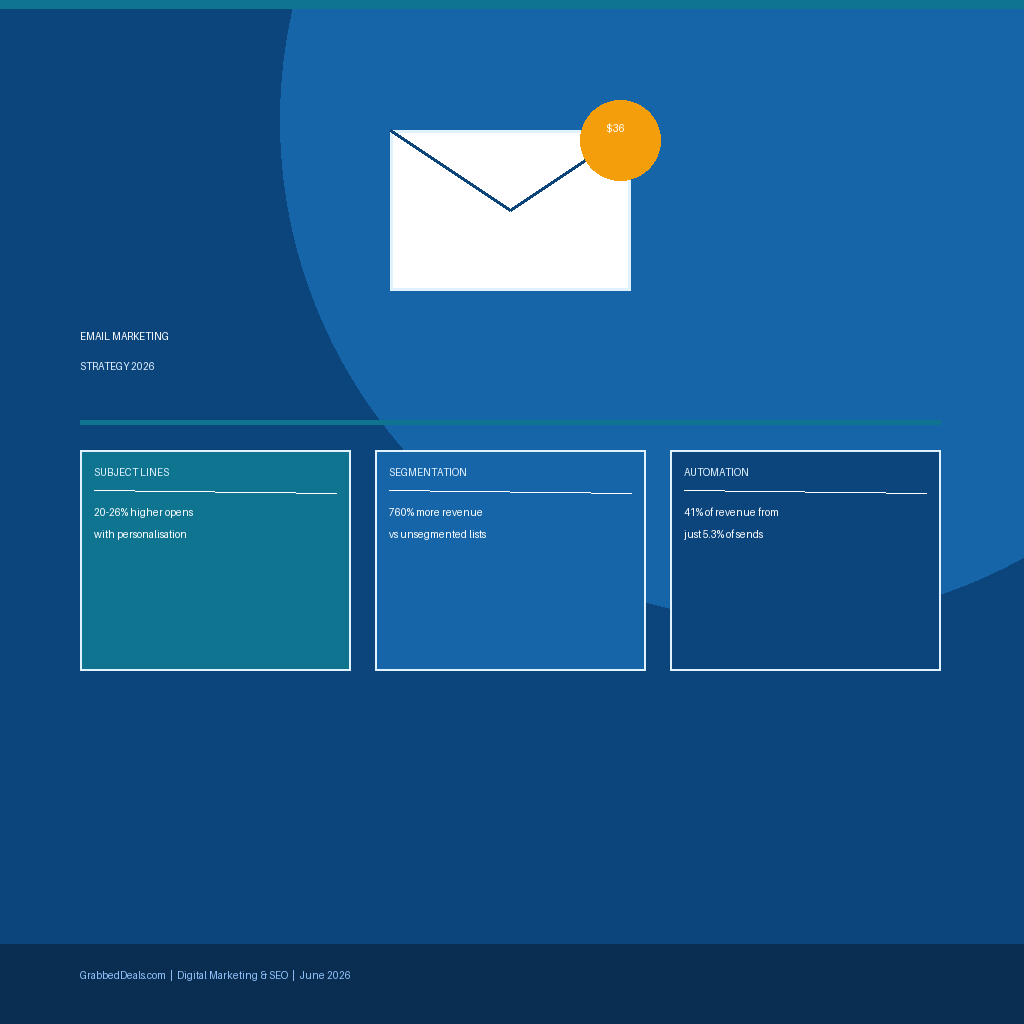
Email still delivers $36 to $45 for every $1 spent in 2026, making it the highest-ROI digital marketing channel available to any business, regardless of size or budget. But most campaigns underperform not because of the platform, but because the strategy is wrong. This guide covers exactly how to build email campaigns that people open, read, and act on, from subject lines to automated flows. It is written for marketers, business owners, and creators who are already using an email platform and want better results.
Key takeaways
- Email marketing delivers $36 to $45 ROI per $1 spent in 2026, outperforming every other digital channel.
- Personalised subject lines lift open rates by 20 to 26%; subject lines under 60 characters consistently outperform longer ones.
- Automated email flows generate nearly 41% of total email revenue from just 5.3% of total sends.
- Segmented lists can produce up to 760% more revenue than unsegmented broadcast campaigns.
- The four automations every business needs in 2026 are: welcome series, abandoned cart, post-purchase follow-up, and re-engagement flow.
Step 1: Set goals that connect to revenue, not vanity metrics
The first step in building an email marketing strategy is deciding what you are actually trying to achieve, and open rates alone are not the answer. Open rate data in 2026 is heavily distorted by Apple Mail Privacy Protection, which automatically “opens” emails for any Apple Mail user regardless of whether they actually read them. This inflates reported opens by 15 to 20 percentage points in many accounts.
Instead, focus on click rate, revenue per recipient, and conversion rate. These are the metrics that tell you whether your campaigns are actually working. Klaviyo’s 2026 benchmarks across 183,000+ brands show that automated email flows achieve revenue per recipient nearly 18 times higher than standard broadcast campaigns. That single data point should shape your entire strategy.
Set one primary goal per campaign: drive a purchase, book a call, download a resource, or re-engage a lapsed subscriber. When every email serves one goal, the copy, design, and call to action all align, and conversion rates follow.
Step 2: Build a segmented list, not just a big one
A large unsegmented list is one of the most common reasons email campaigns fail. Sending the same message to everyone, regardless of where they are in the customer journey, crushes engagement and trains subscribers to ignore you.
In 2026, basic segmentation means separating subscribers by at least three signals: where they came from (ad, organic, referral), what they have already done (purchased, browsed, clicked), and how recently they engaged. Marketers using advanced segmentation see up to 760% more revenue than those who do not, according to Campaign Monitor data.
Start simple. Create three core segments: new subscribers who have never purchased, active buyers who have purchased in the last 90 days, and lapsed subscribers who have not opened or clicked in 90 days or more. These three buckets alone will dramatically change how your campaigns perform compared to a single broadcast approach.
Platform-specific note: Klaviyo is the strongest tool for behaviour-based segmentation if your data lives in Shopify or another ecommerce platform. Mailchimp offers accessible segmentation for smaller lists. Brevo gives good mid-market flexibility with competitive pricing.
Step 3: Write subject lines that earn the open
Your subject line is the single biggest lever in email marketing. It decides whether your campaign gets read or ignored, and 55% of email opens now happen on mobile, where preview text is cut off after roughly 40 characters.
The 2026 data on subject lines is clear. Personalised subject lines (using the subscriber’s name, location, or behaviour) increase open rates by 20 to 26%. Subject lines under 60 characters see 21% higher open rates than longer ones. AI-powered subject line testing across Mailchimp, Klaviyo, and HubSpot in early 2026 shows open rate improvements of 35 to 95% compared to untested subject lines, with the largest gains for brands that were previously sending generic, unpersonalised lines.
Three subject line frameworks that work in 2026:
The curiosity gap: “You left something behind” (for abandoned cart). Creates a reason to open without revealing the full message.
The direct benefit: “Your June discount: 20% off, today only.” No cleverness needed. Clarity converts.
The personal trigger: “Based on what you viewed last week, [Name]…” References a specific behaviour and signals relevance immediately.
Always write your preheader text as the second half of your subject line. It appears in the inbox preview and is routinely ignored, which is a wasted opportunity on every campaign.
Step 4: Build the four automations every business needs
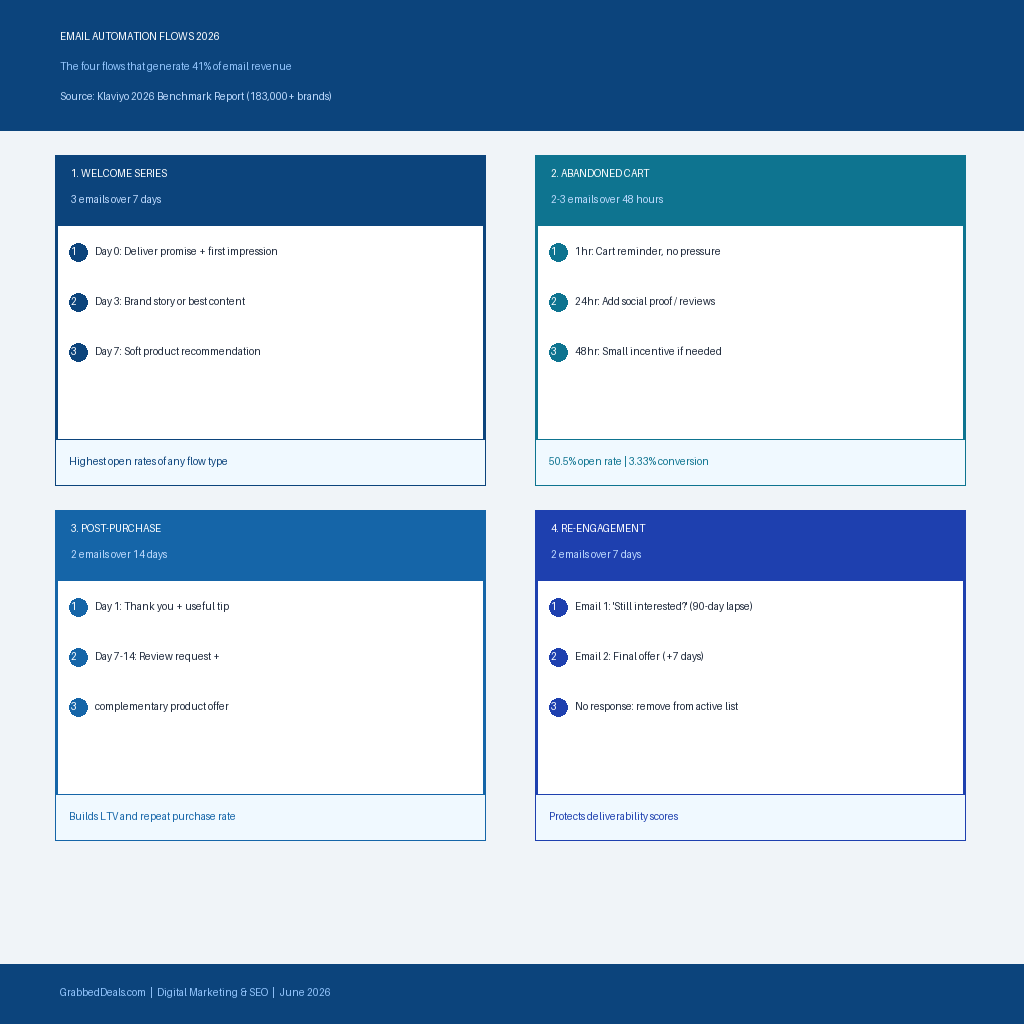
Automated email flows are where the real ROI lives. Klaviyo’s 2026 data shows that flows generate nearly 41% of total email revenue from just 5.3% of total sends. Setting them up once and letting them run is the highest-leverage activity in any email program.
Welcome series (3 emails, sent over 7 days): Email 1 sends immediately after signup and delivers what you promised (a discount, a lead magnet, or a personal note). Email 2 goes out on day 3 and introduces your brand story or best content. Email 3 sends on day 7 with a soft product recommendation based on what they signed up for. Welcome emails have some of the highest open rates of any campaign type.
Abandoned cart (2 to 3 emails, sent over 48 hours): Abandoned cart emails achieve an average open rate of 50.5% and a conversion rate of 3.33%, with top-performing brands reaching 7.69%. Email 1 sends 1 hour after cart abandonment. Email 2 sends 24 hours later with a review or social proof element. Email 3 sends at 48 hours with an optional small incentive.
Post-purchase follow-up (2 emails): Email 1 is a thank-you with order confirmation and a useful tip related to their purchase. Email 2 sends 7 to 14 days later requesting a review and introducing a complementary product.
Re-engagement flow (2 emails): Targets subscribers who have not opened or clicked in 90 days. Email 1 asks a direct question: “Still interested?” Email 2 goes out 7 days later with a final offer. Subscribers who do not respond should be removed from your active list to protect deliverability.
Step 5: Write campaign copy that converts
Strategy determines who receives your email and when. Copy determines whether they act. In 2026, the highest-converting campaign copy shares four characteristics.
It opens with the reader’s problem, not your product. “Struggling to get replies from cold outreach?” outperforms “Introducing our new email tool” every time. The reader recognises themselves in the first line and keeps reading.
It uses one clear call to action. Emails with a single CTA consistently outperform those with multiple links competing for attention. Every sentence in the body should move the reader toward that one action.
It is short. Mobile-first reading habits mean that long blocks of text are skimmed or abandoned. Two to four short paragraphs, a clear CTA button, and white space between sections is the standard for high-performing campaigns in 2026.
It is specific. “Save 20% on the Klaviyo plan you viewed last Tuesday” outperforms “Save big this week” because specificity signals relevance. Use your platform’s dynamic content and personalisation features to inject this kind of specificity at scale.
For email authentication, ensure SPF, DKIM, and DMARC records are set up on your sending domain. Sending without these in 2026 significantly increases your chances of landing in spam, particularly with Google and Yahoo inboxes.
Final verdict
Email marketing in 2026 rewards strategy over volume. The businesses seeing $36 to $45 returns per dollar spent are not sending more emails than their competitors. They are sending fewer, better-targeted campaigns to segmented lists, backed by automations that run in the background and compound over time. Start with the four automations in Step 4, fix your subject lines using the frameworks in Step 3, and build your segmentation from Step 2. The ROI follows from structure, not from effort alone.
Frequently asked questions
What is a good email marketing ROI in 2026?
The industry benchmark for email marketing ROI in 2026 is $36 to $45 for every $1 spent, according to data from Litmus and Klaviyo. ROI varies significantly by industry and strategy. Businesses using advanced segmentation and automation consistently outperform the average. E-commerce brands using abandoned cart and post-purchase flows tend to sit at the higher end of that range.
How often should I send marketing emails in 2026?
Research shows that 5 to 8 emails per month produces the highest average ROI for most industries. Sending daily is almost always counterproductive unless your audience has opted in specifically for daily content. The right frequency depends on your list’s engagement data: if open and click rates are dropping, you are sending too often for your specific audience.
What email marketing platform is best in 2026?
The best platform depends on your data sources and business model. Klaviyo is the strongest choice if your customer data lives in Shopify or a similar ecommerce stack. HubSpot is better if you are running CRM-led campaigns. Mailchimp is the most accessible option for small businesses or creators with lists under 50,000 subscribers. Brevo offers competitive pricing for mid-market businesses needing SMS alongside email.
Why are my email open rates so high but conversions so low?
High open rates with low conversions in 2026 are usually caused by Apple Mail Privacy Protection inflating your reported opens. Apple opens every email automatically for Mail app users, regardless of whether the person actually reads it. Focus on click rate and revenue per recipient instead. If your click rates are healthy but conversions are low, the problem is on your landing page, not in your email.
Is email marketing still worth it for small businesses in 2026?
Yes. Email is the only digital marketing channel where you own the audience outright. No algorithm change can reduce your reach overnight the way social platform updates do. For small businesses with even a modest list, a well-structured welcome series and one or two targeted campaigns per month can generate consistent revenue at a fraction of the cost of paid advertising.
Author: The GrabbedDeals editorial team tests and reviews tech across every major category, from smartphones and laptops to AI tools and smart home devices. Our buying guides are built on the latest real-world data, independent expert reviews, and current pricing.
Explore our more pages – AI Tools | Smartphone | Laptop & PCs | Audio & Sound Systems | Gaming & Photography | EV & Green Tech | Digital Marketing | Smart Tech Deal & Buying Guides