LinkedIn for B2B lead generation in 2026 is the most direct path from content to client that exists in digital marketing today. Most businesses set up a company page, post occasionally, and wonder why nothing converts. The problem is almost never effort; it is strategy. The LinkedIn algorithm changed significantly in 2025, and the outreach patterns that worked two years ago now get ignored or filtered as spam.
This guide covers the exact step-by-step process that works with the current algorithm: how to position your profile, what to post and when, and the outreach template structure that consistently gets replies. No vague advice about “adding value” – only the specific actions that generate pipeline in 2026.
- Your LinkedIn profile headline must lead with the problem you solve, not your job title. This single change affects how the algorithm surfaces your profile in search.
- Posting 3 to 4 times per week with short-form authority content outperforms long articles. The 2025 algorithm update prioritised engagement velocity over content length.
- Outreach messages under 60 words with a single specific question get a measurably higher reply rate than lengthy pitches.
- LinkedIn Sales Navigator is worth the cost only after your organic profile and content strategy is already generating inbound signals. Start free, upgrade once you hit volume limits.
- This guide applies to a personal LinkedIn profile, not a company page. Company pages have significantly lower organic reach in 2026.
Why your LinkedIn strategy from 2023 is not working in 2026
LinkedIn overhauled its feed algorithm in late 2025. The previous version rewarded posts with the most total engagement over time. The updated version rewards engagement velocity, specifically how many meaningful comments a post receives in the first 60 to 90 minutes after publishing. A post with 8 genuine comments in the first hour will now outperform a post that accumulated 200 likes over three days.
This matters because it changes when you post, what you post, and how you engage with your own content immediately after publishing. Businesses still using 2023 tactics are essentially invisible on the platform regardless of how often they post. The six steps below are built around how the algorithm actually works right now.
Step 1 of 6
Your LinkedIn headline is not a job title field. It is the first thing the algorithm reads to decide who sees your profile, and the first thing a prospect reads to decide whether to connect. Most people write “CEO at Company Name” or “B2B Sales Specialist.” This tells the algorithm nothing useful and tells a prospect nothing they care about.
The format that consistently performs better is: what you do, for who, so they can achieve what outcome. For example: “I help SaaS founders generate enterprise pipeline without a large sales team.” This headline contains the problem, the audience, and the result in under 15 words. It ranks in LinkedIn search for terms your prospects actually type.
Update your About section to follow the same structure. Open with the problem your clients face, then explain how you solve it. Keep it to three short paragraphs. Add your top three client results in the Featured section using screenshots, case study PDFs, or short testimonial posts. This is the only section of your profile that lets you add rich media directly below your headline.
Posting to a small or irrelevant connection pool is the most common reason LinkedIn content fails to generate leads. Before investing time in content, spend two weeks connecting deliberately. Your target is 50 to 100 new first-degree connections who match your ideal customer profile (ICP).
Use LinkedIn’s People search with the following filters: industry, job title, company size, and geography. Send connection requests with a short personalised note. No pitch, just a genuine reason for connecting. Something like: “I noticed you are building out your digital marketing team. I write about B2B pipeline strategies that tend to be relevant to that stage. Would be glad to connect.” Personalised notes increase acceptance rates by roughly 40% compared to blank requests.
Once connected, do not send a pitch. Engage with their content first. Comment on their posts with a specific and useful observation. This starts the relationship in a non-transactional way and primes the algorithm to show your content to them when you do post.
Step 3 of 6
The highest-performing content format on LinkedIn in 2026 is the short-form text post with a strong opening line, a clear insight or counterintuitive claim in the body, and a question or invitation to comment at the end. Keep posts between 150 and 300 words. Avoid links in the post body; drop them in the first comment instead. The algorithm suppresses posts that send users off-platform.
Post between 7 and 9am or 5 and 7pm on Tuesday, Wednesday, or Thursday. These windows consistently produce the highest first-60-minute engagement for B2B audiences, which feeds directly into the algorithm’s velocity scoring.
- Short takes on a problem your ICP faces
- Counterintuitive observations from client work
- Specific numbers and outcomes from real projects
- One-question polls with a strong hook
- Honest “what I got wrong” posts
- Inspirational quotes with no B2B relevance
- Long articles as your primary content format
- Links in the post body to external sites
- Posting and disappearing with no replies
- Company announcements with no insight attached
Algorithm tip: Spend the first 30 minutes after publishing responding to every comment. The algorithm interprets fast back-and-forth discussion as high-quality engagement and extends the post’s reach window significantly. Do not post and leave.
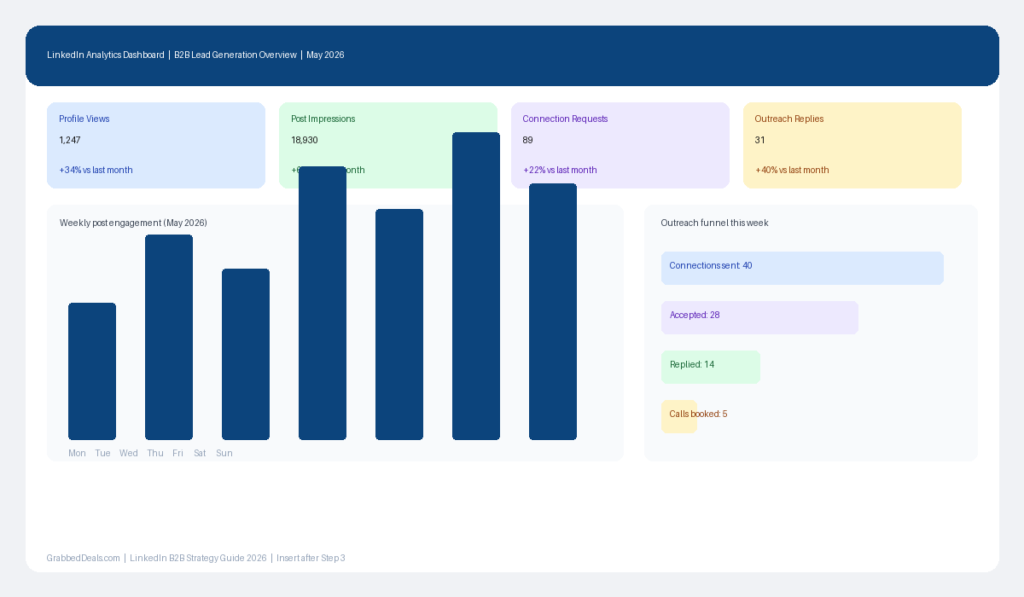
Before sending any outreach, identify who is already engaging with your content or visiting your profile. These are warm signals from people who are aware of you and at least moderately interested in your topic. LinkedIn shows you post viewers, profile visitors (in detail with a paid account), and who reacted to or shared your content. This list is your primary outreach pool, not a cold-sourced list.
Check these signals weekly. Anyone who has engaged with two or more of your posts in the last 30 days is a genuine warm lead. If they match your ICP, they go into outreach. If they are not a perfect fit but are well-connected in your target industry, they are worth a relationship-first message without any pitch attached.
The LinkedIn Sales Navigator tool gives you access to advanced filters and saved lead lists, but it is only worth the monthly cost once you are consistently generating warm signals from organic content. Do not pay for it while your content output is below three posts per week.
The most common mistake in LinkedIn outreach is length. Long messages get skimmed and ignored. The message format that consistently generates replies in 2026 is under 60 words, references something specific about the recipient, and ends with a single yes/no question. It never pitches a product or service in the first message.
Use this structure as your baseline. Adapt the specifics for each recipient, but keep every element in place:
Outreach template (60 words or fewer)
Hi [First name],
Saw your post on [specific topic they wrote about]. Your point about [one specific observation] is something I have been thinking about a lot in relation to [relevant ICP problem].
I work with [type of company] on exactly this. Would it be worth a 20-minute call to compare notes?
[Your name]This template works because it demonstrates you read their content, connects their interest to a shared problem, and asks for something small and low-commitment. It does not mention pricing, services, or outcomes. Those come after the first reply, never before.
Not every reply converts to a call immediately. Most people who respond positively still need one more touchpoint before they commit to a meeting. Wait 3 to 5 days after the first reply, then send a follow-up that adds a small piece of value: a relevant article, a specific case study result, or a one-line observation that connects to something they mentioned in their reply.
Keep the follow-up under 40 words. End it by gently re-offering the call: “Still happy to connect for 20 minutes if timing works this week.” Do not send more than two follow-ups. If there is no response after the second, remove the contact from your active outreach pool for 90 days before trying again with fresh content.
Track your outreach in a simple spreadsheet. Columns: name, company, date of first message, reply status, follow-up sent, call booked. This keeps your pipeline visible and stops warm leads from going cold through neglect rather than lack of interest. A structured content calendar helps you coordinate posting and outreach cycles without letting either one slip during busy periods.
Final verdict
LinkedIn for B2B lead generation in 2026 works consistently when you treat the platform as a long-game relationship channel, not a broadcast tool. The six steps above, done in order, produce results within 4 to 8 weeks for most B2B businesses. The most important single action is fixing your headline. Do that first. Everything else builds on the audience that change attracts. If your pipeline is quiet right now, start with LinkedIn before adding any other channel: the targeting precision and professional intent are unmatched by any other free platform available today.
Frequently asked questions
Most businesses see the first inbound signals within 2 to 4 weeks of posting consistently. The first booked call from outreach typically happens within 4 to 8 weeks, assuming 3 to 4 posts per week and a targeted outreach list of 50 to 100 ICP contacts. Results vary significantly based on niche size and how competitive your audience is on the platform.
Not immediately. LinkedIn Sales Navigator costs around £79 per month in the UK and adds real value only once you have a consistent organic content presence generating warm signals. Start with the free tier, build your posting habit and connection base, then upgrade when you hit the limits of free search filters and need saved lead lists at scale.
Short-form text posts between 150 and 300 words with a strong opening line, a specific insight or counterintuitive claim, and a question to invite comments. The 2025 algorithm update significantly reduced the reach of long articles and external link posts. Save articles for your website and use LinkedIn for short, high-engagement content that drives profile visits and connection requests.
Use your personal profile. Company pages have significantly lower organic reach in 2026. LinkedIn’s algorithm prioritises person-to-person content because it drives higher engagement. Your company page should exist and look professional, but your content and outreach should come from your personal profile to maximise visibility with your target audience.
Stay below 100 connection requests per week to avoid LinkedIn’s automated spam flags. A safer target is 20 to 40 personalised requests per week, which keeps acceptance rates high and reduces the risk of account restrictions. Personalised notes dramatically increase acceptance rates, which signals quality to LinkedIn’s system and keeps your account in good standing long-term.
Author: The GrabbedDeals editorial team tests and reviews tech across every major category, from smartphones and laptops to AI tools and smart home devices. Our buying guides are built on the latest real-world data, independent expert reviews, and current pricing.
Explore our more pages – AI Tools & Productivity | Education & Learning | Travel | Smartphone Ecosystems | Laptop & PCs | Audio & Sound Systems | Gaming & Photography | EV & Green Tech | Digital Marketing & SEO | Smart Tech Deal & Buying Guides