Introduction
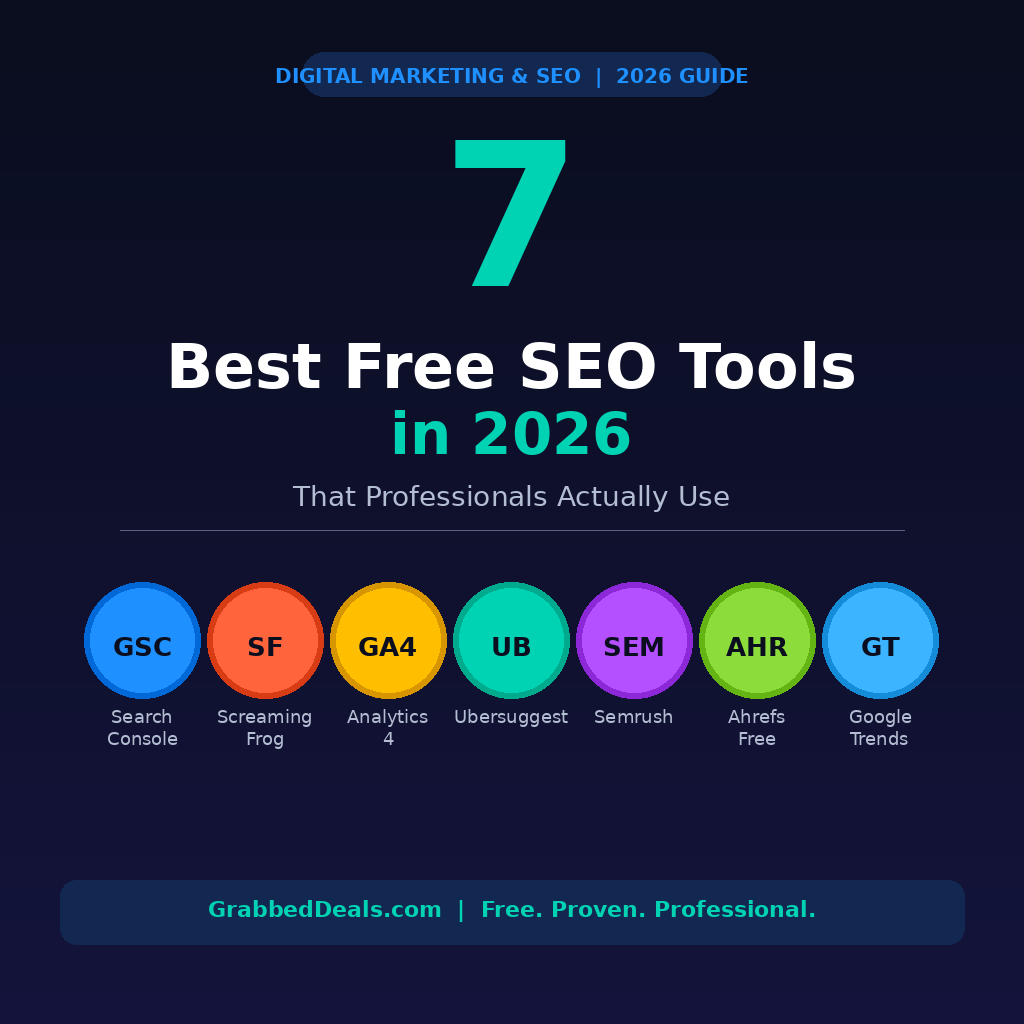
You do not need $150 a month to rank on Google. The best free SEO tools in 2026 cover keyword research, technical audits, backlink analysis, and AI-assisted planning without a credit card. This guide covers the 7 tools professionals actually keep open.
Key takeaways
- Google Search Console is the non-negotiable starting point: real data, directly from Google, free forever.
- Screaming Frog’s free tier crawls 500 URLs and surfaces technical issues that silently cost you rankings.
- Semrush’s free plan unlocks 10 daily queries into a 27-billion-keyword database.
- Ubersuggest and Ahrefs fill keyword and backlink gaps without a paid subscription.
- Three to four free tools cover 80% of what most bloggers and small businesses need in 2026.
1. Google Search Console
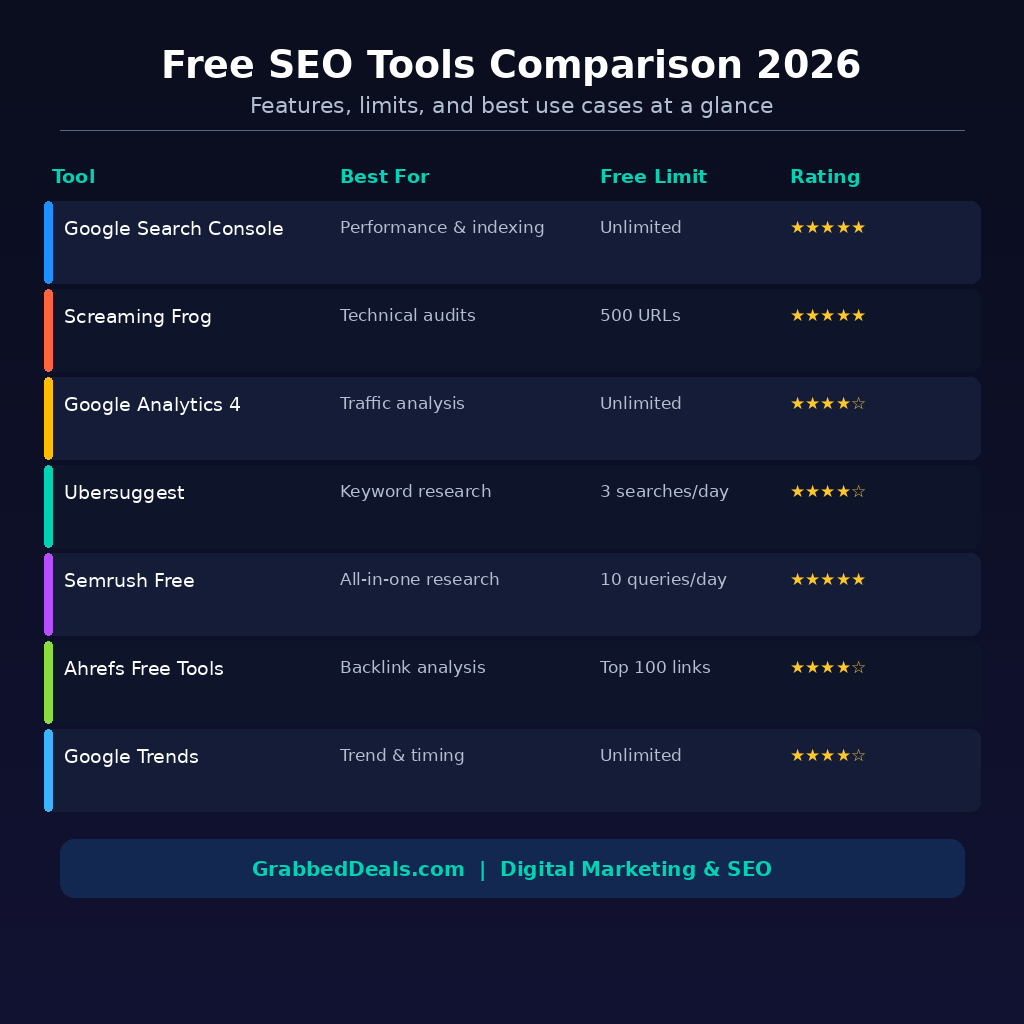
Google Search Console (GSC) is the tool no professional drops from their stack, regardless of budget. It connects directly to Google’s index and shows you exactly how your site performs in search, which pages get impressions, what queries trigger them, and where your average position sits.
The 2026 dashboard includes a more detailed Page Indexing report and lets you filter by country, device, and search type. No third-party tool replaces it because none has access to Google’s own crawl data.
Best for: Every website owner, blogger, and SEO professional. It is the non-negotiable starting point.
Pros: Free forever. Tracks clicks, impressions, CTR, and average position. Flags crawl errors and mobile usability issues.
Cons: Only covers your own site. Data is aggregated for low-traffic queries, so some keyword detail is hidden.
2. Screaming Frog SEO Spider (Free Tier)
Screaming Frog is the standard for technical SEO audits. The free version crawls up to 500 URLs and surfaces broken links, missing metadata, duplicate content, redirect chains, and XML sitemap errors. For small sites and landing pages, 500 URLs is more than enough to run a thorough technical sweep.
In 2026, its GA4 and Search Console integration lets you pull live performance data into the crawl report to see which broken pages are actively losing traffic.
Best for: Bloggers and small business owners auditing sites under 500 pages.
Pros: Catches issues most tools miss. Exports CSV reports. Integrates with GA4 and GSC. No login needed for the free tier.
Cons: 500-URL crawl limit. Advanced features like JavaScript rendering require the paid licence at $259 per year.
3. Google Analytics 4
GA4 is not a traditional SEO tool, but professionals treat it as one because organic search performance only makes sense when you connect it to what users actually do on your site. GA4 tracks user journeys across web and app, shows which organic landing pages retain visitors, and lets you build event-based goals that tie SEO traffic to real conversions.
The free plan has no data cap and includes real-time reports, event-based goals, and BigQuery integration. Paired with Search Console, GA4 completes the picture from query to conversion.
Best for: Any site owner who wants to connect organic traffic to real user behaviour and conversions.
Pros: Free with no limits. Event-based tracking is far more flexible than the old Universal Analytics model. Integrates with GSC, Google Ads, and BigQuery.
Cons: Steeper learning curve than old Universal Analytics. Event tracking requires upfront configuration.
4. Ubersuggest (Free Plan)
Ubersuggest is the most beginner-friendly keyword research tool with a free tier worth using in 2026. Neil Patel’s platform gives you keyword suggestions, search volume estimates, keyword difficulty scores, and a basic site audit without paying a cent. The free plan allows three daily searches, which is enough for focused research sessions.
The AI content ideas tab lets you enter a topic and get blog post ideas ranked by traffic potential. Not as deep as Semrush, but ideal for building a first content calendar.
Best for: Bloggers and small business owners doing initial keyword research and content planning.
Pros: Clean interface. Keyword ideas, difficulty scores, and content suggestions in one place. No technical knowledge needed.
Cons: Three daily searches disappear fast. Data is less precise than Semrush in competitive niches.
5. Semrush (Free Plan)
Semrush is one of the most powerful all-in-one SEO platforms available, and its free plan is more useful than most people realise. You get 10 queries per day against a database of over 27 billion keywords. A free site audit covers up to 100 pages. You can track 10 keywords daily and run domain overviews for competitor research.
In 2026, Semrush added AI search visibility data showing how your brand appears inside AI-generated answers on Google and Bing. The free tier does not unlock this fully, but the data quality alone justifies keeping it in your stack.
Best for: SEO professionals and marketers who need occasional deep keyword and competitor data without a monthly subscription.
Pros: World-class data quality. Competitor analysis. Keyword Magic Tool on free queries. AI visibility signals in 2026.
Cons: 10 daily queries go fast. Paid plans start at $139.95 per month.
6. Ahrefs Free Tools (Backlink Checker and Keyword Generator)
Ahrefs does not offer a free full-platform account, but its standalone free tools are among the most accurate on the market. The Ahrefs Backlink Checker shows the top 100 backlinks to any domain, with anchor text breakdowns and domain rating scores. The free Keyword Generator produces up to 150 keyword ideas per search across Google, YouTube, and Bing.
The backlink data refreshes every 15 minutes, making it more current than many paid alternatives. No account is required for basic checks.
Best for: Content creators and SEO professionals who need reliable backlink and keyword data without a full Ahrefs subscription.
Pros: Industry-leading backlink database. No account needed. Keyword data spans Google, YouTube, and Bing.
Cons: Limited to the top 100 backlinks. Full keyword research and rank tracking require the paid plan starting at $129 per month.
7. Google Trends
Google Trends is underused by most SEOs, which makes it a competitive advantage for those who build it into their workflow. It shows real-time and historical search interest for any topic or keyword, broken down by region, sub-region, and time period. In 2026, with AI search altering which queries surface in traditional results, spotting a trend before it peaks is more valuable than ever.
Professionals use it to time publication, spot seasonal spikes, and find breakout queries before they saturate. Pair it with GSC or Ubersuggest to build a content calendar that stays ahead of demand.
Best for: Content strategists and bloggers who want to publish ahead of rising search demand.
Pros: Completely free. Real-time data. Breakout query detection. Regional filtering helps target local SEO content.
Cons: Shows relative search interest, not absolute volume. Needs to be combined with a keyword tool to validate actual search numbers.
Final verdict
The smartest free SEO stack in 2026 is Google Search Console plus Screaming Frog for technical health, Ubersuggest or Semrush’s free plan for keyword research, Ahrefs’ free backlink checker for link data, and Google Trends for timing. That combination costs nothing and covers what most small business owners and bloggers need to rank and stay ranked. When you outgrow the free limits, Semrush Pro or SE Ranking at $44 per month are the natural next steps.
Frequently asked questions
What is the best free SEO tool in 2026?
Google Search Console is the best free SEO tool in 2026. It provides real data directly from Google, showing which keywords drive traffic, which pages are indexed, and where technical errors occur, all for free.
Is Semrush free to use in 2026?
Semrush offers a free plan with 10 keyword queries per day, a 100-page site audit, and 10 keyword tracking slots. The full platform starts at $139.95 per month.
What is Screaming Frog used for?
Screaming Frog crawls your site and identifies broken links, missing metadata, duplicate content, and redirect chains. The free version covers up to 500 URLs, enough for most small business websites.
Can you do professional SEO using only free tools?
Yes, for most small sites. Google Search Console, Screaming Frog’s free tier, and Ubersuggest cover technical audits, performance tracking, and keyword research without spending a cent. Upgrade to a paid tool when you consistently hit the free limits.
Which free tool is best for keyword research?
Ubersuggest gives three daily searches with keyword difficulty scores and content ideas. For deeper data, Semrush’s free plan offers 10 queries per day. Use Google Trends alongside either to validate seasonal demand.
Author: The GrabbedDeals editorial team tests and reviews tech across every major category, from smartphones and laptops to AI tools and smart home devices. Our buying guides are built on the latest real-world data, independent expert reviews, and current pricing.
Explore our more pages – AI Tools & Productivity | Education & Learning | Travel | Smartphone Ecosystems | Laptop & PCs | Audio & Sound Systems | Gaming & Photography | EV & Green Tech | Digital Marketing & SEO | Smart Tech Deal & Buying Guides