Key Takeaways
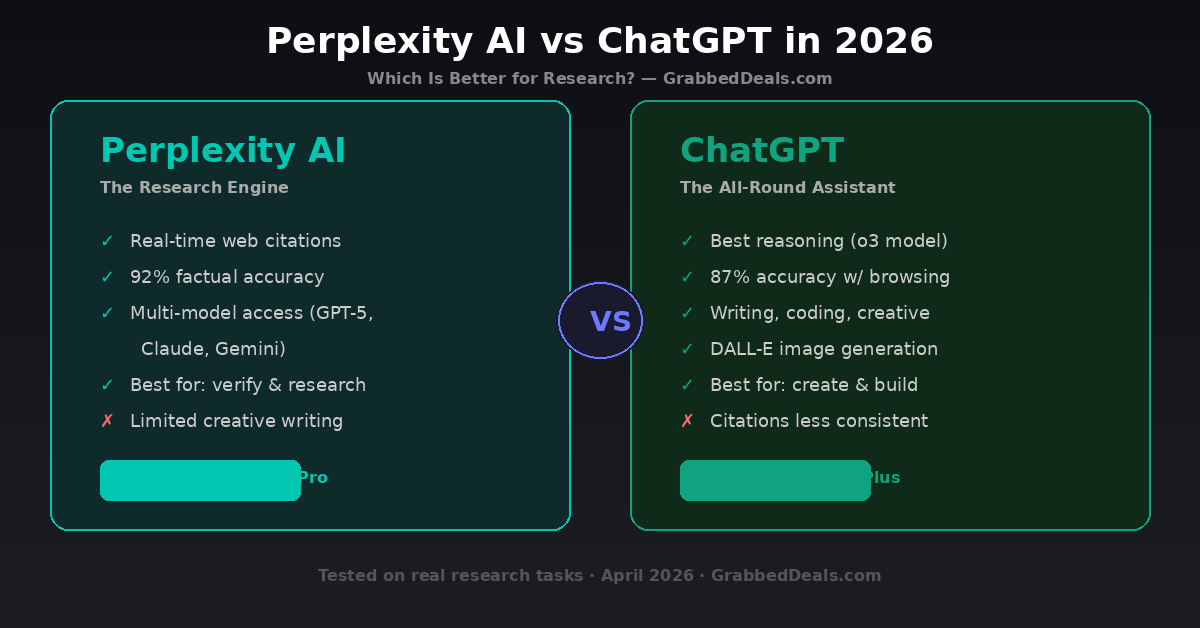
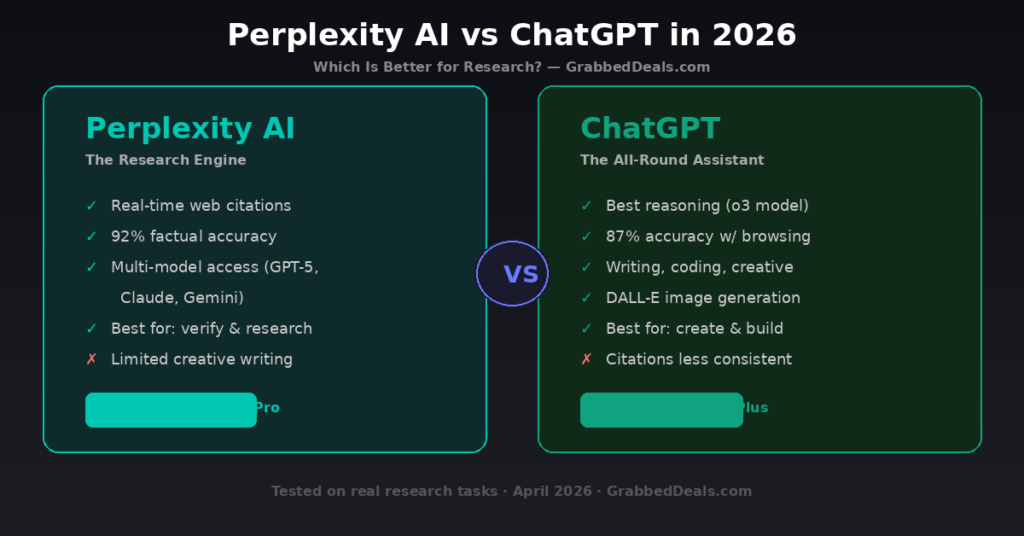
- Perplexity AI is built for research: it retrieves live web sources and cites them by default on every response.
- ChatGPT is the stronger all-rounder: better for writing, coding, creative tasks, and deep reasoning.
- Both cost £16 to £20 per month at Pro level, but what you get from each subscription is very different.
- Independent benchmarks show Perplexity achieving 92% factual accuracy on real-time queries vs ChatGPT at 87%.
- For most professionals, the smartest move in 2026 is to use both tools together, not pick one.
Who is this for? Anyone trying to decide between Perplexity Pro and ChatGPT Plus in 2026, whether you are a researcher, content creator, student, or professional doing regular online research. If you want to know which tool is worth your money, this is the comparison you need.
What is Perplexity AI?
Perplexity AI is a real-time AI answer engine built around web search and source citation. Every single response it generates includes numbered, clickable citations linking directly to the original source. You do not have to ask it to cite sources. It does it automatically, every time.
That design choice is deliberate. Perplexity was built from the ground up as a search engine first, with AI capabilities layered on top. The result is a tool that feels less like a chatbot and more like a research assistant that shows its working.
In 2026, Perplexity Pro gives you access to multiple frontier AI models, including GPT-5, Claude, and Gemini, all within one interface. You can switch models mid-workflow depending on the task. That multi-model flexibility is one of the strongest reasons to choose Pro over the free tier.
The free tier remains generous for casual use, but Pro unlocks unlimited Pro Search (a deeper, multi-source research mode), file uploads, image generation, and the Comet browser integration that lets you ask questions while reading any page on the web.
What is ChatGPT?
ChatGPT is OpenAI’s conversational AI assistant, and it remains the most widely used AI tool in the world in 2026. It has moved well beyond being a text generator. It now handles writing, coding, image creation via DALL-E, data analysis, voice conversations, and complex multi-step reasoning through the o3 and GPT-5 model family.
The current default model on ChatGPT Plus in 2026 is GPT-5, with access to the o3 reasoning model for tasks that need structured, step-by-step thinking. ChatGPT’s free tier now includes limited access to GPT-5.3, image generation, and basic web search, though the free version has introduced ads in the US market from early 2026.
ChatGPT does not search the web by default. It operates from its training data unless you explicitly enable browsing or use the Deep Research feature, which does a thorough multi-source sweep. When browsing is enabled, it can retrieve current information, but citations are not consistently inline the way they are in Perplexity.
How they handle research differently
This is the core of the comparison, and it comes down to architecture. Perplexity was built as a search engine. ChatGPT was built as a language model. That difference shapes everything about how each tool performs on research tasks.
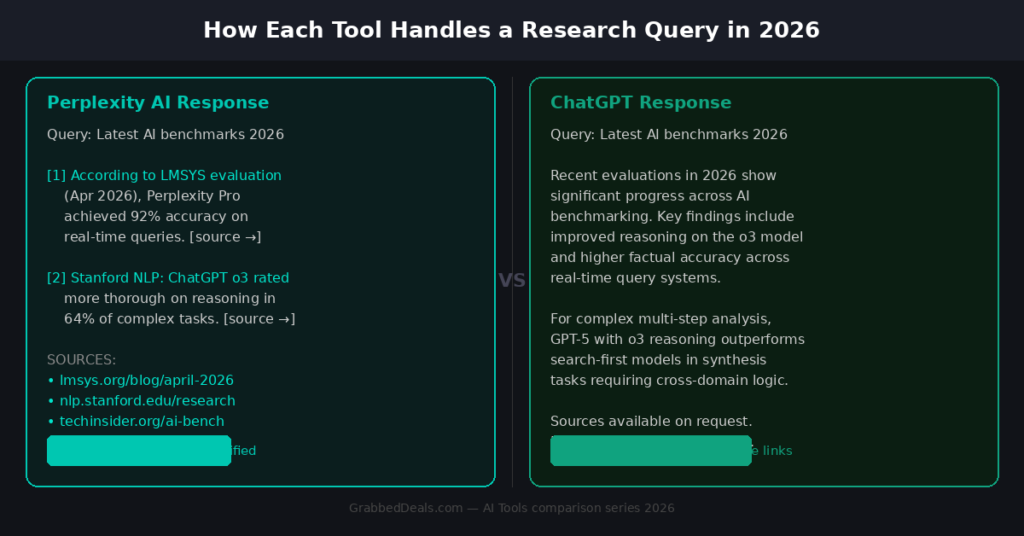
Perplexity’s approach: When you ask a research question, Perplexity simultaneously scans multiple live web sources, synthesises the findings, and presents the answer with numbered citations. Each citation links directly to the original article, paper, or page. You can click any number and verify the claim in seconds.
ChatGPT’s approach: ChatGPT generates an answer from its training data by default. It knows a lot, but its knowledge has a cutoff point, and it does not show sources unless you specifically ask or enable web search. When web search is active, it browses pages sequentially, which is slower than Perplexity’s parallel source scanning. The analysis it produces, however, tends to be deeper.
An independent evaluation by LMSYS in April 2026 measured factual accuracy on real-time information queries. Perplexity Pro scored 92% accuracy. ChatGPT with browsing enabled scored 87%. The gap was wider on financial and scientific questions where source freshness matters most: Perplexity reached 94% on stock-related queries compared to ChatGPT’s 81%.
The reason for that gap: Perplexity’s web index updates in near real time. ChatGPT’s browsing relies on Bing’s index, which introduces a slight but measurable delay on very recent information.
Head-to-head: real research tasks tested
Finding and verifying current facts
Perplexity wins clearly here. Its default mode is to find current, verified, sourced answers. When asked about recent news, live market data, or newly published research, Perplexity surfaces authoritative sources quickly and presents them in a format you can verify without leaving the tool.
ChatGPT with browsing enabled can do this too, but citations appear inconsistently. Some responses come with source links; others do not. For anyone whose work requires traceability, that inconsistency is a genuine problem.
Writing and content creation
ChatGPT wins without much contest. It produces polished, structured long-form content with strong narrative flow, style control, and the ability to iterate across a multi-turn conversation. You can give it a rough draft and refine it across ten exchanges. The output feels like writing, not a list of search results.
Perplexity generates text, but its primary strength is informational synthesis rather than creative output. Ask it to write a 1,000-word article and you will get something structured and factual, but lacking the editorial voice that ChatGPT handles naturally.
Complex multi-step reasoning
ChatGPT’s o3 model is the best reasoning tool available at the Pro price point in 2026. Stanford NLP evaluators rated ChatGPT’s reasoning chains as more thorough than Perplexity’s on 64% of complex multi-domain questions. For tasks that involve analysis, synthesis across disciplines, or working through open-ended problems step by step, ChatGPT has the advantage.
Real-time news and current events
Perplexity wins. It is simply faster at surfacing recent information, and the source-first design means you see exactly where each piece of information came from. ChatGPT can retrieve current news when browsing is enabled, but the experience is slower and less transparent.
Coding and technical tasks
ChatGPT wins by a significant margin. It has Canvas (an integrated coding environment), Codex Agent for complex programming tasks, and the ability to run and test code within the conversation. Perplexity can retrieve coding examples and explain concepts, but it is not designed as a coding tool.
Pricing compared
Both Perplexity Pro and ChatGPT Plus cost around $20 per month (approximately £16 at current rates) on monthly billing. Annual billing on both platforms brings the effective cost down to around £13 to £14 per month.
What you get for that price is very different.
Perplexity Pro gives you unlimited Pro Search (deep multi-source research mode), access to multiple frontier models including GPT-5, Claude, and Gemini, file uploads, image generation, and the Comet browser integration. The multi-model access is a genuine differentiator. You get flexibility that no single-model subscription at this price point offers.
ChatGPT Plus gives you priority access to GPT-5 and the o3 reasoning model, faster response times, DALL-E image generation, Advanced Data Analysis, and custom GPTs. It is the most polished single-tool subscription at this price if OpenAI’s ecosystem is where your workflow already lives.
For teams, ChatGPT’s Team plan sits at $25 per user per month, which undercuts Perplexity’s Pro tier by a meaningful margin. However, Perplexity’s enterprise tier offers stricter data privacy defaults and no training on user data, which matters for professionals in regulated industries.
Who should use Perplexity AI?
Perplexity is the right tool if your work revolves around finding, verifying, and citing accurate information. The clearest use cases are:
Researchers and academics who need sourced, verifiable answers they can check and cite. Perplexity’s citation-first design reduces hallucination risk and provides an immediate path to fact-checking.
Journalists and fact-checkers who need current information with traceable sources. The ability to click a citation and verify a claim in seconds is genuinely useful in a professional newsroom context.
Business analysts who regularly track industry news, competitor updates, and market data. Perplexity’s real-time web access and multi-source synthesis produce the kind of briefing documents that would otherwise take hours to compile manually.
Anyone on Octopus Intelligent tariffs, sorry, that is the EV guide slipping in. Any professional who regularly relies on Google for research will find Perplexity a faster, more structured replacement for informational queries.
Who should use ChatGPT?
ChatGPT is the right tool if your work involves creation, not just retrieval. The clearest use cases:
Writers, marketers, and content creators who need a tool that produces polished long-form output with editorial voice and strong iteration capability. ChatGPT’s ability to refine across a conversation makes it far superior to Perplexity for drafting.
Developers and engineers who need a coding assistant with execution capability. ChatGPT’s Canvas environment and Codex Agent handle complex programming tasks that Perplexity simply does not support.
Students and generalists who need an all-purpose assistant that can handle writing, research, maths, coding, and creative tasks without switching tools. ChatGPT is the most versatile single subscription at this price.
Teams already in the Microsoft 365 ecosystem who benefit from ChatGPT Enterprise’s deep integration with Teams, SharePoint, and Outlook.
Can you use both?
Yes, and in 2026, many power users do exactly this. The two tools complement each other rather than compete directly.
The most productive workflow combines Perplexity for the research and verification phase with ChatGPT for the creation and execution phase. You use Perplexity to find current, sourced information on your topic. Then you take that data into ChatGPT to write the report, draft the proposal, or build the presentation. Each tool does what it was designed for, and the results are better than relying on either alone.
The main reason people do not do this already is cost: two Pro subscriptions add up to around £32 per month. If budget is a constraint, your primary use case should drive the decision.
Verdict: which wins for research?
For pure research tasks, Perplexity AI wins in 2026. Its architecture, its citation system, and its real-time web access are purpose-built for exactly this use case. The 92% factual accuracy benchmark, the sourced responses, and the multi-model flexibility make it the stronger research tool at the Pro price point.
But ChatGPT is the better all-rounder. If research is one of many things you use AI for, ChatGPT does more across more tasks and does most of them very well. The o3 reasoning model for complex analysis, Canvas for coding, and DALL-E for visual content add up to a tool that handles entire workflows from start to finish.
The honest answer: if you primarily need to verify and cite, choose Perplexity. If you primarily need to create, choose ChatGPT. If you do both, find a way to run both subscriptions, because the combination is genuinely more powerful than either alone.
Try Perplexity Pro free for 7 days | Start ChatGPT Plus with a free trial
FAQs
Is Perplexity AI more accurate than ChatGPT for research in 2026? On real-time factual queries, yes. An independent LMSYS evaluation in April 2026 found Perplexity Pro achieving 92% factual accuracy on live web queries, compared to ChatGPT’s 87% with browsing enabled. The gap is largest on financial and scientific topics where information freshness is critical. However, ChatGPT scores higher on deep reasoning and analysis tasks where synthesis across multiple domains matters more than source freshness.
Does Perplexity AI use ChatGPT’s technology? No. Perplexity uses its own proprietary search and routing technology. In Perplexity Pro, you can choose from multiple AI models including GPT-5, Claude, and Gemini, but the search engine itself, the citation system, and the source retrieval architecture are entirely Perplexity’s own. It is not a wrapper around ChatGPT.
Which is better for students, Perplexity or ChatGPT? For academic research requiring cited, verifiable sources, Perplexity is the stronger choice. For writing essays, solving maths problems, getting coding help, and handling a wide range of coursework tasks, ChatGPT is more versatile. Many students use Perplexity to research and gather sources, then move to ChatGPT to help structure and write. Perplexity also offers discounted Pro access through educational partnerships.
Can ChatGPT search the web like Perplexity in 2026? Yes, but not in the same way. ChatGPT with browsing enabled can retrieve current web information, but it browses pages sequentially rather than scanning multiple sources in parallel. Citations appear inconsistently, and the experience is slower than Perplexity’s real-time search. ChatGPT’s Deep Research feature is more thorough but takes longer to run. Perplexity’s citation-first design remains more transparent and reliable for research specifically.
Is Perplexity Pro worth paying for in 2026? If research is a significant part of your daily work, yes. The unlimited Pro Search mode, access to multiple frontier AI models within a single subscription, and the Comet browser integration justify the £16 monthly cost for professionals who research regularly. If you only use AI occasionally for casual queries, the free tier covers most needs. The paid tier makes most sense for journalists, analysts, researchers, and anyone who currently spends significant time on Google every day.
Related Posts
- Best AI Tools for Content Creators in 2026: Tested and Ranked
- Perplexity AI Review 2026: Is It Worth Paying For?
- ChatGPT vs Claude in 2026: Which AI Assistant Is Right for You?
Explore our more pages – AI Tools & Productivity | Smartphone Ecosystems | Laptop & PCs | Audio & Sound Systems | Gaming | Photography & Videography | EV & Green Tech | Digital Marketing & SEO | Smart Home & Wearables | Tech Deals & Buying Guides |
Author bio: The GrabbedDeals editorial team tests AI tools, tech products, and software so you don’t have to. Every review and comparison on this site is written after hands-on testing with real tasks.