Key Takeaways
- There is no single best home EV charger. The right one depends on your electricity tariff, whether you have solar panels, and how much you care about aesthetics.
- Ohme Home Pro is the top pick for smart tariff users, especially those on Octopus Intelligent Go.
- Myenergi Zappi is the clear winner for homes with solar panels, with ECO+ mode charging your car on 100% surplus solar.
- Pod Point Solo 3S is the most reliable no-fuss option for drivers who want simple, dependable charging.
- Andersen A3 is the premium choice for design-conscious buyers who want the charger to look like part of the house.
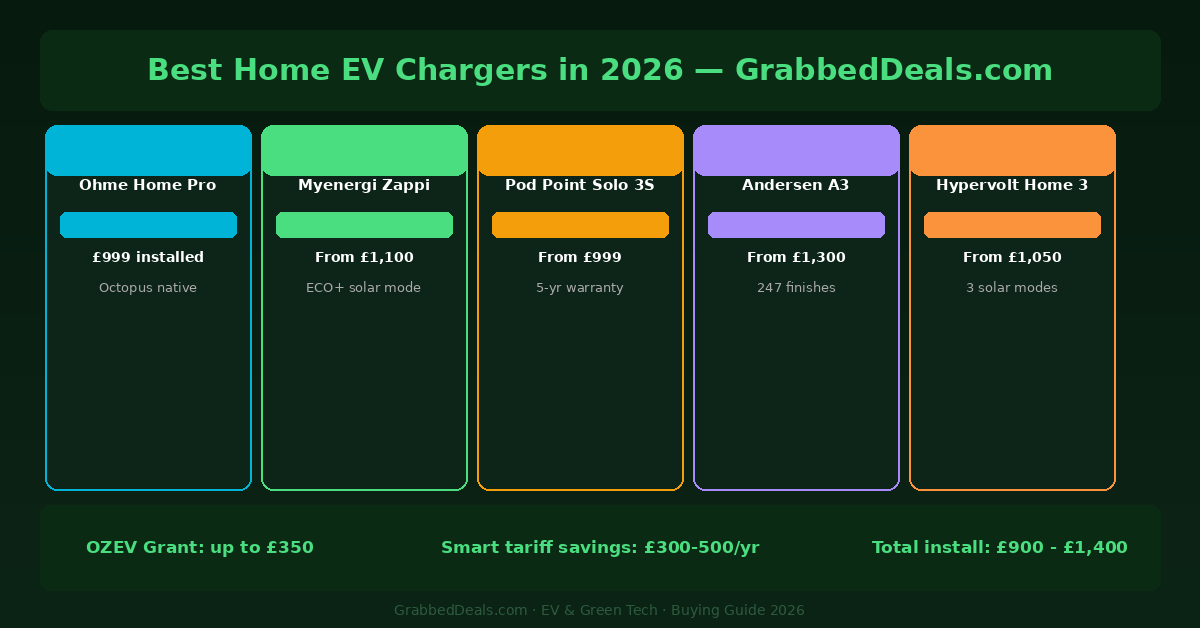
- Total installation cost in 2026 typically runs £900 to £1,400 including the unit and labour.
Who is this for? Anyone buying their first home EV charger in 2026, or switching from an older unit. Whether you are on a smart tariff, have solar panels, or just want a reliable wall box installed without stress, this guide covers every scenario.
Why a home EV charger matters more than you think
Most new EV owners treat the home charger as an afterthought. You buy the car, sort the insurance, and then figure out charging later. That is a mistake, and it costs you money and convenience every single day.
A properly chosen and installed home charger does three things for you. It charges your car at the speed your battery allows (typically 25 to 30 miles of range added per hour on a 7kW unit). It integrates with your electricity tariff to charge at the cheapest times automatically. And on the right setup with solar panels, it charges your car entirely from surplus energy you would otherwise export to the grid for almost nothing.
The difference between a basic charger and the right charger can be worth £300 to £500 per year in electricity savings. Over a decade, that is thousands of pounds. Choosing properly from day one is one of the best financial decisions you can make as an EV owner.
What to decide before you buy
Before you look at specific models, answer these four questions. Your answers narrow the field significantly.
Do you have solar panels? If yes, the Zappi is almost certainly your answer. Its ECO+ mode charges your car using 100% surplus solar, effectively giving you free miles on sunny days.
Are you on Octopus Intelligent Go, or planning to switch? If yes, the Ohme Home Pro is the native integration choice. Octopus and Ohme communicate directly, scheduling your charging automatically in the cheapest overnight slots without you having to touch an app.
Do you want the charger to be practically invisible? If yes, the Andersen A3 or Quartz is built for you. These are the only chargers on the market that genuinely look like intentional design choices rather than electrical equipment.
Do you just want something reliable that works? If yes, Pod Point Solo 3S is the answer. It has proven reliability across hundreds of thousands of UK installations and a 5-year warranty with a no-fuss setup.
The best home EV chargers in 2026
Ohme Home Pro
Best for: Octopus Energy users and smart tariff optimisation
The Ohme Home Pro has earned its place at the top of most 2026 UK charger rankings, and the reason is straightforward: its native integration with Octopus Intelligent Go is better than any other charger on the market.
You plug in your car at night. The Ohme and Octopus communicate directly. Your car charges in the cheapest overnight slots, typically around 7.5p per kWh between 11pm and 5am on Intelligent Go, compared to 24p or more on a standard rate. You wake up to a full battery and pay roughly 70% less per charge than you would on a flat tariff.
The charger itself is compact and unobtrusive, with a built-in LCD display showing your battery level and charge rate without needing to open an app. It offers both tethered (cable attached) and untethered configurations. The Home Pro is rated at 7.0kW rather than the 7.4kW of some competitors, but the practical difference in daily charging is negligible for the vast majority of UK drivers.
The Ohme ePod is the budget sibling, at £949 installed versus £999 for the Home Pro. The £50 difference buys you the LCD screen, the tethered cable option, and the better app experience. For most buyers, the Pro is the right choice.
The one limitation to know: the Ohme Home Pro relies on a 4G data connection for smart tariff communication. In areas with poor mobile signal, this can cause intermittent scheduling issues.
Price: From £999 fully installed | Warranty: 3 years | Smart tariff: Native Octopus integration | Solar: Yes (in 2026 update)
Myenergi Zappi
Best for: Homes with solar panels or planned solar installation
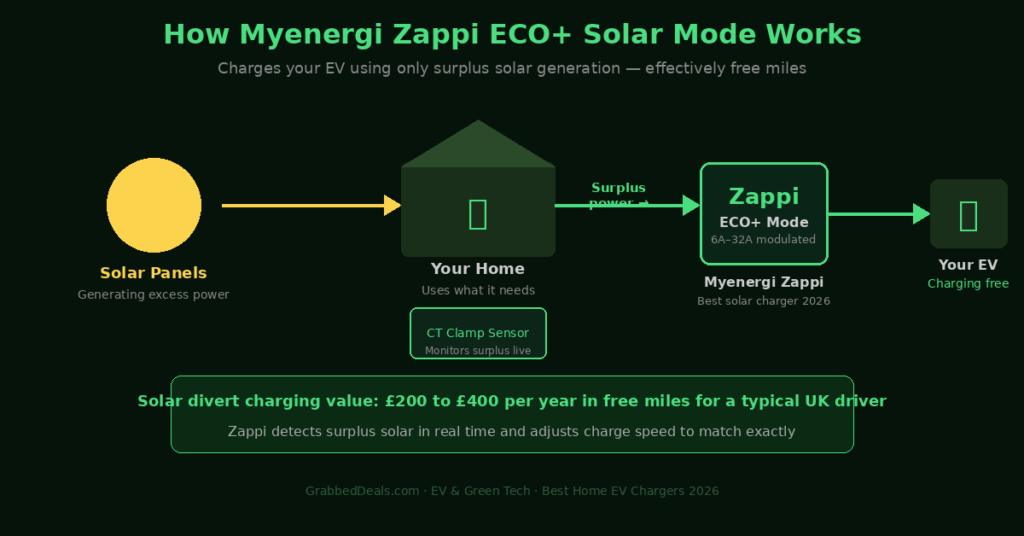
If you have solar panels, the Zappi is the obvious choice. No other charger on the mainstream market replicates what Zappi’s ECO+ mode does: charge your car using only surplus solar generation, adjusting the charge rate in real time as your solar output fluctuates.
The way it works is elegant. A CT clamp sensor monitors your home’s import and export at the meter. The Zappi reads this data live and modulates its charge current continuously, from 6A to 32A in roughly 5A steps, to match what your panels are generating beyond what your house needs. On a clear summer day, your car charges for free. On a partially cloudy day, it tops up the solar contribution with cheap grid power as needed.
Over a year, solar divert charging is worth £200 to £400 in free miles for a typical UK driver. The Zappi is also part of the broader myenergi ecosystem, which includes the Eddi hot water diverter and Libbi home battery. If you want a fully integrated home energy system, Zappi is your entry point into that ecosystem.
The Zappi is compatible with Octopus Intelligent Go, handling smart tariff scheduling through its own app rather than Ohme’s native integration. It costs slightly more than the Ohme and the setup is a little more involved due to the CT clamp installation, but the solar divert capability justifies that complexity for any home with panels.
Price: From around £1,100 to £1,300 installed | Warranty: 3 years | Smart tariff: Octopus-compatible via app | Solar: Yes, best-in-class ECO+ mode
Pod Point Solo 3S
Best for: Drivers who want reliable, no-fuss charging without complexity
Pod Point has been one of the UK’s most trusted EV charging brands since 2009, with over 250,000 charge points installed across the country. The Solo 3S is the current model, and it earns its recommendation through dependability rather than flashy features.
The Solo 3S charges at 7kW (3.6kW version also available for homes with lower supply capacity), comes with either a tethered 5m cable or untethered configuration, and backs everything with a 5-year warranty as standard. That 5-year warranty is one of the best in the category: most competitors offer 3 years.
Smart features are solid without being market-leading. The app handles scheduling, energy monitoring, and basic load balancing. Solar divert is technically supported but is less mature than Zappi’s implementation. The Solo 3S does not have native Octopus integration, relying instead on the app-based approach that works well but requires more manual management than the Ohme.
Pod Point’s nationwide installer network is one of the strongest in the UK, which matters practically: you are less likely to face a long wait for an installation slot.
Price: From £999 (untethered) or £1,049 (tethered with 5m cable) | Warranty: 5 years | Smart tariff: App-based | Solar: Basic support
Andersen A3
Best for: Design-conscious buyers and premium residential properties
The Andersen A3 is not trying to compete on smart features. It competes on aesthetics, build quality, and warranty, and it wins on all three.
With 247 colour and finish combinations, including real wood and aluminium front panels, the A3 is the only home EV charger that genuinely looks intentional. Architects, interior designers, and homeowners in listed buildings or high-end developments specify Andersen chargers because they blend with the property rather than drawing attention to themselves.
Practically, the A3 delivers solid smart features including app scheduling, energy monitoring, and compatibility with Octopus Intelligent Go via app. The 7-year warranty is unmatched in the category: more than double the industry standard and a genuine long-term peace of mind argument for a device you will use daily for a decade or more.
What the Andersen does not offer is solar divert. If renewable energy integration is your priority, the Zappi is the better choice. The A3 is for buyers who have already decided they want something that looks exceptional, and are willing to pay a premium accordingly.
Price: From around £1,300 to £1,634 installed depending on configuration | Warranty: 7 years | Smart tariff: Octopus-compatible via app | Solar: No
Hypervolt Home 3 Pro
Best for: UK-manufactured option with strong solar support and Alexa integration
The Hypervolt Home 3 Pro is manufactured in Rainham, Essex, and has built a strong reputation in the UK market for its three dedicated solar charging modes, Alexa voice integration, and high customer satisfaction scores, reaching 86% in independent testing.
It is a competitive mid-range option that sits between the Ohme and Zappi in both price and features. Three solar charging modes offer more nuance than most competitors. Alexa integration lets you check charge status or start/stop charging with a voice command, which is a practical convenience if your home is already on Alexa.
Hypervolt supports Octopus Intelligent Go and offers cable lengths up to 10m as standard, which is longer than most competitors and useful for garages where the car parks further from the consumer unit.
Price: From around £1,050 to £1,200 installed | Warranty: 3 years | Smart tariff: Octopus-compatible | Solar: Yes, three dedicated modes
How much does installation cost in 2026?
The total cost of a home EV charger installation in 2026 typically runs between £900 and £1,400. This covers the charger unit, labour, and standard materials.
A standard installation includes wall-mounting the charger within 3 to 5 metres of your consumer unit, running cabling from the consumer unit to the charger location, installing a dedicated circuit breaker and RCBO protection, and full testing to BS 7671 wiring regulations.
Additional costs can apply for:
- Cable runs over 10 metres (typically £5 to £10 per extra metre)
- Consumer unit upgrades if your board is full (£150 to £300)
- External groundworks for detached garages (£200 to £500)
- Earth rod installation if your supply requires it (£75 to £150)
Always use an OZEV-approved installer. OZEV approval is required to access the government grant (see below), and it guarantees a minimum standard of installation quality.
OZEV grant: can you still claim it?
The OZEV (Office for Zero Emission Vehicles) EV chargepoint grant in 2026 covers up to £350 toward the cost of installing a home charger for renters, landlords, and flat owners in blocks of flats. The grant does not currently apply to homeowners with their own driveway, though the eligibility rules have shifted over recent years and are worth checking against the latest GOV.UK guidance.
For those who do qualify, the grant reduces the effective installation cost meaningfully. Your OZEV-approved installer handles the application process on your behalf. The key requirements are that the charger meets Smart Charge Points Regulations 2021 (all five chargers in this guide do) and that the installer is OZEV-registered.
Smart tariffs and how they change the maths
Choosing the right electricity tariff alongside your charger is as important as choosing the right charger itself.
On Octopus Intelligent Go at around 7.5p per kWh overnight (versus 24.5p peak in 2026), a typical EV driver doing 8,000 miles per year pays roughly £160 annually to charge. On a standard flat tariff at 24p per kWh, the same driver pays around £549 per year. That is a saving of £389 per year, or over £30 per month, simply by switching tariff and using a smart charger.
If you combine an Octopus Intelligent tariff with a Zappi and solar panels, your cost per mile drops even further. On sunny days, solar surplus charges the car at effectively zero cost. The Zappi tracks your solar output in real time and prioritises it automatically.
The financial case for a smart charger pays for itself quickly. At £389 per year in savings, a £300 premium for a smart charger over a basic unit pays back in under a year.
Verdict: which charger should you buy?
Ohme Home Pro: Buy this if you are on Octopus Energy or planning to switch. The native integration is the smoothest smart charging experience available at any price.
Myenergi Zappi: Buy this if you have solar panels. The ECO+ solar divert mode is purpose-built, best-in-class, and genuinely unique at this price point.
Pod Point Solo 3S: Buy this if you want reliability without complexity. The 5-year warranty, proven installation track record, and no-fuss operation make it the safest default choice.
Andersen A3: Buy this if aesthetics matter as much as function. The 7-year warranty and 247 finish options justify the premium for the right buyer.
Hypervolt Home 3 Pro: Buy this if you want a British-made alternative with strong solar support and voice integration.
There is genuinely no wrong answer from this list. All five chargers are quality products from reputable brands with proper UK installation networks. The right choice depends on your setup, your tariff, and your priorities.
Get free quotes from OZEV-approved installers near you | Check Octopus Intelligent Go tariff eligibility
FAQs
Do I need a smart EV charger or will any wall box do? In 2026, a smart charger is almost always the right choice. The savings from scheduling charging to off-peak rates typically amount to £300 to £500 per year for a standard EV driver. That saving recoups the small premium a smart charger carries over a basic unit within months. Smart chargers also provide energy monitoring, load balancing, and app control. The only scenario where a basic charger makes sense is if you are on a simple flat electricity tariff with no plans to change, and cost is the primary consideration.
What is the difference between tethered and untethered EV chargers? A tethered charger has a fixed cable permanently attached, usually 5m to 10m long. You plug it directly into your car. An untethered charger has a socket instead of a cable, so you use your own Type 2 cable. Tethered is more convenient for daily use, as the cable is always ready. Untethered is tidier in appearance and useful if you drive different EVs with different cable types. Most UK drivers prefer tethered for the convenience, but untethered suits those who prefer a cleaner wall installation.
How long does a home EV charger installation take? A standard installation takes 2 to 3 hours for an experienced OZEV-approved installer. This covers mounting the unit, running the cable from your consumer unit, installing the dedicated circuit breaker, and full testing. More complex installs involving long cable runs, consumer unit upgrades, or external groundworks for detached garages can take a full day.
Can I charge a non-Tesla EV with any of these chargers? Yes. All five chargers in this guide use the Type 2 connector standard, which is compatible with every non-Tesla EV sold in the UK. Tesla vehicles can also charge on Type 2 using the included adapter. Tesla’s own Wall Connector is available as a separate option for Tesla owners who want native in-app integration, but all mainstream chargers in this guide are fully compatible with Teslas.
Is the OZEV grant still available in 2026? Yes, but eligibility has narrowed compared to earlier years. The current OZEV EV chargepoint grant provides up to £350 toward installation costs for renters (including those in rental accommodation), landlords installing for tenants, and those installing in blocks of flats. Homeowners with their own driveway are no longer eligible for the residential grant under current 2026 rules. Always verify the latest eligibility criteria at GOV.UK before installing, as rules have changed multiple times and may change again.
Related Post
- Best EVs Under £35,000 in 2026: Tested and Ranked
- Octopus Intelligent Go Review: Is It Worth Switching For?
- Home Solar Panels and EV Charging: The Complete 2026 Guide
Explore our more pages – AI Tools & Productivity | Smartphone Ecosystems | Laptop & PCs | Audio & Sound Systems | Gaming | Photography & Videography | EV & Green Tech | Digital Marketing & SEO | Smart Home & Wearables | Tech Deals & Buying Guides |
Author bio: The GrabbedDeals editorial team tests AI tools, tech products, and software so you don’t have to. Every review and comparison on this site is written after hands-on testing with real tasks.