Key Takeaways
- The mid-range Android market in 2026 offers genuine flagship-quality features for under £400.
- Samsung Galaxy A36 (£399) is the best all-rounder for most buyers.
- Nothing Phone (4a) (£349) wins on design and value.
- Google Pixel 9a sits just over £400 at £499, but is worth noting for camera and software support.
- Motorola Edge 60 Neo (under £400) leads on battery charging speed at this price point.
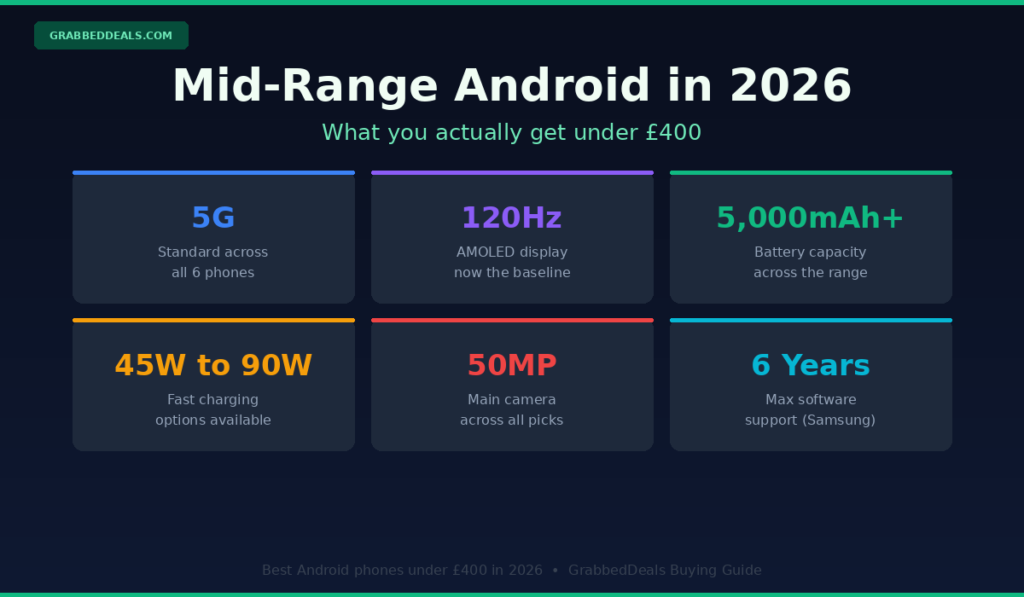
- 5G, AMOLED displays, and fast charging are now standard at this price bracket.
- Software update commitments vary massively: Samsung offers 6 years, Google offers 7, Motorola offers 3 to 5.
Who is this for? This guide is for anyone who wants a great smartphone without paying flagship prices. Whether you’re upgrading from an older handset, buying a first smartphone, or looking for a reliable daily driver that handles everything without drama, this list covers the six best options you can buy right now for £400 or less.
Why under £400 is the sweet spot in 2026
A few years ago, spending under £400 on a smartphone meant real compromise. Slow chipsets, muddy cameras, and plastic builds that felt cheap in hand. In 2026, that story has completely changed.
The gap between flagship and mid-range phones is narrower than it’s ever been. You now get AMOLED displays with 120Hz refresh rates, multi-lens camera systems with decent low-light performance, 5G as standard, and all-day battery life in phones that cost less than half what a Samsung Galaxy S26 or iPhone 17 Pro commands.
Manufacturers are pushing features downmarket faster than ever. Samsung brings Galaxy AI to the A36. Nothing brings a Snapdragon 7s Gen 4 chipset to the (4a) at £349. Motorola packs 68W wired charging and five years of updates into the Edge 60 Neo.
If you’re spending £400 or under in 2026, you’re not settling. You’re making a smart buying decision.
What to look for before buying
Before jumping to the list, here are the four things that actually matter when picking a phone at this price point.
Chipset and RAM. A modern mid-range processor with at least 8GB of RAM keeps apps running smoothly, handles multitasking without dropping frames, and supports 5G. Look for Snapdragon 7 series or MediaTek Dimensity 7000 series chips as your baseline.
Display quality. AMOLED panels at 120Hz are now the standard to expect under £400. A high refresh rate makes scrolling and gaming feel notably smoother than a 60Hz LCD. Check peak brightness too: anything above 1,000 nits handles outdoor visibility well.
Battery and charging speed. Most phones in this range carry a 5,000mAh battery, which comfortably covers a full day of use. The differentiator is charging speed. Some phones in this bracket charge at 45W to 68W wired, which means topping up in under an hour. That matters for daily life.
Software update support. This is where buyers make costly mistakes. A phone with only two years of Android updates left is a phone you’ll need to replace sooner. Check the manufacturer’s policy before you buy. Samsung now offers six years of OS updates on the A36. Google offers seven years on the Pixel 9a. Motorola’s commitment varies by model.
The top 6 best Android phones under £400 in 2026
These six phones have been selected based on real-world performance data, expert reviews from sources including Trusted Reviews and Tech Advisor, and current UK pricing. Each earns its place for a specific reason.
1. Samsung Galaxy A36 5G
Price: £399 | Best for: All-round daily use
The Galaxy A36 5G costs £399 in the UK for the only model available, which offers 8GB of RAM and 256GB of storage.
At exactly the top of our budget, the Samsung Galaxy A36 5G earns the top spot because it does everything well without any glaring weakness. It’s the phone you buy when you want the right answer, not the interesting one.
The display is a highlight: a 6.7-inch, Full HD+ 120Hz AMOLED which Samsung claims is 20% brighter than the Galaxy A35. In real-world use, that brightness makes a genuine difference outdoors, and the screen is sharp enough that you won’t notice any downgrade from more expensive handsets.
Galaxy A36 5G offers a 12MP front camera with video HDR, 45W for faster charging, and 6 generations of OS and 6 years of security updates. That software commitment is one of the best in the mid-range market, and it’s the reason this phone will still feel relevant in 2030.
The camera setup covers 50MP main, 8MP ultrawide, and 5MP macro. It’s not class-leading, but it’s solid enough for social media, travel, and everyday shots. Samsung’s image processing also continues to improve with each generation.
Samsung is also bringing some of its Galaxy AI features to the A36, including Circle to Search. It’s a trimmed-down version of what the Galaxy S25 series offers, but the inclusion of AI features at this price point is a genuine bonus.
The case for buying it: The A36 is the safest choice in this entire list. Strong display, fast 45W charging, six years of updates, and Samsung’s One UI 7 software, which is one of the best Android experiences available. It’s not the cheapest, but at £399 it delivers exceptional value.
The one thing to know: The chipset, a Snapdragon 6 Gen 3, is mid-range in the truest sense. If gaming or heavy multitasking matters to you, the POCO X7 Pro below is a better pick.
2. Nothing Phone (4a)
Price: £349 | Best for: Design, value, and a unique experience
The Phone (4a) starts at £349 and launches March 13th, featuring brighter 1.5K displays, new Snapdragon chipsets, upgraded 50MP cameras, enhanced durability with Gorilla Glass 7i, and redesigned Glyph lighting systems.
Nothing has done something genuinely interesting with the Phone (4a). At £349, it’s the most affordable phone on this list, and yet it doesn’t feel like a budget product. The build quality, the software, and the design coherence all punch well above the price.
The original Glyph Interface has been replaced with a new Glyph Bar, a row of 63 mini-LEDs that acts as a notification indicator, charging status display, and general visual personality for the phone. It’s unconventional in a way that people either love immediately or find pointless. If you care about your phone looking different from everything else out there, nothing else on this list comes close.
Both phones feature 5080mAh batteries with 50W wired charging. Nothing OS continues to offer one of the cleanest, most stock-adjacent Android experiences on the market, with regular updates and a growing community of users who appreciate the minimal bloatware approach.
The 50MP main camera with Gorilla Glass 7i protection represents a genuine step up from the (3a) series. Daylight shots are excellent. Low-light performance is competitive, though it doesn’t quite match the Galaxy A36 or Pixel 9a in challenging conditions.
The case for buying it: If you want the most phone for your money at the lowest price on this list, the Nothing Phone (4a) at £349 is the pick. It’s distinctive, well-built, and runs clean Android software with regular updates. At £50 less than the Galaxy A36, the savings are real.
The one thing to know: Nothing is a younger brand with a smaller ecosystem than Samsung or Google. If you want maximum third-party accessory support or the widest carrier availability, the Galaxy A36 is the safer long-term bet.
3. Motorola Edge 60 Neo
Price: Under £400 (approximately £320 to £360) | Best for: Battery life and charging speed
At under £400, the Motorola Edge 60 Neo is a brilliant budget-friendly Android that should suit most everyday uses.
The Edge 60 Neo earns its place on this list by doing one thing better than anything else at this price: charging. With support for 68W wired charging speed and 15W wireless too, the Edge 60 Neo even surpasses the likes of the Samsung Galaxy S25 Ultra for battery prowess, for over half the cost.
That 68W wired speed means you can go from nearly empty to full in under an hour. In a world where most phones in this price bracket max out at 25W or 45W, that’s a meaningful practical advantage for anyone who forgets to charge overnight.
Powering the Edge 60 Neo is a mid-range MediaTek Dimensity 7400 chip which runs casual apps and the odd spot of gaming without much stutter. Motorola also promises up to five years of major Android upgrades, making this a solid budget investment.
The camera system includes a 50MP main, a 13MP ultrawide, and a 10MP 3x telephoto. Having a proper telephoto at this price point is genuinely rare, and while the zoom quality drops off beyond 3x, the core 1x and 3x shots are strong.
Nothing OS and One UI aren’t the only clean Android options available. Motorola’s near-stock software is refreshingly uncluttered, and Moto AI adds practical features without turning the phone into a bloatware showcase.
The case for buying it: If fast charging and all-day battery matter more to you than anything else, the Edge 60 Neo wins. It’s also the best value entry on this list in terms of raw spec-to-price ratio.
The one thing to know: Motorola’s update promises have historically been inconsistent, and five years of “major Android upgrades” requires checking the small print. Make sure the specific model you’re buying carries that commitment before purchasing.
4. POCO X7 Pro
Price: Approximately £300 to £370 (availability varies by retailer) | Best for: Performance, gaming, and heavy users
The POCO X7 Pro delivers proper flagship-level performance that’s perfect for gaming without the associated price tag, down to the use of the Dimensity 8400-Ultra, which sits just under MediaTek’s flagship 9000 series chips.
The POCO X7 Pro is the performance outlier on this list. If you want a phone that handles mobile gaming, heavy multitasking, or demanding apps without breaking into a sweat, nothing else here gets close.
The POCO X7 Pro also looks as good as it works, and is easily one of the best overall phones that you can get under $400, provided it’s available in the region that you live in. UK availability through third-party retailers is reliable, though it’s worth checking stock before committing.
The Dimensity 8400-Ultra pairs with up to 12GB of LPDDR5X RAM and UFS 4.0 storage, which means app loading times that feel closer to flagship territory than mid-range. The 90W fast charging is the fastest on this list, and the large battery backs that speed with genuine all-day endurance.
The camera system is competent rather than class-leading. You get a 50MP main and solid processing for social media and casual photography. Where this phone stands apart is in everything that isn’t camera-related: the smooth display, the processing speed, and the gaming experience.
The case for buying it: For gamers, power users, or anyone who wants the fastest phone on this list, the POCO X7 Pro is the pick. The performance gap between this and the other phones here is noticeable in sustained use.
The one thing to know: POCO is a Xiaomi sub-brand, and MIUI (the software layer) brings more pre-installed apps and a different UI experience compared to Nothing OS or One UI. It’s not a dealbreaker, but it’s worth knowing going in.
5. OnePlus Nord CE 4 5G
Price: Approximately £270 to £300 | Best for: Smooth everyday performance and value**
The OnePlus Nord CE 4 5G sits at the more affordable end of this list and makes a strong case for buyers who want a reliable, fast daily driver without any unnecessary extras.
Popular OnePlus Nord midrange models commonly sit below $400, especially variants with slightly lower RAM or storage. They usually feature 90Hz or 120Hz screens, strong performance for gaming and multitasking, and charging speeds that can refill large batteries in a short time.
The CE 4 runs the Qualcomm Snapdragon 7 Gen 3 chipset, which handles everyday tasks with ease. The display is a smooth 120Hz AMOLED, the 5,000mAh battery lasts a full day comfortably, and the charging speeds are competitive for the price.
Where OnePlus earns consistent praise is in the software. OxygenOS remains one of the more responsive and polished Android skins available, and the company continues to refine the experience with each generation.
The main strengths are speed, smooth scrolling, and fast charging, combined with software that feels close to stock Android but with extra tweaks. Weaknesses tend to be shorter update timelines than Samsung or Google and camera quality that is solid but not class-leading.
The case for buying it: If your budget is closer to £270 than £400, the Nord CE 4 is the most honest choice at that price. It doesn’t try to compete on every front, but it nails the fundamentals.
The one thing to know: The software update commitment is shorter than Samsung or Google. If longevity matters, step up to the Galaxy A36 or budget stretch to the Pixel 9a.
6. Google Pixel 9a
Price: £499 (128GB) | Best for: Camera quality and the longest software support
Yes, the Pixel 9a sits £99 above this guide’s stated budget. It earns an inclusion because it’s the most recommended phone by buyers who stretch slightly, and for good reason.
The Google Pixel 9a went on sale in the UK on April 10, 2026, priced from £499 for the 128GB model. The Pixel 9a is built around Google’s Tensor G4 chip, paired with 8GB of RAM and your choice of 128GB or 256GB of storage. The display is a 6.3-inch AMOLED panel with a 120Hz adaptive refresh rate and peak brightness of 2,700 nits.
The Pixel 9a has a flagship-level IP68 rating, meaning it’s protected against dust and submersion in up to 1.5m of freshwater for up to 30 minutes.
The seven-year software update commitment from Google is the longest on this list by a meaningful margin. If you buy a Pixel 9a today, Google commits to keeping it secure and updated until 2033. That changes the total cost of ownership considerably.
The Pixel A-series is the only smartphone line featuring Gemini Nano at a sub-£500 price point. Gemini’s built-in AI assistant can help you with Google apps like Maps, Calendar, and YouTube.
The camera remains Google’s biggest differentiator. The Pixel 9a’s computational photography consistently outperforms hardware specs that look similar on paper. Low-light performance, portrait mode, and video stabilisation all sit noticeably above anything else on this list.
The case for buying it: If you can stretch to £499, the Pixel 9a is the best phone you can buy under £500 in 2026. The camera, the software experience, and the seven-year update promise make it worth the extra spend.
The one thing to know: At 23W wired charging only, the Pixel 9a charges slowly compared to everything else on this list. If you’re used to fast charging, that adjustment takes time. It also ships without a charger in the box.
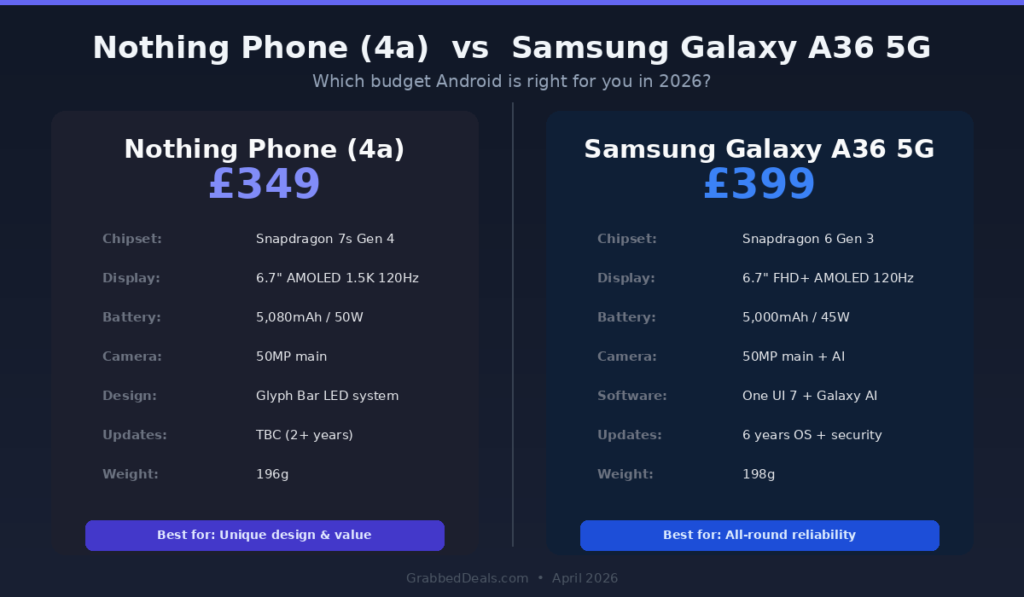
How they compare: quick spec overview
| Phone | Price | Chipset | Display | Battery | Charging | Updates |
|---|---|---|---|---|---|---|
| Samsung Galaxy A36 5G | £399 | Snapdragon 6 Gen 3 | 6.7″ AMOLED 120Hz | 5,000mAh | 45W | 6 years |
| Nothing Phone (4a) | £349 | Snapdragon 7s Gen 4 | 6.7″ AMOLED 1.5K 120Hz | 5,080mAh | 50W | TBC |
| Motorola Edge 60 Neo | ~£340 | Dimensity 7400 | 6.8″ AMOLED 120Hz | 5,000mAh | 68W + 15W wireless | 5 years |
| POCO X7 Pro | ~£330 | Dimensity 8400-Ultra | 6.67″ AMOLED 120Hz | 6,000mAh | 90W | 3 years |
| OnePlus Nord CE 4 | ~£280 | Snapdragon 7 Gen 3 | 6.7″ AMOLED 120Hz | 5,000mAh | 100W | 3 years |
| Google Pixel 9a | £499 | Tensor G4 | 6.3″ AMOLED 120Hz | 5,100mAh | 23W | 7 years |
Which one should you actually buy?
Here’s the honest breakdown by buyer type.
Buy the Samsung Galaxy A36 5G if you want the safest, most capable all-rounder under £400. It has the best software commitment in the budget, a flagship-quality display, 45W charging, and Samsung’s One UI 7. It’s the right answer for most people.
Buy the Nothing Phone (4a) if you want something genuinely different at a lower price. At £349, it’s £50 cheaper than the A36, runs cleaner software, and carries a design that stands out in any room. It’s the best value pick on this list.
Buy the Motorola Edge 60 Neo if fast charging is the priority. 68W wired and 15W wireless charging puts it ahead of everything else here, and the telephoto lens is a rare bonus at this price.
Buy the POCO X7 Pro if you game on your phone or need raw processing power. The Dimensity 8400-Ultra chipset is in a different performance class from the rest of this list.
Buy the OnePlus Nord CE 4 if your budget is closer to £270 to £280 and you want a smooth, no-nonsense daily driver with fast charging.
Stretch to the Google Pixel 9a if you want the best camera in this price bracket, the longest software support available anywhere under £500, and you don’t mind the slower charging. At £499 it’s the smartest long-term purchase on this list.
FAQs
What is the best Android phone under £400 in 2026? The Samsung Galaxy A36 5G is the best all-round Android phone under £400 in 2026. It offers a 6.7-inch 120Hz AMOLED display, 45W fast charging, 256GB of storage, and six years of Android and security updates. For buyers who want something different at a lower price, the Nothing Phone (4a) at £349 is an excellent alternative with clean software and a distinctive design.
Is it worth buying a budget Android phone in 2026? Yes. The mid-range Android market in 2026 delivers features that were exclusive to flagship phones just two years ago. AMOLED 120Hz displays, 5G connectivity, 5,000mAh batteries with fast charging, and solid multi-lens cameras are all standard under £400. For most people’s daily needs, these phones are indistinguishable from handsets costing twice as much in everyday use.
How many years of updates do budget Android phones get? It varies significantly. Samsung offers six years of OS updates and security patches on the Galaxy A36. Google offers seven years on the Pixel 9a. Motorola offers up to five years on some models, including the Edge 60 Neo. OnePlus and POCO typically offer three years of OS updates. If software longevity matters to you, Samsung and Google are the clear leaders in this price category.
What’s the difference between the Nothing Phone (4a) and the Samsung Galaxy A36? The Nothing Phone (4a) costs £50 less at £349 and runs a cleaner, more minimal version of Android with Nothing OS. It has a slightly more powerful Snapdragon 7s Gen 4 chipset and a distinctive Glyph Bar design on the back. The Samsung Galaxy A36 offers a larger display, 45W charging, the Galaxy AI feature set, and six confirmed years of updates, which is currently a longer commitment than Nothing has specified for the (4a). The A36 suits buyers who want ecosystem support; the (4a) suits those who want something original and lightweight.
Can you get a 5G phone under £400 in 2026? Yes. Every phone on this list supports 5G, which is now standard across the mid-range segment. Whether you choose the Samsung Galaxy A36, Nothing Phone (4a), Motorola Edge 60 Neo, POCO X7 Pro, or OnePlus Nord CE 4, you’re getting 5G connectivity as a baseline. There’s no need to pay extra for 5G in 2026.
Ready to buy? Check the current prices and deals for the Samsung Galaxy A36 5G on Amazon UK, the Nothing Phone (4a) at Currys, and the Motorola Edge 60 Neo on Amazon UK. Prices change regularly, so clicking through gives you the live rate.
Related posts
- Nothing Phone 3 Review: Is the Glyph Interface Actually Useful in 2026?
- Best Budget Laptops Under £500 in 2026: Our Top 6 Tested Picks
- Best Wireless Earbuds Under £100 in 2026: Sony vs Samsung vs Nothing
Author: The GrabbedDeals editorial team tests and reviews tech across every major category, from smartphones and laptops to AI tools and smart home devices. Our buying guides are built on the latest real-world data, independent expert reviews, and current UK pricing.
Explore our more pages – AI Tools & Productivity | Smartphone Ecosystems | Laptop & PCs | Audio & Sound Systems | Gaming | Photography & Videography | EV & Green Tech | Digital Marketing & SEO | Smart Home & Wearables | Tech Deals & Buying Guides |