Key Takeaways
- The smart home market reached £174 billion globally in 2025 and is growing fast, making 2026 the best time to start.
- Matter 1.3 has finally solved the compatibility problem. Most new devices from Amazon, Google, and Apple now work together.
- Start with three things: a smart speaker, a set of smart plugs, and a smart bulb starter pack.
- The TP-Link Tapo P110 is the best smart plug for most UK homes. It costs £12 to £18 and monitors your energy in real time.
- Alexa has the widest device compatibility. Google Home has the best voice AI. HomeKit has the best privacy. Matter bridges all three.
- A solid starter setup costs £100 to £300 and can save you £300 to £500 a year on energy bills once fully built out.
Who is this for? This guide is for anyone who has never bought a smart home device before, or who picked up one or two products and is not sure what to do next. If you want a clear, honest plan for where to start, what to buy first, and how to avoid the mistakes that make people give up after a week, you are in exactly the right place.
Why 2026 is the best year to start a smart home
Smart home technology used to be genuinely frustrating. You’d buy a smart plug that worked with Alexa but not Google. You’d set up your lights only to find they wouldn’t talk to your thermostat. The ecosystem fragmentation was real, and it put a lot of people off.
That problem is largely over now.
The Matter protocol, which launched in 2022 and reached version 1.3 in 2026, means devices from different brands finally share a common language. Whether you buy an Amazon device, a Google product, or something from a smaller brand like TP-Link or Eufy, it now talks to everything else on your network. You’re not locked in, and you don’t need to pick one brand and stick with it forever.
The global smart home market hit £174 billion in 2025 and is on track to exceed £231 billion by 2028. That growth is driving prices down and quality up. The devices that cost £80 three years ago now cost £30 and work better.
If you’ve been waiting for the right time to start, this is it.
Choosing your ecosystem: Alexa, Google Home, or HomeKit?
Before you buy anything, you need to pick your home’s control layer. This is the platform everything will connect to. You don’t have to stick with one brand forever, especially with Matter now bridging the gaps, but your main smart speaker will become the brain of your setup.
Here’s the honest breakdown.
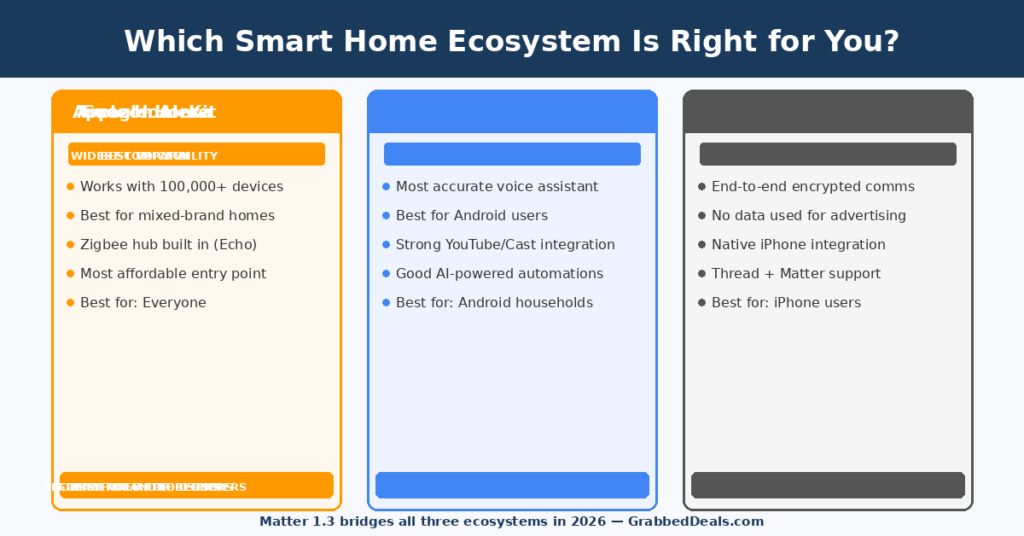
Amazon Alexa has the widest device compatibility of any platform. During independent testing, Alexa skills were found for almost every smart home device category, from budget smart plugs to high-end security systems. If you want to mix and match brands without hitting compatibility walls, Alexa is the safest starting point. It’s also the best option if you’re not committed to either Apple or Google in your daily life.
Google Home has the most accurate voice AI of the three. Google Assistant is better at understanding natural language, answering general knowledge questions, and handling follow-up commands. If you ask it more complex things and want the assistant to actually be useful beyond turning lights on and off, Google Home is the stronger choice.
Apple HomeKit has the best privacy and security. All communication is encrypted end to end, and Apple doesn’t use your home data for advertising. If privacy is your primary concern, and you’re already in the Apple ecosystem with an iPhone, HomeKit is the obvious fit. The Aqara brand in particular offers excellent HomeKit-native devices at fair prices.
Our recommendation: If you’re an iPhone user, start with HomeKit or go with an Alexa Echo and use Matter to bridge both. If you use Android, go with Google Home or Alexa. If you’re not sure, Alexa’s device compatibility makes it the lowest-risk starting point for a beginner.
The three devices every beginner should buy first
Forget the fancy stuff for now. These three categories give you the highest return per pound spent and teach you how smart home devices actually work before you go further.
1. A smart speaker This is your control hub. Everything talks to it. Get one before anything else.
2. A pack of smart plugs Smart plugs are the fastest, cheapest way to make any existing device smart. They require zero installation, cost £10 to £35, and start delivering value immediately by letting you schedule, control, and monitor your appliances remotely.
3. A smart bulb starter pack Smart bulbs let you control your lighting by voice or phone, set schedules, and create scenes. A two or three-bulb starter pack from Philips Hue or TP-Link Tapo costs £20 to £50 and instantly changes how you interact with your home.
Start with these three and get comfortable with how they work together before adding anything else. Most people who give up on smart home tech do so because they skipped the basics and bought something complex before they understood the fundamentals.
Best smart plugs for beginners
Smart plugs are the best first smart home purchase for most people. They’re cheap, they’re risk-free, and they turn any ordinary appliance into something you can control with your phone or voice.
TP-Link Tapo P110 — best for most people
The Tapo P110 is the best-value smart plug for UK homes in 2026. It costs £12 to £18 and includes genuine energy monitoring, which means you can see exactly how much electricity each appliance is using in real time. The Tapo app is clean and reliable, scheduling is straightforward, and it works with both Alexa and Google Home without any fiddling.
The energy monitoring alone makes it worth buying. Many users find their TV setup, games consoles, and kitchen appliances are drawing phantom power even when switched off. The Tapo P110 shows you exactly where that money is going and lets you cut it with a single scheduled automation.
Best for: Android users, Alexa homes, anyone who wants energy monitoring. UK price: £12 to £18 each. Works with: Alexa, Google Home.
Meross MSS310 — best for mixed-platform homes
If your household has a mix of iPhones and Android phones, or you want something that works with Alexa, Google Home, and Apple HomeKit without any compromise, the Meross MSS310 is the one to buy. It costs £18 to £25 and delivers solid energy monitoring alongside broad compatibility.
It’s particularly useful if you’re starting your setup and genuinely haven’t decided which ecosystem you’re committing to. The Meross gives you breathing room to decide later without replacing your plugs.
Best for: Mixed iPhone and Android households, undecided buyers. UK price: £18 to £25 each. Works with: Alexa, Google Home, Apple HomeKit.
Eve Energy — best for Apple HomeKit users
If you’re an iPhone household and privacy matters to you, the Eve Energy is the one to buy. It supports HomeKit natively, includes Thread connectivity for faster response times, and is Matter-certified, so it’ll work with any platform you switch to in future.
It’s more expensive at £30 to £40 each, but the HomeKit integration is genuinely better than any adapter-based workaround, and the build quality is noticeably higher than budget alternatives.
Best for: iPhone users, privacy-focused buyers. UK price: £30 to £40 each. Works with: Apple HomeKit, Matter.
A practical note: Smart plugs are binary devices. They are either fully on or fully off. If you want to dim a lamp, you need a smart bulb, not a smart plug. Plugging a dimmable floor lamp into a smart plug and trying to reduce brightness will damage the plug’s internal relay.
Best smart bulbs for beginners
Smart bulbs are the most visible upgrade you can make to a room. They let you change the colour temperature from warm white in the evening to cool white in the morning, set wake-up and sleep automations, and control your entire lighting from your phone without getting up.
Philips Hue White Ambiance Starter Kit — best overall
Philips Hue is the most trusted name in smart lighting. The White Ambiance range lets you adjust colour temperature from warm to cool white, which is more useful in daily life than full colour-changing bulbs. The Hue Bridge (included in starter kits) gives you faster response times, local control even if your internet goes down, and access to the full Hue ecosystem of accessories including motion sensors, dimmer switches, and gradient lightstrips.
Starter kits typically include two or three bulbs and a Bridge, priced at £60 to £90. That’s more than the competition, but the reliability and ecosystem depth justify it if you plan to expand your lighting setup over time.
Best for: Anyone planning to build out a serious smart lighting setup. UK price: £60 to £90 for a starter kit. Works with: Alexa, Google Home, Apple HomeKit, Matter.
TP-Link Tapo L530E — best budget option
If you want to try smart bulbs without the Hue price tag, the Tapo L530E delivers colour-changing capability, app control, and Alexa and Google Home compatibility for around £12 to £18 per bulb. The Tapo app is reliable and setup takes less than five minutes.
The main limitation is that Tapo bulbs work over Wi-Fi rather than Zigbee, so if your router is in a different part of the house from your lights, you may get occasional connectivity issues. For most homes, though, this is never a problem.
Best for: Budget-conscious beginners, first-time smart bulb buyers. UK price: £12 to £18 per bulb. Works with: Alexa, Google Home.
Best smart speakers for beginners
Your smart speaker is the hub everything connects to. It doesn’t have to be expensive, and you don’t need the top model.
Amazon Echo Dot (5th Generation) — best starter pick
The Echo Dot is the entry point to the Alexa ecosystem and it’s all most beginners need. At around £35 to £50, it gives you voice control over every compatible device in your home, access to Alexa skills, music streaming, and two-way intercom between Echo devices if you buy more than one.
The 5th generation model has improved audio quality over its predecessor and a built-in temperature sensor, which lets it trigger automations based on room temperature. For a beginner, it’s the lowest-cost way to get a smart speaker into the room where you’ll be controlling devices most.
Best for: Alexa beginners, anyone starting a mixed-brand setup. UK price: £35 to £50.
Google Nest Mini (2nd Generation) — best for Google users
If you use Android, Gmail, and Google Calendar in your daily life, the Google Nest Mini fits in more naturally than Alexa. Google Assistant is better at answering general questions and connecting to your existing Google account data. The sound isn’t exceptional, but for a control hub in a bedroom or kitchen, it does the job well.
Priced at around £30 to £50, the Nest Mini is a practical starting point for Google Home users who don’t want to overspend before they’re sure about smart home tech.
Best for: Android users, existing Google ecosystem households. UK price: £30 to £50.
Amazon Echo Show 8 — best if you want a screen
If you want more than voice control, the Echo Show 8 adds an 8-inch touchscreen that lets you see camera feeds, control devices visually, and watch video content. It’s a meaningful upgrade over a plain Echo Dot for kitchens and living rooms where you’d genuinely use the screen.
Priced at £100 to £130, it’s significantly more than the Dot but makes the smart home feel more tangible for people who respond better to visual feedback than audio responses.
Best for: Kitchens, families, anyone who wants a visual control panel. UK price: £100 to £130.
What to add next: video doorbells and smart thermostats
Once you have your speaker, plugs, and bulbs working, these two categories deliver the next tier of value.
Video doorbells
A video doorbell lets you see who’s at the door from your phone, anywhere in the world. For UK households dealing with regular parcel deliveries and doorstep security concerns, it’s one of the most genuinely useful smart home upgrades.
Ring Battery Doorbell Plus (£130 to £160) is the best overall pick for most homes. The 1536p camera captures head-to-toe footage including parcels at your feet, the Ring app is the most polished in the category, and it integrates seamlessly with Alexa. The main downside is the subscription fee for video recording: Ring Protect costs around £35 per year.
Eufy Security Video Doorbell Dual S330 (£200 to £230) is the best option if you want to avoid subscriptions entirely. It stores footage locally on a HomeBase hub, uses dual cameras to see both the visitor and any parcels at the step, and does face recognition on-device without sending your data to the cloud. The higher upfront cost pays for itself within 18 months compared to a Ring subscription.
If you’re in the Apple ecosystem, the Aqara Smart Video Doorbell G4 is the only major doorbell with native HomeKit Secure Video support, meaning 10 days of recording comes included with any 200GB+ iCloud plan at no extra cost.
Smart thermostats
A smart thermostat attacks your heating bill directly. Heating accounts for roughly 55% of the average UK energy bill, and a smart thermostat cuts that by learning your schedule, detecting when the house is empty, and turning the heating down automatically when nobody is home.
Savings of £100 to £220 per year are commonly reported, which puts the payback period for most smart thermostats at 12 to 18 months. After that, the savings are pure profit.
The leading options in the UK are Hive Active Heating, Nest Learning Thermostat, and Tado (which adds room-by-room control through smart radiator valves). For most UK homes, Hive is the simplest to install and the most widely compatible with existing boilers.
The biggest beginner mistakes and how to avoid them
Buying everything at once. The most common smart home mistake is picking up eight different products from three different brands in one go and then trying to make them all work together on a Saturday afternoon. Start with three devices, get them working, and understand them before expanding.
Ignoring ecosystem compatibility. Not every device works with every platform. Always check the product packaging or spec page for “Works with Alexa”, “Works with Google Home”, or “Works with Apple Home” before buying. Better still, prioritise Matter-certified products, which work across all three.
Buying a cheap Wi-Fi extender instead of fixing your router. Smart home devices are only as reliable as your Wi-Fi. If you’re getting connectivity drops, a mesh router system like the TP-Link Deco or Eero is a better investment than any smart device you could buy.
Overcomplicating automations too early. Simple automations work. “Turn the hallway light on at sunset and off at 11pm” is useful and reliable. A ten-device automation chain that triggers in sequence is not a beginner project. Build simple, reliable routines first.
Buying from brands with no update support. Security updates matter. A smart device that never gets a firmware update is a security risk on your home network. Stick to major brands like Amazon, Google, TP-Link, Philips, and Eufy until you know the smart home market better.
How much does a starter smart home cost?
You don’t need to spend much to get started. Here’s what a realistic phased budget looks like for a UK home.
Starter setup (£80 to £120) One Echo Dot (£35 to £50) plus four TP-Link Tapo P110 smart plugs (£12 to £18 each). This gives you voice control over your main appliances and energy monitoring across your most-used devices. Setup time: under an hour.
Mid-tier setup (£150 to £280) Everything above plus a Philips Hue White Ambiance starter kit (£60 to £90) and a Ring Battery Doorbell Plus (£130 to £160). You now have voice-controlled lighting, a video doorbell, and energy monitoring. Your home starts to feel genuinely automated.
Full setup (£350 to £500) Everything above plus a smart thermostat (£80 to £200 depending on model) and additional smart plugs and bulbs as needed. At this level, you have full home automation across lighting, heating, security, and appliance control.
A reasonable combined saving from a full setup, based on smart thermostat plus smart plugs eliminating phantom load plus smart lighting reductions, is £300 to £500 per year for a typical UK home. That makes the investment pay for itself within 12 to 24 months.
FAQ
Do smart home devices work without the internet? Most smart home devices need a Wi-Fi connection to work at full capability, especially for remote access and voice control. However, Matter-certified devices support local network communication, which means basic functions like turning a light on or off can still work on your home network even if your internet connection drops. For full remote access, cloud connectivity is required.
Is Alexa or Google Home better for beginners? For most beginners, Alexa is the safer starting point because it works with more devices than any other platform. If you encounter a budget smart plug or a niche security device, the chance it supports Alexa is higher than for Google Home. That said, if you use Android and Google services daily, Google Home will feel more natural and the voice assistant is more accurate for general questions.
Can you mix Alexa and Google Home devices? Yes, especially since the Matter standard became widespread in 2026. If both devices are Matter-certified, they can work together on the same network. You can control a Google-ecosystem bulb with an Alexa speaker if both support Matter. That said, it’s simpler to pick one primary platform for your main speaker and keep additional devices compatible with it.
Are smart home devices a security risk? The security risk from smart home devices is real but manageable. The biggest risks come from cheap, no-name brands that don’t receive firmware updates and use unencrypted communication. Stick to Matter-certified products from established brands, enable two-factor authentication on your hub account, and keep your router firmware updated. Apple HomeKit offers the strongest privacy defaults of the three major platforms.
What is Matter and do I need to care about it? Matter is the smart home interoperability standard backed by Amazon, Apple, Google, and Samsung. In plain terms, it means a product with the Matter logo on the box will work with all four ecosystems without any workarounds or adapters. You don’t need to understand the technical details, but you should actively look for Matter certification on anything you buy in 2026. It’s the clearest signal that a product is future-proof and won’t become incompatible as your setup grows.
The bottom line
Starting a smart home in 2026 is genuinely straightforward if you begin with the right three things: a smart speaker, a set of smart plugs, and a smart bulb starter pack. That combination teaches you how the ecosystem works, delivers immediate practical value, and costs between £80 and £150 depending on the brands you choose.
From there, a video doorbell and a smart thermostat give you the next tier of benefit, both in convenience and in measurable savings on your energy bills.
Prioritise Matter-certified products, pick one primary ecosystem for your speaker, and resist the urge to buy everything at once. Smart home tech rewards patience. Add one category at a time, get each one working reliably, and your setup will be significantly more functional than one built in an afternoon of impulse buying.
Your home is ready. Start with the plugs.
Shop the devices mentioned in this guide:
- TP-Link Tapo P110 Smart Plug with Energy Monitoring on Amazon UK
- Philips Hue White Ambiance Starter Kit on Amazon UK
- Amazon Echo Dot 5th Generation on Amazon UK
- Ring Battery Doorbell Plus on Amazon UK
Related Posts
- Best Smart Home Devices to Cut Your Energy Bills in 2026
- Alexa vs Google Home in 2026: Which Smart Speaker Should You Buy?
- Best Video Doorbells in 2026: Ring, Eufy, Aqara and Nest Compared
Explore our more pages – AI Tools & Productivity | Smartphone Ecosystems | Laptop & PCs | Audio & Sound Systems | Gaming | Photography & Videography | EV & Green Tech | Digital Marketing & SEO | Smart Home & Wearables | Tech Deals & Buying Guides |
Author bio: The GrabbedDeals editorial team tests AI tools, tech products, and software so you don’t have to. Every review and comparison on this site is written after hands-on testing with real tasks.


1 comment