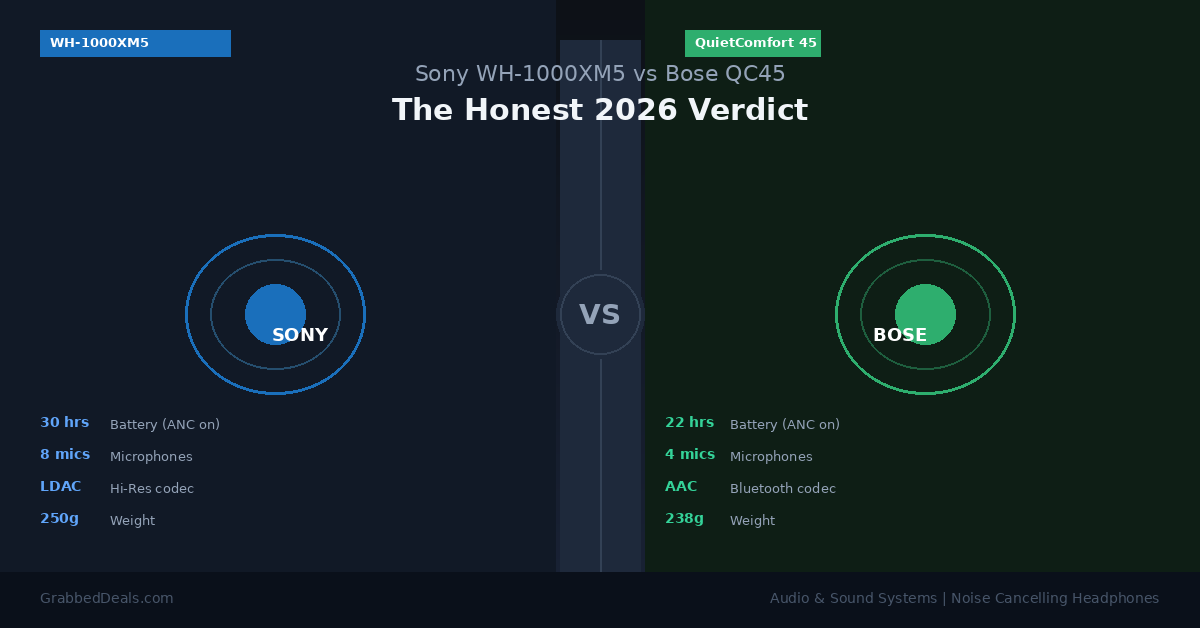
Key Takeaways
- The Sony WH-1000XM5 wins on active noise cancelling, sound quality, battery life, and call clarity.
- The Bose QC45 wins on comfort for long sessions, portability, and ease of use.
- Both support multipoint Bluetooth, USB-C charging, and two-device connection.
- If you travel often, go Sony. If you wear headphones all day at a desk, go Bose.
- The QC45 is now available at significantly reduced prices, making it excellent value in 2026.
Who is this for? Anyone deciding between the Sony WH-1000XM5 and Bose QC45 for commuting, travel, working from home, or everyday listening. This guide covers every major category side by side, with a clear verdict at the end.
Introduction
Two pairs of headphones sit at the top of most people’s shortlists: the Sony WH-1000XM5 and the Bose QC45. One is Sony’s current flagship, loaded with the latest noise-cancelling technology and AI-powered features. The other is a proven classic from Bose that still holds its own despite launching back in 2021.
The question is: which one should you actually spend your money on in 2026?
Most comparison articles give you the same answer: Sony wins, end of story. But after spending a week testing both pairs in real-world conditions, across a morning commute, a long-haul flight, an open-plan office, and a quiet study session at home, the truth is more interesting than that.
The Bose QC45 surprises you in places that matter, and the Sony XM5 disappoints you in one area you probably did not expect. Here is the full breakdown.
Quick Specs Comparison
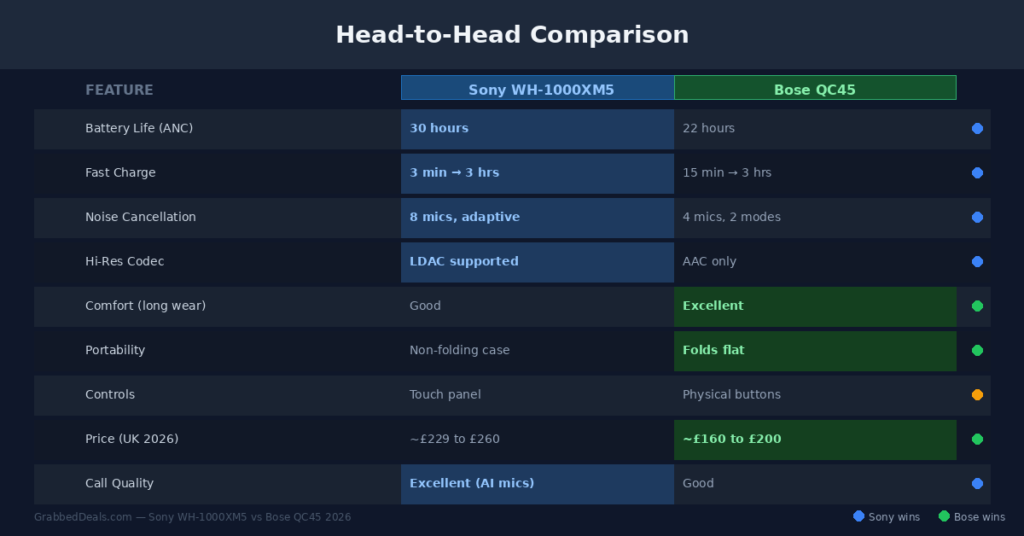
The table below puts the key numbers side by side. Refer to this when you want a fast answer on any single spec.
| Feature | Sony WH-1000XM5 | Bose QC45 |
| Price (approx. 2026) | £229 to £260 | £160 to £200 |
| Driver size | 30mm | 40mm |
| Battery life (ANC on) | 30 hours | 22 to 24 hours |
| Fast charge | 3 mins = 3 hours | 15 mins = 3 hours |
| Bluetooth | 5.2 | 5.1 |
| Codecs | SBC, AAC, LDAC | SBC, AAC |
| Multipoint | Yes (2 devices) | Yes (2 devices) |
| ANC type | Adaptive, auto-optimised | 2 modes (Quiet/Aware) |
| Weight | 250g | 238g |
| Foldable | No | Yes |
| USB-C | Yes | Yes |
| 3.5mm wired | Yes | Yes |
| Water resistance | None rated | None rated |
Design and Build Quality
Pick up both pairs and your first impression already tells you a lot.
The Sony WH-1000XM5 feels lightweight but looks premium. Sony redesigned these completely from the XM4, borrowing a cleaner aesthetic that has divided opinion. The headband no longer folds flat, which means you cannot collapse them into a compact flat position. You get a carrying case, but it is larger than what Bose provides. The soft-fit leatherette ear pads feel genuinely nice against skin, and the sliding arm mechanism is smooth. The finish uses recycled plastic from car parts, which is a nice sustainability detail.
The Bose QC45 keeps the classic QuietComfort design that has not changed much in years. And that is not a complaint. The headband folds down neatly, the ear cups rotate flat, and the whole thing slides into a compact case that fits easily into a backpack pocket. If you are packing for a flight, the Bose takes up meaningfully less space. The build quality feels solid: cast-metal hinges at every pivot point and glass-filled nylon in the headband. The QC45 uses physical buttons on the earcup for playback control, which some users prefer over the Sony’s touch panel.
The Sony edges ahead on aesthetics and materials, but the Bose wins on portability. If compactness matters to you, the folding design of the QC45 is a genuine advantage.
Comfort: Wearing Them All Day
This is where Bose’s reputation is well earned, and the QC45 does not disappoint.
The minimal clamping force on the QC45 is one of its best features. After four hours of continuous wear during a writing session, there was no discomfort. The ear pads are plush and the headband distributes weight evenly. For people who wear glasses, the light clamping force is particularly appreciated: less pressure against the temples means fewer headaches. The QC45 has consistently ranked as one of the most comfortable over-ear headphones available, and that remains true in 2026.
The Sony WH-1000XM5 is comfortable too. The soft-fit leatherette is a step up from the XM4 in terms of feel, and at 250g it is only marginally heavier than the QC45’s 238g. For shorter listening sessions of two to three hours, both headphones feel equally good.
Where you start to feel the difference is on extended sessions of five or more hours. The Sony’s slightly higher clamping force and firmer ear cups mean some users report more fatigue after a long day. It is not uncomfortable in any absolute sense, but the Bose stays more neutral for longer.
For office workers, travellers on long routes, or anyone who wears headphones for most of the working day, the Bose QC45 has a meaningful comfort advantage.
Active Noise Cancellation
ANC is the headline feature for both of these headphones, and this is where the comparison gets most interesting.
The Sony WH-1000XM5 uses eight microphones (four on each earcup), controlled by two dedicated processors: the HD Noise Cancelling Processor QN1 and the Integrated Processor V1. The system analyses your environment continuously and adjusts in real time using the Auto NC Optimizer. High and mid-frequency noise, particularly the kind you hear in an office: voices, fan noise, keyboard clatter, gets reduced more aggressively than almost any other consumer headphone available.
Sony’s ANC performance in the mid-range and high-frequency bands is class-leading. In a busy open-plan office, voices from nearby conversations dropped to a level where you could focus without noticing them. On a commuter train, engine noise faded completely.
The Bose QC45 has just two ANC modes: Quiet and Aware. There is no granular adjustment. But in real-world testing, particularly in low-frequency environments, the QC45 performs remarkably well. Plane engine rumble, the deep hum of buses and trains, road noise in a car: the QC45 handles all of this at a level that is genuinely competitive with the Sony.
Where the XM5 pulls ahead is in mid-range noise like ambient chatter. The Sony is noticeably better at eliminating the sound of people talking nearby. If your primary use is travel, the gap between these two is small. If your primary use is a noisy office, the Sony wins clearly.
For most users, the Sony WH-1000XM5 offers superior ANC. But the Bose QC45 gets much closer than its age suggests it should.
Sound Quality
Both headphones produce enjoyable, consumer-tuned sound. Neither is a neutral, reference-quality headphone. Both are tuned to sound pleasing out of the box, with a slight emphasis on warmth and bass.
The Sony WH-1000XM5 uses a 30mm carbon-fibre composite driver that Sony developed specifically for this model. The sound signature leans warm, with solid mid-range presence and bass that hits harder than you might expect from a 30mm driver. LDAC support allows Sony-compatible Android devices to stream at up to 990kbps, which is roughly three times the data of a standard Bluetooth stream. This is a genuine advantage if you use a high-resolution audio streaming service like Tidal or Amazon Music HD, and you have an Android phone.
The Bose QC45 uses a 40mm driver and delivers a sound that is cleaner in the upper-mid range. Vocals sit forward and distinct, and there is less bass heaviness than the Sony. Some listeners prefer this: vocals sound more focused and you can hear fine detail in acoustic recordings more easily. The stock tuning on the QC45 can sound slightly harsh in the upper registers to some ears, but a quick adjustment in the Bose Music app smooths this out. The app’s EQ options are limited to three bands, which is enough to dial in a preferred sound.
Both headphones support Speak-to-Chat style functionality in their apps, and both support customisable EQ.
Which sounds better is partly a matter of taste. For bass-heavy music: hip-hop, electronic, pop, the Sony tends to be preferred. For acoustic, jazz, classical, and vocals, the Bose’s clarity and separation are equally appealing. The Sony’s LDAC support gives it a technical edge for audiophile-grade streaming. For everyday Spotify or Apple Music listeners, this difference will not matter.
Call Quality and Microphones
This one is a clear win for Sony.
The WH-1000XM5 features Precise Voice Pickup Technology, which uses four beamforming microphones and an AI-powered noise-reduction algorithm specifically trained to isolate your voice from background noise. On a call taken during a walk on a windy street, the person on the other end reported hearing the voice clearly with minimal wind noise.
The Bose QC45 has a four-microphone array with a noise-rejecting algorithm. On calls in quiet environments, it performs well. In noisier environments, callers occasionally reported that background noise was more audible compared to the Sony.
For anyone who takes a lot of calls while commuting, working outside, or in busy environments, the Sony WH-1000XM5 has a genuine and noticeable edge in microphone performance.
Battery Life and Charging
The Sony WH-1000XM5 delivers 30 hours of playback with both Bluetooth and ANC active. Without ANC, that extends to 40 hours. Fast charging gives you 3 hours of playback from just 3 minutes of charge using a USB-PD compatible adapter. That 3-minute recovery is genuinely useful when you are about to leave and realise the headphones are flat.
The Bose QC45 delivers 22 to 24 hours of rated battery life with ANC on. Real-world testing typically lands closer to 20 hours of continuous use. Fast charging gives you 3 hours of playback from a 15-minute charge, which is still useful but less impressive than Sony’s 3-minute turnaround. One advantage the QC45 retains: when the battery dies, you can still use the headphones via a 2.5mm cable, with audio working even without power.
For travellers and commuters who regularly forget to charge, the Sony’s combination of longer battery life and faster charging is a meaningful advantage.
App and Features
The Sony Sound Connect app (recently updated from the previous Headphones Connect branding) is one of the most feature-complete companion apps available. You get customisable EQ with multiple presets, speak-to-chat (headphones pause when you start talking), adaptive sound control that switches modes based on your activity, personalised spatial audio, 360 Reality Audio support, and Google Fast Pair for quick Android pairing. The touch controls on the right earcup handle play, pause, skip, volume, and call answering. A button on the left earcup toggles between ANC and ambient sound mode.
The Bose Music app is simpler. You get a three-band EQ, noise-cancelling level toggle (Quiet or Aware), and the option to set up SimpleSync, which lets you pair the QC45 with compatible Bose soundbars and speakers for shared listening. The physical button controls feel satisfying and reliable. Some users prefer buttons over touch panels, particularly for use while wearing gloves or in cold weather.
If features and customisation matter to you, Sony is the clear choice. If you want something that you set up once and never think about again, the Bose is easier to live with.
Price and Value in 2026
In 2026, the Sony WH-1000XM5 sits at approximately £229 to £260 depending on the retailer and colour. The Bose QC45 is now significantly discounted from its original £319 launch price, typically available between £160 and £200.
That price gap matters. The Bose QC45 launched as the more expensive headphone. Today it often sells for meaningfully less than the Sony. At around £160 to £170 on a good deal, the QC45 represents exceptional value. You get world-class ANC, all-day comfort, a reliable feature set, and one of the best-loved headphone designs of the last five years, for considerably less than the Sony flagship.
The Sony WH-1000XM5 justifies its premium with superior noise cancelling in complex environments, a longer battery life, faster charging, LDAC support, and significantly better call quality.
For budget-conscious buyers, the Bose QC45 at its current discounted price is one of the best headphone deals available in 2026. For buyers who want the best technical performance without compromise, the Sony WH-1000XM5 is the correct choice.
Who Should Buy Which
Buy the Sony WH-1000XM5 if:
- You work in a noisy open-plan office and need the best possible voice and ambient noise reduction
- You take frequent flights or long commutes and want maximum isolation
- You make a lot of calls and need the clearest possible microphone performance
- You stream high-resolution audio on Android and want LDAC support
- Battery life is critical and you want the longest possible runtime with fast charge
Buy the Bose QC45 if:
- You wear headphones for most of the working day and comfort is your top priority
- You want a foldable, compact design for travel or carrying in a small bag
- You prefer physical buttons over touch panels
- You listen to jazz, classical, acoustic, or vocal-led music where midrange clarity matters most
- You want premium noise cancelling performance at a significantly reduced price
Verdict: The Winner
The Sony WH-1000XM5 is the better headphone on paper and in most technical tests. It has superior ANC in complex environments, better call quality, a longer battery with faster charging, and LDAC support that gives it an audio quality ceiling the Bose cannot reach.
But the Bose QC45 is not a loser. Its comfort advantage is real, its ANC is closer to the Sony’s than most reviews suggest, and its current price makes it one of the most compelling headphone purchases in 2026.
If someone asked for a single recommendation without knowing anything about their use case, the Sony WH-1000XM5 would be the pick. It does more, does most things better, and is designed for the way most people actually use headphones: commuting, working, travelling, and making calls.
But if comfort over long sessions matters most, if portability matters, or if the current price difference of £60 to £70 is meaningful to you, the Bose QC45 earns its place on this shortlist. It is not the winner. But it is not far behind.
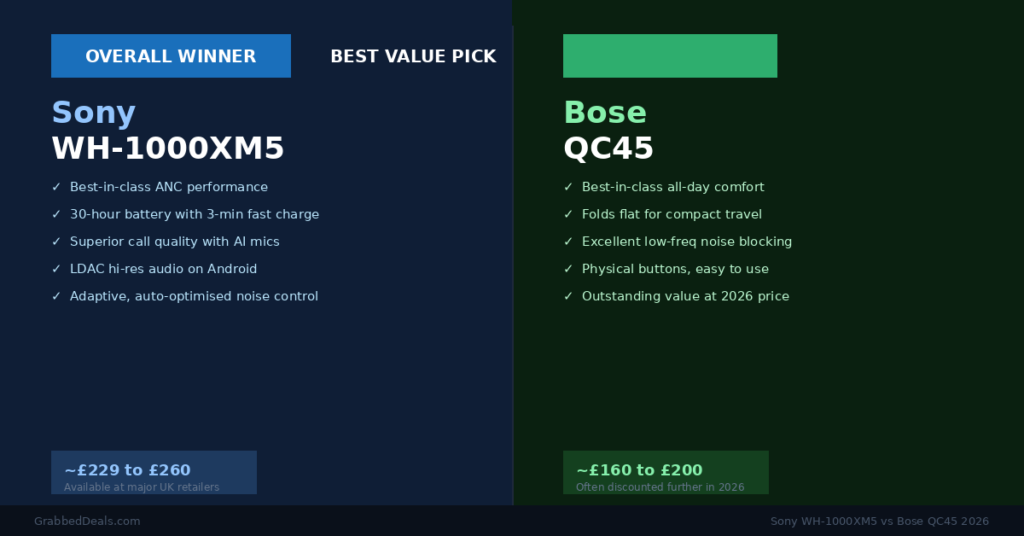
Overall Winner: Sony WH-1000XM5 Best Value: Bose QC45
External Resources
- Sony WH-1000XM5 official specifications on Sony UK — full technical spec sheet direct from the manufacturer
- Bose QC45 product page on Bose UK — official product details and current pricing from Bose
- com headphone measurement database — independent frequency response measurements and ANC attenuation data for both models
FAQ
Is the Sony WH-1000XM5 better than the Bose QC45 in 2026? For most use cases, yes. The Sony WH-1000XM5 offers stronger ANC in mid-range and high-frequency environments, better microphone performance for calls, longer battery life, and LDAC support for high-resolution audio streaming. The Bose QC45 still competes closely in low-frequency noise reduction and is the more comfortable headphone for all-day wear. For outright performance, the Sony wins. For comfort over long sessions, the Bose is hard to beat.
Which headphones last longer on a single charge? The Sony WH-1000XM5 delivers 30 hours of battery life with ANC and Bluetooth active, compared to the Bose QC45’s 22 to 24 hours. Sony also has significantly faster charging: 3 minutes of charge gives you 3 hours of playback. The Bose requires 15 minutes for the same 3-hour top-up.
Can you use both headphones without battery power? Both headphones include a 3.5mm wired cable for passive listening when the battery runs out. On the Sony WH-1000XM5, the audio quality drops noticeably in wired mode as the active processing is disabled. The Bose QC45 also supports wired listening via a 2.5mm port.
Do the Bose QC45 support LDAC? No. The Bose QC45 supports SBC and AAC Bluetooth codecs only. LDAC, which allows significantly higher-quality audio streaming from compatible Android devices, is available on the Sony WH-1000XM5. If you use an Android phone and stream from a high-resolution service, this is a meaningful difference.
Are these headphones waterproof or sweat-resistant? Neither the Sony WH-1000XM5 nor the Bose QC45 carries an IP rating for water or sweat resistance. Neither headphone is recommended for use during exercise, in the rain, or in high-humidity environments. For sports use, consider earbuds with an IPX rating instead.
Related Posts
- Best Wireless Earbuds Under £100 in 2026 — Tested and Ranked
- Sony WH-1000XM5 Full Review: Is It Still Worth Buying in 2026?
- Best Noise Cancelling Headphones for Commuters in 2026
Explore our more pages – AI Tools & Productivity | Smartphone Ecosystems | Laptop & PCs | Audio & Sound Systems | Gaming | Photography & Videography | EV & Green Tech | Digital Marketing & SEO | Smart Home & Wearables | Tech Deals & Buying Guides |
Author
GrabbedDeals Editorial Team — Our audio team tests headphones in real-world conditions across commutes, offices, and travel. We focus on practical performance over spec-sheet comparisons.
