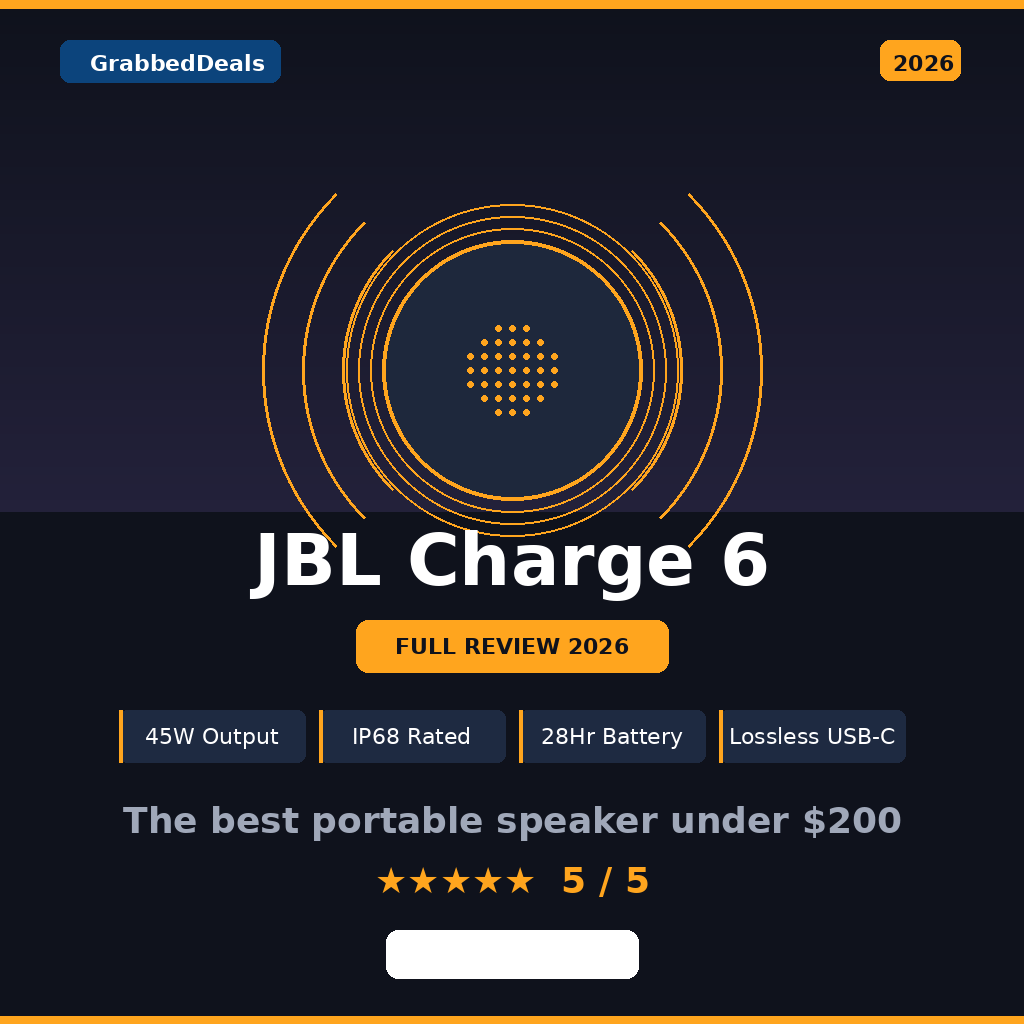
The JBL Charge 6 review 2026 verdict is straightforward: this is the best portable Bluetooth speaker under $200 right now, and the competition knows it. Released in early 2025, the Charge 6 upgrades its predecessor with a 45W output, IP68 waterproofing, AI Sound Boost, lossless audio over USB-C, and up to 28 hours of battery life. Summer is the season it was built for. Whether you’re heading to the beach, a campsite, or just the back garden, this is the speaker most people should buy. That said, the Bose SoundLink Flex and UE Boom 4 are both credible alternatives, and this review covers exactly where the Charge 6 wins, where it doesn’t, and who should consider those rivals instead.
Key takeaways
- The JBL Charge 6 delivers 45W of power with deep bass, improved vocal clarity, and a 7-band customisable EQ via the JBL Portable app.
- Battery reaches 24 hours in standard use, extendable to 28 hours via Playtime Boost (with a trade-off on bass).
- IP68 rated: waterproof to 1.5m for 30 minutes and drop-proof from 1 metre onto concrete.
- Lossless audio up to 24-bit/96kHz is available via USB-C, a genuine advantage in this price range.
- Priced at $199/£149, it outperforms the Bose SoundLink Flex on volume and battery, and the UE Boom 4 on bass depth.
What is the JBL Charge 6 and who is it for?
The Charge 6 is JBL’s mid-sized outdoor speaker, sitting between the compact Flip 7 and the party-ready Boombox 4. It measures 9.0 x 3.9 x 3.7 inches and weighs 2.17 pounds: portable, but not pocketable. The new removable carry strap makes one-handed transport comfortable, which was a missing feature on the Charge 5.
Its buyer is someone who wants a durable, loud outdoor speaker for day trips, pool sessions, or group settings. A built-in powerbank lets you charge a phone via USB-C while music plays. Nine colour options including Squad (camo), Sand, and Blue give enough variety for most tastes.
Sound quality
Sound is where the Charge 6 earns its price. The 45W output is an increase over the Charge 5’s 40W, and you can hear the difference at the same volume: the bass hits harder, and the overall sound fills more space. The passive radiators on each end contribute real low-frequency extension. This speaker physically moves air in a way that similarly priced rivals don’t.
AI Sound Boost is JBL’s real-time audio processing feature, adjusting output to reduce distortion at high volumes. In practice, the speaker stays cleaner when pushed loud, which is when cheaper options tend to fall apart. Mid-range clarity is also improved over the Charge 5: vocals sit more distinctly in the mix and instruments separate more clearly.
The 7-band EQ in the JBL Portable app gives you full control to shape sound. Four presets (JBL Signature, Chill, Energetic, Vocal) plus a Custom setting are available. This is a significant upgrade from the 3-band EQ on the Charge 5.
One genuine limitation: the Charge 6 loses energy at low volume. In a quiet room at low levels, the sound becomes flat and uninvolving. This is a speaker built for medium to high volume in open spaces, and it performs best there.
Battery life and charging
JBL rates the Charge 6 at 24 hours of playback, extendable to 28 hours with Playtime Boost. Independent testing at 80dB from one metre returned 13 hours and 15 minutes, which is below the claimed figure. At 30 to 40% volume, 24 hours is consistently achievable.
The practical result is that the Charge 6 lasts a full day of outdoor use at moderate volume without needing a recharge. Playtime Boost extends runtime by reducing bass, which works for background listening but is not a recommended default setting if sound quality matters.
Quick charge is genuinely useful: 10 minutes on the charger returns 150 minutes of playback. A full charge takes around three hours from flat. There is no USB-C cable included in the box, which is a frustration given the price.
Build quality and durability
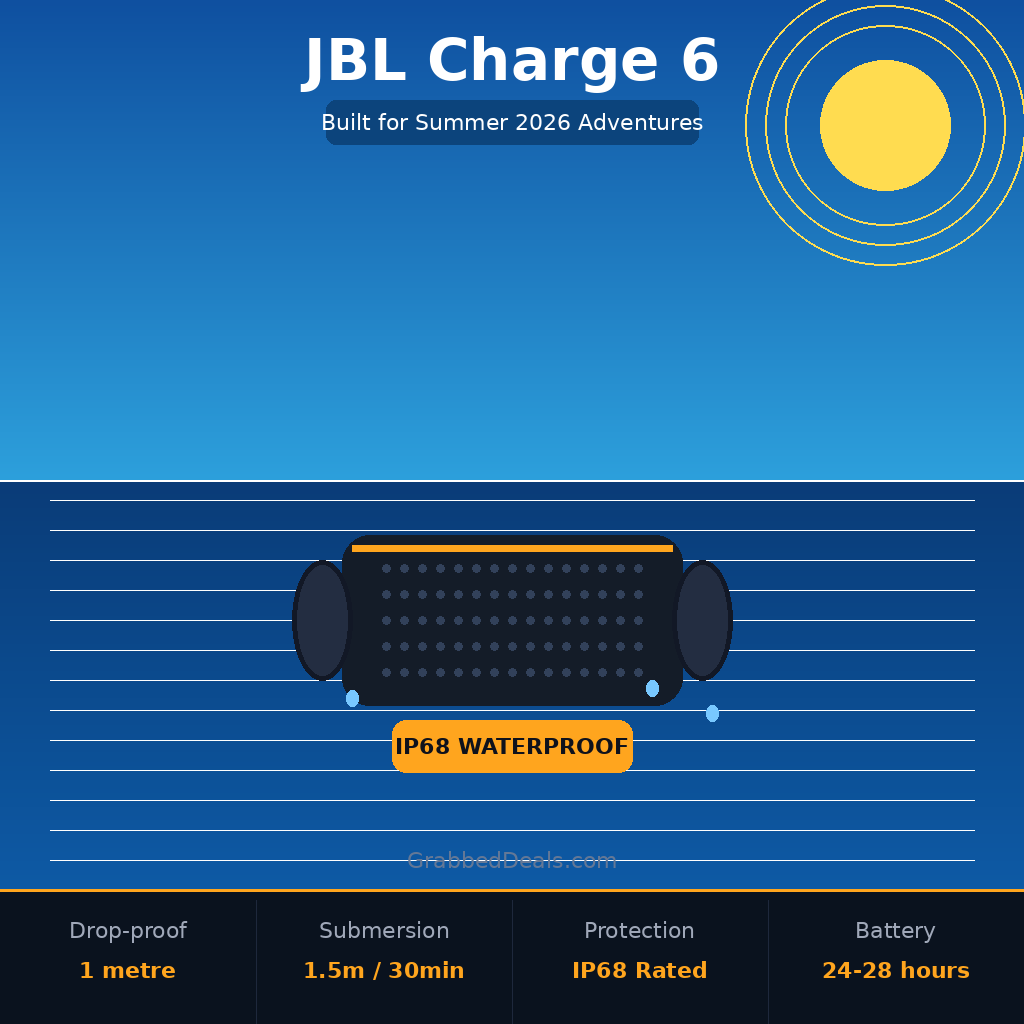
The Charge 6 is IP68 rated, meaning it handles submersion in up to 1.5 metres of freshwater for 30 minutes and survives a 1-metre drop onto concrete. The fabric grille, recycled plastic housing, and wider flat base all feel solid and well-considered. JBL has also used post-consumer recycled materials in the construction, which is worth noting for buyers who factor sustainability into purchases.
Physical controls cover volume, play/pause, power, Bluetooth pairing, and Auracast pairing. All buttons are positive in action and easy to locate by feel. The move from USB-A to a single USB-C port handles both charging and lossless audio input, which simplifies the port situation even if it removes the USB-A passthrough some users relied on from the Charge 5.
Connectivity and the JBL Portable app
The Charge 6 connects via Bluetooth 5.4 (up from 5.1 on the Charge 5), offering a more stable connection over longer distances. Over Bluetooth, audio uses SBC. Lossless audio up to 24-bit/96kHz becomes available when connected to a compatible source via USB-C, a feature that genuinely differentiates this speaker in its price range.
Multi-speaker pairing uses Auracast, replacing JBL’s older PartyBoost system. Up to 100 Auracast-enabled JBL speakers (including the Flip 7, Clip 5, and Xtreme 4) can be connected simultaneously. The critical caveat: the Charge 6 is not backwards compatible with Charge 5 or other PartyBoost models. Two Bluetooth devices can be paired at once, making phone-to-laptop switching easy.
The JBL Portable app manages EQ, speaker grouping, Playtime Boost, battery status, and firmware updates. It is clean and reliable. Downloading it is worth doing immediately after setup because it unlocks the 7-band EQ, which materially improves the listening experience over the default preset.
JBL Charge 6 vs Bose SoundLink Flex vs UE Boom 4
The Charge 6’s two main rivals in 2026 are the Bose SoundLink Flex (2nd Gen) and the UE Boom 4. Here is the honest comparison.
Volume and bass: The Charge 6 wins clearly. At 45W versus the Bose SoundLink Flex’s 20W, the JBL gets louder and delivers deeper bass. The UE Boom 4 is competitive on volume but does not match the low-end weight of the Charge 6.
Portability: The Bose SoundLink Flex is smaller and lighter. If you want a speaker that slips easily into a bag, the Flex has the advantage.
360-degree sound: The UE Boom 4 projects sound in all directions, which suits settings where listeners are positioned around the speaker. The Charge 6 is front-facing, which works well for directed listening but less so for centred group settings.
Battery: The Charge 6 leads with 24 to 28 hours. The UE Boom 4 offers around 24 hours. The Bose SoundLink Flex delivers around 12 hours, which is the weakest point of that otherwise strong speaker.
Price: The Charge 6 is $199/£149. The Bose SoundLink Flex is around $149 and the UE Boom 4 sits at around $169. For the extra outlay, the Charge 6 offers more power and longer battery life.
The JBL official product page has full specifications. For objective testing data, RTINGS.com’s JBL Charge 6 review is thorough. If you want a side-by-side breakdown, the SoundGuys Charge 6 vs Bose SoundLink Flex comparison covers the key differences in detail.
Our verdict on the JBL Charge 6
The JBL Charge 6 is the right buy for most people looking for a portable outdoor speaker in 2026. It is the loudest, longest-lasting option in its price bracket, with a durable IP68 build and lossless audio capability that rivals at this price point don’t offer. Real-world battery falls short of the 24-hour claim at louder volumes, and the speaker loses some of its character at low levels. These are manageable trade-offs. If your priority is volume, bass, durability, and all-day battery for outdoor use, the Charge 6 delivers all four. If you want something more compact and affordable, the Bose SoundLink Flex at $149 is a strong alternative. If 360-degree sound projection matters more than bass depth, the UE Boom 4 is the smarter call. For everyone else: buy the Charge 6.
Frequently asked questions
Is the JBL Charge 6 worth buying in 2026?
Yes, the JBL Charge 6 is worth buying in 2026 for most people who want a portable outdoor speaker. At $199/£149 it delivers 45W output, IP68 durability, up to 28 hours of battery, and lossless audio via USB-C. The main reasons to consider alternatives are if you need a more compact speaker (Bose SoundLink Flex) or 360-degree sound projection (UE Boom 4).
How does the JBL Charge 6 compare to the Charge 5?
The Charge 6 improves on the Charge 5 across every key specification. Output increased from 40W to 45W, battery rose from 20 to 24 hours, IP rating stepped from IP67 to IP68, and the EQ expanded from 3-band to 7-band. Lossless audio via USB-C and a detachable carry strap are new additions. The trade-off is that Auracast replaces PartyBoost, making older JBL speakers incompatible.
What is JBL Playtime Boost?
Playtime Boost is a battery-saving mode that extends the Charge 6’s playback from 24 to 28 hours by reducing bass output. It keeps the music going when you’re away from a charger, but noticeably thins the sound. Use it as an emergency setting rather than a default.
Does the JBL Charge 6 support lossless audio?
Yes. The Charge 6 supports lossless audio up to 24-bit/96kHz when connected via USB-C to a compatible source. Over Bluetooth, it uses SBC. Lossless audio over USB-C may require enabling via an app update through the JBL Portable app.
Is the JBL Charge 6 safe to use at the pool?
Yes. The IP68 rating certifies the Charge 6 for submersion in up to 1.5 metres of freshwater for 30 minutes, and drop-proof from 1 metre. It handles pool use comfortably. Prolonged exposure to saltwater or chlorinated water is worth avoiding where possible, as IP ratings are tested in freshwater conditions.
Author: The GrabbedDeals editorial team tests and reviews tech across every major category, from smartphones and laptops to AI tools and smart home devices. Our buying guides are built on the latest real-world data, independent expert reviews, and current pricing.
Explore our more pages – AI Tools & Productivity | Education & Learning | Travel | Smartphone Ecosystems | Laptop & PCs | Audio & Sound Systems | Gaming & Photography | EV & Green Tech | Digital Marketing & SEO | Smart Tech Deal & Buying Guides