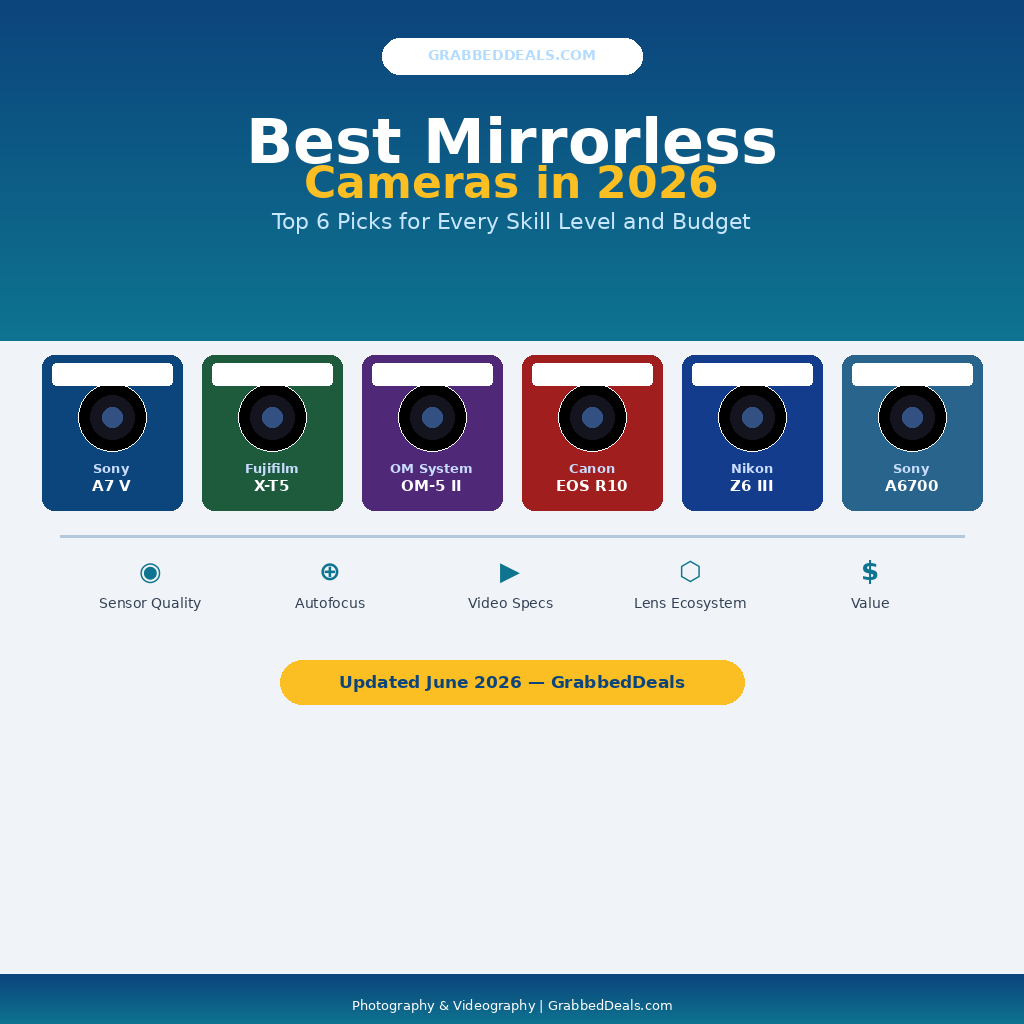
The mirrorless camera has fully replaced the DSLR. Sony, Canon, Nikon, Fujifilm, and OM System have all shifted flagship development to mirrorless systems, and the 2026 lineup is the strongest it has ever been. Whether you are picking up your first interchangeable-lens camera or upgrading to a full-frame workhorse, the best mirrorless cameras in 2026 give you faster autofocus, smarter AI subject tracking, and better video than anything a DSLR ever offered at the same price.
This guide covers six cameras across every skill level and budget. Picks were chosen based on sensor performance, autofocus reliability, video specs, lens ecosystem strength, and real-world value for the type of shooter each camera targets.
Key takeaways
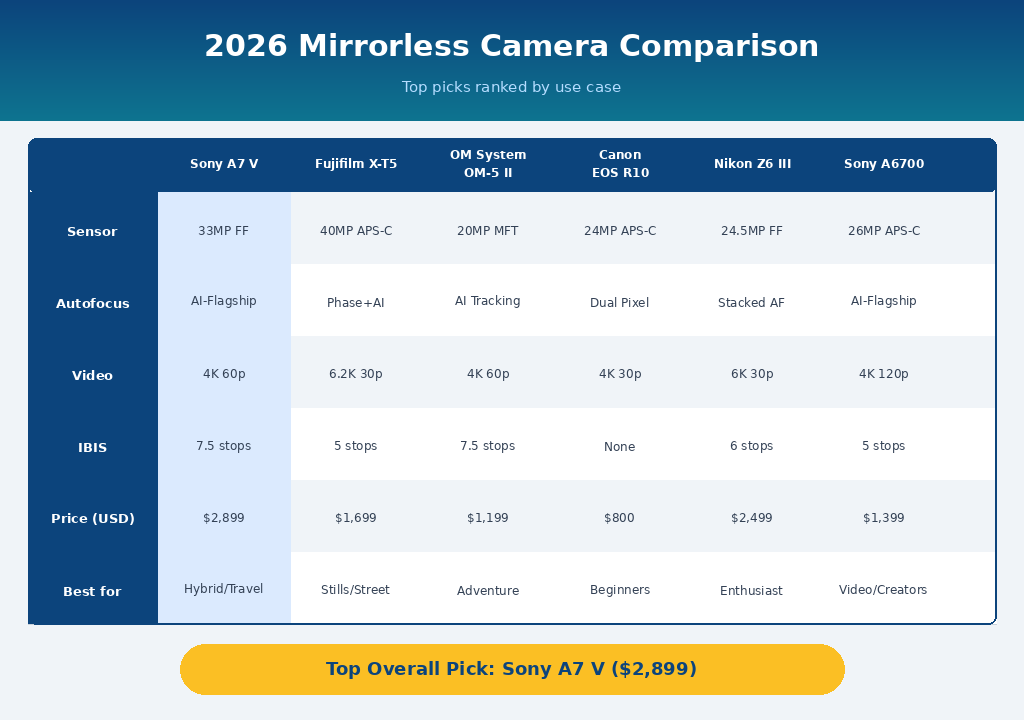
- The Sony A7 V ($2,899) is the top overall pick for enthusiast and hybrid shooters, with a 33MP sensor, AI-powered autofocus inherited from Sony’s flagship A1 II, and 30fps continuous shooting.
- The Fujifilm X-T5 is the best APS-C camera for stills-focused photographers who want dial-based controls and outstanding image quality without full-frame bulk or cost.
- The OM System OM-5 II is the best travel and adventure camera, combining weather sealing, a compact Micro Four Thirds body, and computational photography modes no other system matches at this size.
- For beginners, the Canon EOS R10 offers the lowest barrier to entry in the mirrorless market with a capable APS-C sensor and access to Canon’s RF mount ecosystem.
- Budget: entry-level picks start around $800; full-frame enthusiast options run $2,500 to $3,000 body-only.
- Lens ecosystem matters as much as the body. Commit to a mount before you buy.
What to look for before you buy
Before picking a specific model, three decisions should shape your choice.
Sensor size determines image quality, low-light performance, and gear weight. APS-C sensors (Fujifilm X-T5, Sony A6700, Canon R10) deliver excellent quality at lower cost and lighter weight. Full-frame sensors (Sony A7 V, Nikon Z6 III) give you a clear advantage in low light and maximum dynamic range. Micro Four Thirds (OM System) cuts size and weight further, with a trade-off in ultimate high-ISO performance.
Lens ecosystem matters more than the camera body. Every body you buy today is a commitment to a lens mount. Fujifilm’s X-mount has the strongest APS-C lens selection. Sony’s E-mount has the widest third-party support from Sigma, Tamron, and Viltrox. Canon’s RF mount is growing fast with new third-party autofocus lenses now approved.
Shooting style determines which specs actually matter to you. Sports and wildlife shooters need burst rate and tracking. Travel shooters need light weight. Portrait and landscape photographers prioritise resolution and dynamic range. Video creators need frame rates, codecs, and overheating limits.
Best overall: Sony A7 V
The Sony A7 V launched in December 2025 and has quickly become the benchmark for enthusiast full-frame mirrorless in 2026. Priced at $2,899 body-only, it sits on par with the Canon EOS R6 Mark III and is well-positioned in the full-frame enthusiast tier.
The A7 V carries a 33MP BSI-CMOS sensor with AI subject recognition autofocus inherited directly from Sony’s flagship A1 II. The Pre-Capture function starts recording frames before you fully press the shutter, which makes missed shots a thing of the past for wildlife and unpredictable moments. In-body image stabilisation improves to 7.5 stops compared to 5.5 stops on the outgoing A7 IV, which translates to sharper handheld shots at slower shutter speeds.
Continuous shooting reaches 30fps, and 4K video at 60p is available in a body that handles everything from portrait sessions to travel and events. Color science has been noticeably refined from previous Sony generations, particularly for skin tones.
Best for: Enthusiast photographers, travel and event shooters, hybrid photo-video creators.
One weakness: The grip is narrower than Canon and Nikon rivals, which causes knuckle rub when using larger telephoto lenses. Buffer depth at sustained 30fps can also be a limiting factor for extended action sequences.
Pros: Best-in-class AI autofocus, excellent IBIS, strong hybrid video capabilities, wide E-mount lens ecosystem.
Cons: Narrower grip than competitors, $2,899 body-only price requires additional lens investment.
Best APS-C for photographers: Fujifilm X-T5
For photographers who enjoy Fujifilm’s traditional dial-based controls, there is no more capable body in the X-mount lineup than the X-T5. It delivers a 40.2MP APS-C sensor, the highest resolution in the APS-C category, paired with Fujifilm’s film simulation modes that produce finished-looking JPEGs straight from the camera without heavy editing.
The X-T5 is deliberately stills-focused. There is no vari-angle screen, the video specs are more restrained than the X-H2, and the body is compact and light. That is by design: this is a camera for photographers who want the most detail possible in a manageable APS-C package. Fujifilm’s X-mount has the strongest APS-C lens selection of any manufacturer, with a wide range of primes and zooms from 8mm to 500mm.
Best for: Stills-focused enthusiasts, street and travel photographers, those who prefer manual dial controls.
One weakness: The EVF is smaller than those found on competing cameras, and the video capabilities are more limited than the Sony A7 V at a similar price point.
Pros: 40.2MP resolution, outstanding film simulations, superb lens ecosystem, compact and light body, dial-based ergonomics.
Cons: Limited video specs compared to hybrid rivals, smaller EVF.
Best for travel and adventure: OM System OM-5 II
The OM-1 Mark II and OM-5 II remain the most travel-ready interchangeable-lens cameras available, with computational photography modes including Live ND, Live Composite, and Hand-Held High-Res Shot that deliver effects other systems require tripods and heavy editing to match.
The OM-5 II is weather-sealed to IP53 standard and pairs a 20MP Micro Four Thirds sensor with 5-axis IBIS rated to 7.5 stops. The Micro Four Thirds mount provides a significant system size advantage: paired with OM System’s compact f/4 PRO zoom lenses, a full kit weighs roughly half that of an equivalent full-frame setup. This is the most practical system for hikers, outdoor photographers, and travellers who count grams.
The OM System OM-5 punches above its weight for adventure, nature, and travel photography. Subject tracking for birds and wildlife is competitive with far more expensive full-frame bodies, and the weather sealing gives genuine confidence in difficult conditions.
Best for: Hikers, travellers, wildlife photographers who prioritise reach in a small kit, adventure and nature shooters.
One weakness: Micro Four Thirds sensors produce more noise at very high ISOs compared to APS-C and full-frame rivals. The telephoto lens selection, while good, is expensive at the top end.
Pros: Exceptional weather sealing, computational modes, compact and light system, strong IBIS.
Cons: High-ISO performance trails APS-C and full-frame alternatives, premium telephoto lenses are costly.
Best full-frame value: Nikon Z6 III
The Nikon Z6 III sits exactly where most enthusiasts shop: powerful enough for paid work, friendly enough for personal shooting. Its partially stacked 24.5MP sensor is the world’s first of its kind, and the gains in readout speed translate directly into better autofocus and reduced rolling shutter.
The Z6 III is positioned slightly below the Sony A7 V on price while offering competitive stills and excellent 6K video performance. Nikon’s first-party Z-mount lens range is the sharpest in the full-frame category at many focal lengths, and the growing third-party catalog from Viltrox, Sigma, and Tamron is improving system value rapidly.
Autofocus is fast and reliable in real-world conditions, including low light. The body is well-built with a deep, comfortable grip that many photographers prefer to Sony’s narrower profile. Battery life is practical for full-day shoots.
Best for: Hybrid shooters who want full-frame quality without flagship pricing, wedding and event photographers, those coming from the Nikon DSLR ecosystem.
One weakness: The lens ecosystem is smaller than Sony’s E-mount, particularly for third-party options.
Pros: Partially stacked sensor, outstanding low-light autofocus, excellent build quality, strong first-party lenses.
Cons: Smaller third-party lens selection than Sony E-mount.
Best APS-C for video and creators: Sony A6700
The Sony A6700 is the most capable APS-C camera on the market, with strong autofocus performance, image quality, and video capabilities. Sony’s E-mount has the most complete array of APS-C lenses after Fujifilm’s, largely thanks to third-party support.
The A6700 shoots 4K at up to 120fps, a specification that sits well above competitors in the APS-C video category. AI-powered subject recognition autofocus from Sony’s full-frame lineup carries over to this body, which means subject tracking for humans, animals, and vehicles is class-leading. The body is compact and light enough to carry all day, while the E-mount gives access to one of the largest lens selections available on any APS-C system.
For creators building a video-focused setup, the A6700 represents the most capable APS-C option in 2026 without crossing into full-frame cost territory.
Best for: Content creators, vloggers, sports and action photographers who want APS-C capability without the full-frame price.
One weakness: No AF joystick makes selecting a focus point slightly slower than on Fujifilm’s X-T5. The EVF resolution is lower than competitors.
Pros: 4K 120fps video, AI autofocus from Sony’s flagship, wide E-mount lens ecosystem, compact body.
Cons: No AF joystick, smaller EVF.
Best for beginners: Canon EOS R10
The Canon EOS R10 is compact and lightweight, making it one of the most beginner-friendly options in the mirrorless market. The low weight and deep grip make it a forgiving camera for novices to use, and the presence of an AF joystick is a notable positive.
The R10 uses a 24.2MP APS-C sensor with Canon’s Dual Pixel CMOS AF II autofocus, which is intuitive for first-time users and tracks subjects reliably in a variety of conditions. The menu system is straightforward, and the camera’s guided UI helps new photographers understand what each setting does without requiring deep manual reading.
Entry price is around $800 body-only, which is the most accessible point on this list. Canon’s RF-S lens lineup is growing, and the system gives a clear upgrade path to full-frame RF mount bodies when you are ready to move up.
Best for: First-time mirrorless buyers, photography students, casual shooters stepping up from a smartphone.
One weakness: The EVF is a little small, and there is no in-body image stabilisation, a feature offered on rivals like the OM System OM-D E-M10 Mark IV. The RF-S native lens selection is also still smaller than Fujifilm’s X-mount.
Pros: Approachable price, excellent autofocus for a beginner body, comfortable grip, clear upgrade path within Canon RF ecosystem.
Cons: No IBIS, smaller EVF, limited RF-S lens selection.
Final verdict
The best mirrorless camera in 2026 is the one that fits how you actually shoot, not the one with the longest spec sheet. For most enthusiast photographers and hybrid shooters, the Sony A7 V is the strongest all-round choice: it combines full-frame image quality, AI autofocus from Sony’s flagship tier, and capable 4K video in a proven system with the widest lens ecosystem available. If you shoot predominantly stills and value ergonomics and colour output over specs, the Fujifilm X-T5 is the better buy. Travellers and outdoor shooters should give the OM System OM-5 II serious consideration: no other system delivers this level of practical capability at this weight. Beginners should start with the Canon EOS R10 and invest in glass over time.
Frequently asked questions
What is the best mirrorless camera overall in 2026?
The Sony A7 V is the strongest all-round mirrorless in 2026 for most enthusiast photographers. Its 33MP full-frame sensor, AI-driven autofocus, and 30fps continuous shooting cover the widest range of shooting situations at a price that does not require flagship-level investment. Photographers who prioritise dial-based ergonomics and colour science will prefer the Fujifilm X-T5.
Are mirrorless cameras better than DSLRs in 2026?
Yes, in virtually every measurable way. Every major brand now focuses development on mirrorless systems, delivering faster autofocus, better video, smaller bodies, and access to all the newest lenses. DSLR lens adapters work well on most mirrorless bodies, so switching systems does not mean abandoning your existing glass.
What is the best mirrorless camera for beginners in 2026?
The Canon EOS R10 is the most beginner-friendly option in 2026. It offers a guided shooting interface, reliable autofocus, a comfortable grip, and a clear upgrade path to Canon’s full-frame RF system. The entry price of around $800 makes it the most accessible mirrorless on this list.
Which mirrorless camera is best for travel in 2026?
The OM System OM-5 II is the top choice for travel. Its weather sealing, compact Micro Four Thirds body, and computational modes including Hand-Held High-Res Shot mean you carry a smaller, lighter kit without giving up the versatility needed across changing conditions. Paired with OM System’s compact PRO zoom lenses, the total kit weight is roughly half that of a comparable full-frame setup.
Is the Sony A7 V worth the price in 2026?
At $2,899, the Sony A7 V is strong value relative to the competition in the full-frame enthusiast category. It carries AI autofocus features that were exclusive to Sony’s $6,500 A1 II a year ago, adds 7.5 stops of IBIS, and shoots 30fps. For photographers who will use a full-frame camera seriously for stills and video, the investment is justified. For casual or occasional shooters, the APS-C options on this list deliver more value per dollar.
Related posts
Author: The GrabbedDeals editorial team tests and reviews tech across every major category, from smartphones and laptops to AI tools and smart home devices. Our buying guides are built on the latest real-world data, independent expert reviews, and current pricing.
Explore our more pages – AI Tools & Productivity | Education & Learning | Travel | Smartphone Ecosystems | Laptop & PCs | Audio & Sound Systems | Gaming & Photography | EV & Green Tech | Digital Marketing & SEO | Smart Tech Deal & Buying Guides