Grok 4.3 Is Here: What It Does and Whether It Is Worth Switching To
xAI’s Grok 4.3 went GA on 30 April 2026 with a 40% input price cut, a 1M token context window, and native video input, and barely anyone noticed. While the tech press was covering GPT-5.5 and Claude Opus 4.7, xAI quietly shipped one of the more competitive models in the current field. Here is what changed, how it benchmarks, and the honest answer to whether you should care.
Key takeaways:
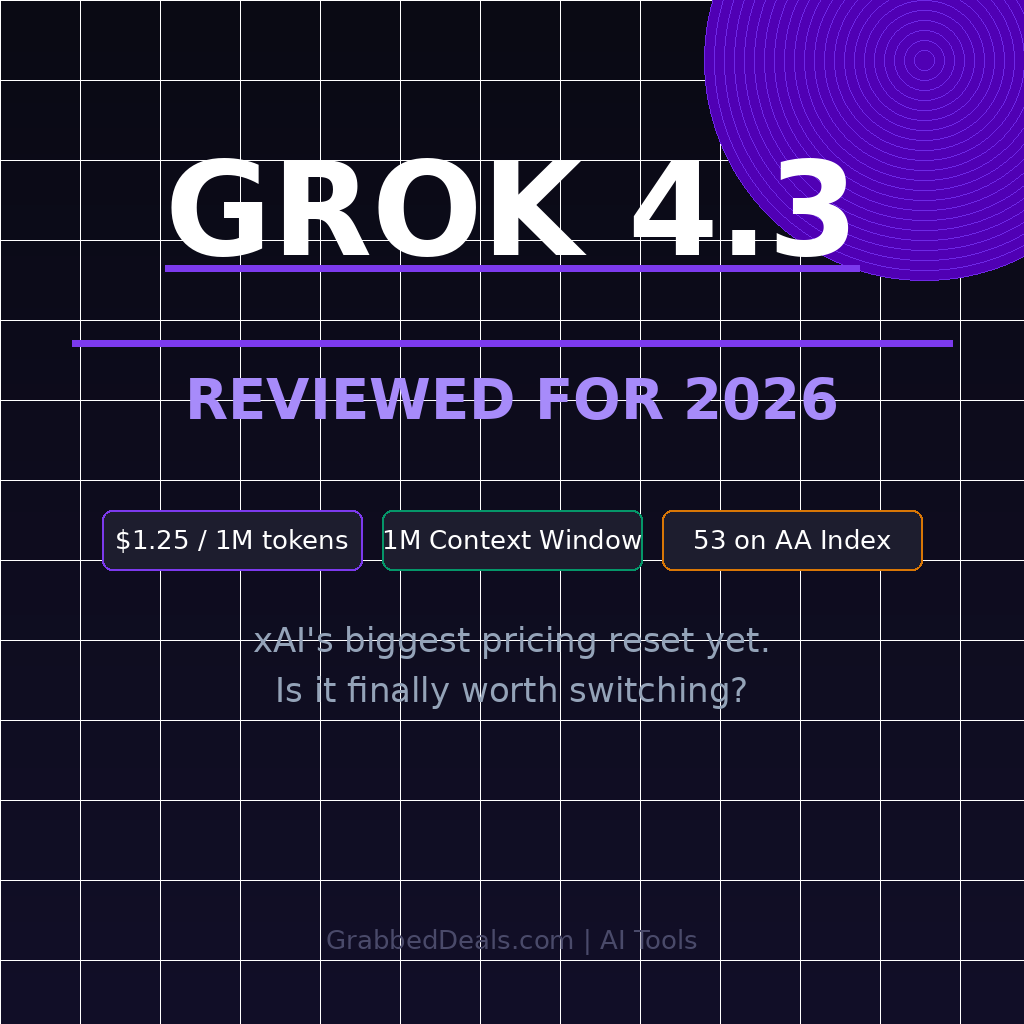
- Grok 4.3 API pricing is $1.25 per million input tokens and $2.50 per million output tokens, roughly 40% and 60% cheaper than Grok 4.20, respectively.
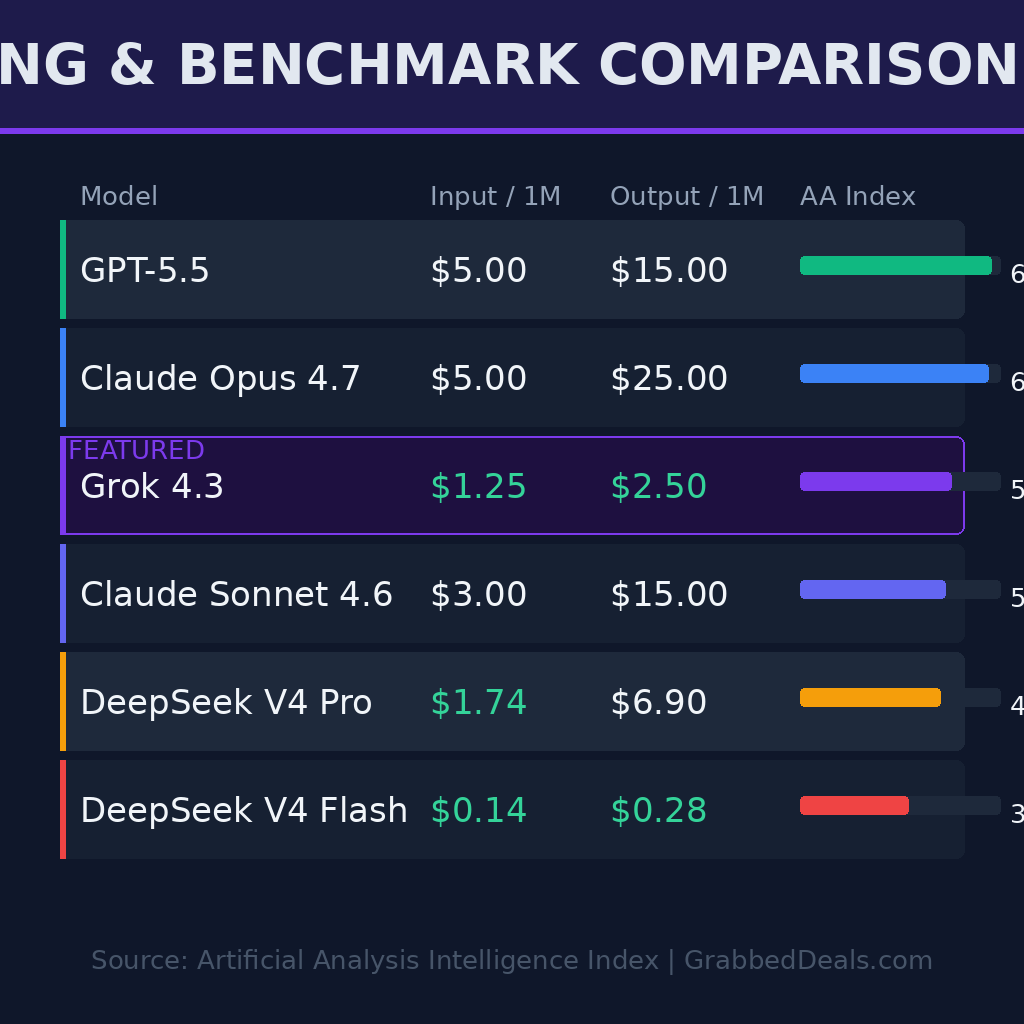
- It scores 53 on the Artificial Analysis Intelligence Index, placing it just above Claude Sonnet 4.6 but below GPT-5.5 and Claude Opus 4.7.
- Native video input (up to 5 minutes, 1080p) and direct document generation (PDF, PPTX, XLSX) are the headline new capabilities.
- The 1M token context window makes it one of the most capable models for long-document workflows at its price tier.
- SuperGrok Heavy access costs $300 per month. Developers can skip that entirely and use the API at the standard rate.
What changed since Grok 4.20
Grok 4.3 launched in beta on 17 April 2026, locked behind SuperGrok Heavy at $300 per month, before reaching full API availability on 30 April. xAI made no formal announcement; the model simply appeared in the selector. That quiet approach is characteristic of how xAI has handled most of its 2026 releases.
The meaningful changes fall into three areas.
Price. Input pricing dropped from $2.00 per million tokens (Grok 4.20) to $1.25. Output pricing dropped from $6.00 to $2.50. This is not a marginal adjustment. At scale, the output cut alone is close to 60%, which changes the economics of agentic workflows significantly. The output price median across comparable reasoning models is $8.00 per million, making Grok 4.3 highly competitive.
Multimodal input. Grok 4.20 handled images. Grok 4.3 now processes video natively up to 5 minutes at 1080p, in mp4, mov, or webm format. You can share a clip and reason about what is in it directly in the conversation. That is a genuine capability addition, not a marketing claim.
Document output. Grok 4.3 generates downloadable PDFs, formatted spreadsheets, and PowerPoint presentations directly from conversation. Early testers have described the quality as output you could hand to someone without reformatting. Whether that holds across more complex tasks remains to be tested at wider rollout.
How it benchmarks against GPT-5.5 and Claude Opus 4.7
On the Artificial Analysis Intelligence Index, Grok 4.3 scores 53. For context, that places it just above Claude Sonnet 4.6 and 4 points ahead of Grok 4.20. It sits comfortably on the Pareto frontier for intelligence versus cost, which is the more useful metric than raw benchmark rank for most buyers.
GPT-5.5 and Claude Opus 4.7 remain the strongest models in reasoning and careful analytical tasks. Grok 4.3 does not displace either of them at the top of the intelligence ranking. What it does offer is near-frontier performance at a price point that is a fraction of those alternatives.
Output speed is 81 tokens per second above the reasoning model average of 66. Time to first token is higher than average at around 10 seconds, which is a real consideration for interactive use cases but less relevant for batch processing and agentic tasks where throughput matters more.
One limitation worth flagging: community reports have noted what some describe as “narcolepsy” in agentic contexts, a tendency to pause or become overly cautious mid-task. VentureBeat’s coverage also flags some coding regressions relative to 4.20. For high-frequency autonomous agents or complex math workflows, this warrants testing before committing.
Pricing and access: what you actually pay
The API is the cleaner option for most users. At $1.25 input and $2.50 output per million tokens, Grok 4.3 is one of the most affordable reasoning models in its performance tier. Pricing doubles above 200,000 tokens per request, which is a standard tiered structure used by most major providers.
Consumer access through SuperGrok Heavy is $300 per month. That puts it above ChatGPT Pro ($200 per month) and Claude Max ($200 per month), which is a difficult pitch unless you have a specific need for native video input or the document generation features at high volume. The $30 per month standard SuperGrok plan will receive Grok 4.3 access through a staged rollout, which was estimated to reach most users by mid to late May 2026.
xAI also reduced agent tool API pricing by up to 50% in April, capping costs at no more than $5 per 1,000 successful calls. For developers building on top of Grok with tool use, this is a meaningful cost reduction that has gone largely unreported.
The xAI docs confirm that several older model slugs, including grok-4, grok-4-fast, and grok-4-1-fast, were retired on 15 May 2026, with requests redirecting to grok-4.3 at standard pricing. If you are using any of those slugs in production, you are already on Grok 4.3, whether you planned to be or not.
Who Grok 4.3 is actually for
Grok 4.3 is not the model you reach for when you need the highest raw intelligence. GPT-5.5 and Claude Opus 4.7 hold that ground. It is the model you reach for when price efficiency matters and you need near-frontier performance on tasks that involve long documents, video analysis, or high-volume agentic runs.
The legal and financial use case is the clearest fit. Processing a million tokens of case documents or financial filings at $1.25 input per million tokens is a genuinely different cost structure than running the same workload through Claude Opus 4.7 at $5 per million input. The 1M context window means you can fit entire document sets into a single request rather than chunking.
For creative and general professional use, the value depends on whether you need the video and document generation features. If you do not, the $30 SuperGrok plan is a reasonable secondary AI subscription alongside ChatGPT or Claude. At $300 per month for SuperGrok Heavy, you need a specific workflow to justify the spend.
Developers should go straight to the API. The pricing is straightforward, the model string is grok-4.3, and the 1M context window with configurable reasoning effort levels (none, low, medium, high) gives real flexibility for different task types.
Final verdict
Grok 4.3 is a stronger release than the lack of press coverage suggests. The pricing reset is the main story: a 40% to 60% reduction makes this a credible first or second model for developers and enterprise teams where cost efficiency matters. The video input and document generation capabilities are real additions that push xAI ahead of where it was six months ago.
It is not the smartest model available in mid-2026. For tasks where reasoning depth is the priority, GPT-5.5 and Claude Opus 4.7 remain ahead. But Grok 4.3 is the most affordable model that does this much, and for specific workflows — long-document analysis, video review, high-volume agentic pipelines, it deserves serious evaluation.
Developers: go to the API now at $1.25 per million input tokens. Chat users: wait for the SuperGrok rollout unless you need video input today, in which case SuperGrok Heavy at $300 per month is the only current option.
Frequently asked questions
Is Grok 4.3 better than GPT-5.5?
No, not on raw intelligence benchmarks. Grok 4.3 scores 53 on the Artificial Analysis Intelligence Index while GPT-5.5 sits higher. However, Grok 4.3 is significantly cheaper at $1.25 input per million tokens versus GPT-5.5’s higher pricing, making it more practical for high-volume or cost-sensitive workflows.
What is new in Grok 4.3 compared to Grok 4.20?
The main additions are native video input (up to 5 minutes, 1080p), direct document generation in PDF, PPTX, and XLSX formats, and a significant price cut of 40% on input and 60% on output versus Grok 4.20. The 1M token context window remains the same but performance improvements give it a 4-point edge on the Artificial Analysis Intelligence Index.
How much does Grok 4.3 cost?
Via API, Grok 4.3 costs $1.25 per million input tokens and $2.50 per million output tokens. Requests exceeding 200,000 total tokens are billed at a higher rate. Consumer access through SuperGrok Heavy costs $300 per month, while the standard SuperGrok plan at $30 per month is receiving Grok 4.3 through a staged rollout.
Can I use Grok 4.3 without a SuperGrok subscription?
Yes. Developer API access is open to all and does not require a SuperGrok subscription. You pay per token at the standard API rate. Consumer chat access to Grok 4.3 is currently limited to SuperGrok Heavy, with rollout to standard SuperGrok underway.
Is Grok 4.3 good for coding tasks?
It handles instruction-following and reasoning tasks well, but some community reports have flagged coding regressions compared to Grok 4.20. For pure coding workloads, it is worth testing against your specific tasks before switching from a model you already use. For document-heavy reasoning and long-context tasks, it performs more consistently.
Explore our more pages – AI Tools & Productivity | Education & Learning | Travel | Smartphone Ecosystems | Laptop & PCs | Audio & Sound Systems | Gaming & Photography | EV & Green Tech | Digital Marketing & SEO | Smart Tech Deal & Buying Guides