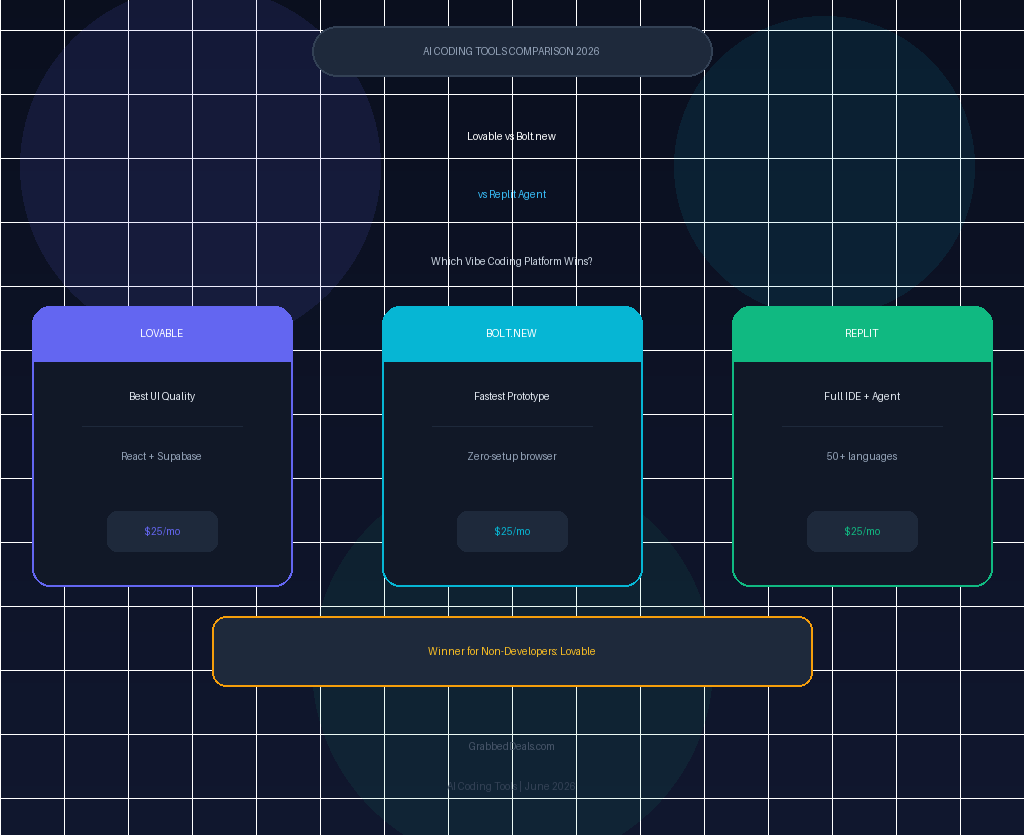
Lovable is the best vibe coding platform for non-developers in 2026 — but Bolt.new and Replit Agent each win in specific situations that are worth knowing before you commit.
Vibe coding has moved from hype to mainstream. According to Hostinger’s 2026 vibe coding statistics report, 63% of active vibe coding users are not developers. Product managers, founders, marketers, and domain experts are building full-stack applications using nothing but natural language. Gartner now predicts that 60% of all new code will be AI-generated by the end of 2026. The question is no longer whether these tools work. It’s which one is right for your situation.
This comparison covers all three platforms honestly, with no affiliation to any of them, on ease of use, output quality, backend capability, pricing, and who each platform is actually built for.
Key takeaways
- Lovable wins for non-developers who want a polished, deployable app with a real backend and clean React code out of the box.
- Bolt.new is the fastest from prompt to preview, with zero setup and strong framework flexibility including React, Vue, Svelte, and Astro.
- Replit Agent 4 (launched March 2026) is the most autonomous and powerful platform, but it has a steeper learning curve and unpredictable usage costs.
- All three have Pro plans at $25/month, but pricing diverges significantly for teams.
- The Lovable-to-Cursor graduation workflow is now a widely used pattern: build the scaffold in Lovable, then bring it into Cursor or Claude Code for complex logic.
What is vibe coding and why does the platform choice matter?
Vibe coding is building software by describing what you want in natural language and letting an AI generate the code. The term was coined by Andrej Karpathy in February 2025, and by 2026 it has become a structural shift in who gets to build software.
The platform you choose matters more than most comparisons admit. Lovable, Bolt.new, and Replit Agent are not interchangeable tools with different logos. They were built with fundamentally different architectures and different target users. Choosing the wrong one means hitting a hard ceiling at the worst possible moment — usually when you are halfway through building something real.
The three tools now sit at the centre of a vibe coding market valued at $4.7 billion globally and growing at roughly 38% annually. Lovable reached $400 million ARR in February 2026. These are not experiments. They are production platforms used by hundreds of thousands of builders.
Lovable: best for non-developers who want production-ready apps
Lovable is an AI-first UI builder optimised for generating polished web interfaces. You describe your app in plain English, and Lovable generates React components, sets up a Supabase database and authentication, and gives you a deployable application in one session.
Who it is for: Non-technical founders, product managers, and solo builders who want a real application, not a throwaway prototype.
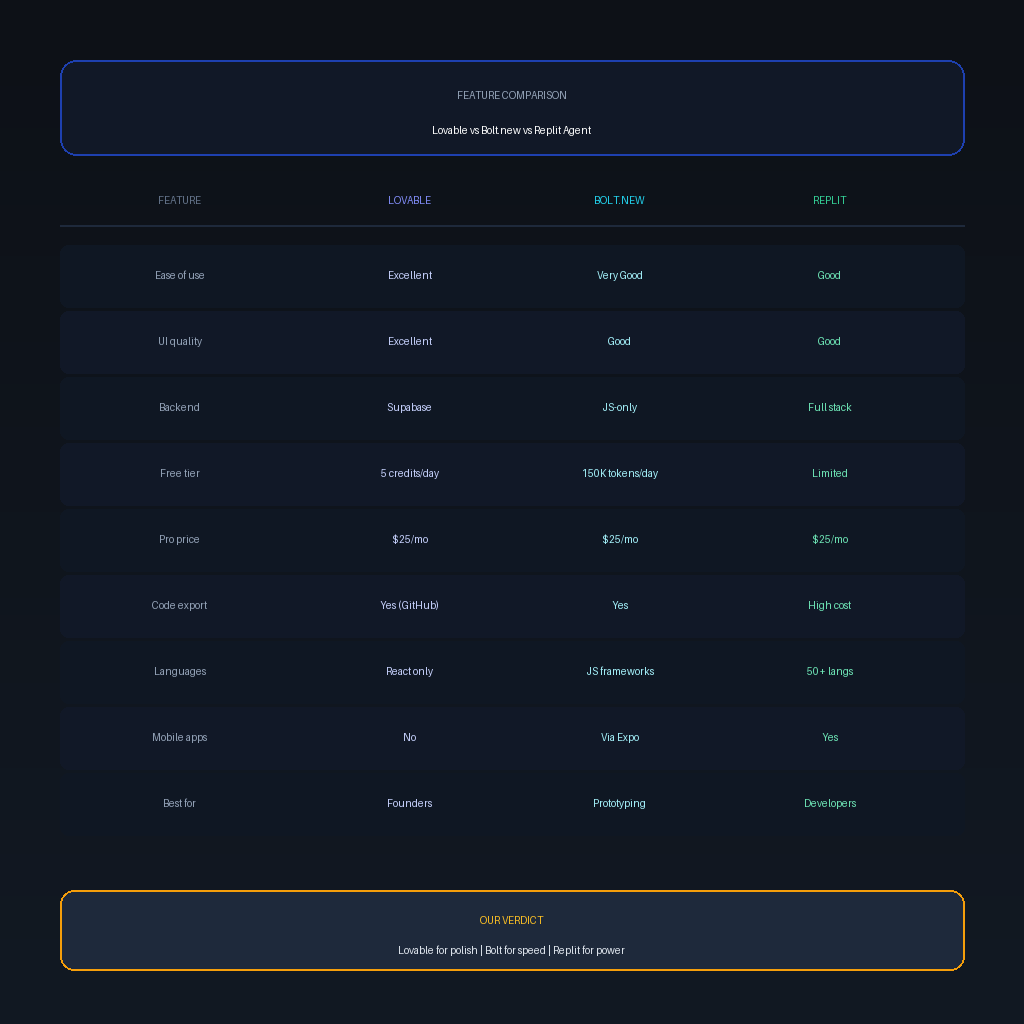
Strengths: Lovable consistently produces the cleanest React code and the most polished UI of the three platforms. Its built-in Supabase integration handles backend concerns (authentication, databases, row-level security) without requiring you to configure anything. The conversational refinement loop lets you iterate without starting from scratch. Code exports to GitHub with no lock-in, and the Lovable-to-Cursor workflow is now well-documented and widely used by the vibe coding community.
Weaknesses: Lovable’s credit system is not fully transparent. A complex instruction can consume anywhere from 10 to 50 credits, and many users report that the 100-credit Pro plan runs short on complex projects. It only supports React, which is limiting if your stack requires something different. There is also no mobile app output.
Pricing: Free plan with 5 credits per day. Pro at $25 per month for 100 credits, shared across unlimited users on one account.
Bolt.new: best for rapid prototyping with zero setup
Bolt.new is a browser-based AI agent that generates full-stack JavaScript applications from a single prompt. Open a browser tab, type your idea, and get a working preview. No account connections, no configuration screens, no friction.
Who it is for: People who need to validate an idea quickly, create demos, or build prototypes that do not need a full production backend yet.
Strengths: Bolt is the fastest from prompt to preview of the three platforms. It supports multiple JavaScript frameworks including React, Vue, Svelte, and Astro, which gives experienced builders more flexibility than Lovable’s React-only output. It also supports mobile app output via Expo, which Lovable does not. The WebContainer technology means everything runs in the browser without a server.
Weaknesses: Bolt’s generated code has been described by community users as sometimes “half done” on complex projects. Production readiness requires more manual work than Lovable. Its token-based pricing model means costs scale with project complexity: larger codebases use more tokens per prompt because Bolt syncs the entire codebase to the AI on each interaction. For teams, Bolt charges $30 per user per month with unshared tokens, which gets expensive quickly compared to Lovable’s flat team pricing.
Pricing: Free tier at 150K tokens per day. Pro at $25 per month for 10 million tokens. Teams at $30 per user per month.
Replit Agent: best when you need a full development environment
Replit Agent 4, launched in March 2026, sits in a different category from the other two. Replit started as a cloud IDE and added AI agent capabilities. You can code alongside the AI, let it run autonomously, or mix both approaches. It supports over 50 programming languages, has a built-in PostgreSQL database, built-in hosting, and a new Security Agent launched in April 2026 that runs vulnerability scans in under an hour.
Who it is for: Developers who want an AI agent inside a real IDE, or builders who need backend flexibility beyond JavaScript and Supabase.
Strengths: Replit Agent is the most capable platform overall. Agent 4 supports parallel task execution, checkpoint-based rollback, Design Mode for interactive mockups, and autonomous long builds on the Core plan. With 35 million users, it is by far the largest platform in this comparison. The full IDE gives you terminal access, direct file editing, and GitHub integration.
Weaknesses: Replit has a steeper learning curve than Lovable or Bolt for pure non-developers. Its effort-based pricing is honest in theory but unpredictable in practice. Users have reported significant additional charges on top of base plan costs. Code migration out of Replit carries a higher cost than Lovable or Bolt due to infrastructure coupling.
Pricing: Core at $25 per month with $25 in usage credits. Pro at $100 per month. Teams at $40 per user per month. Deployments billed separately by usage.
Watch: Lovable vs Bolt vs Replit in action
Pricing and ease of use: head-to-head
All three platforms sit at $25 per month for individual Pro plans, but the value each delivers at that price is very different. Lovable’s credit model covers unlimited users on a single account, making it the best value for small teams. Bolt charges $30 per user per month for teams, with tokens that are not shared. Replit’s Core plan includes $25 in usage credits, but actual costs can climb with compute and deployment charges.
For ease of use, Bolt has the lowest barrier to entry for a complete beginner: open a browser tab, write a prompt, see a result. Lovable’s Supabase setup introduces backend concepts that take a few extra minutes up front, but the payoff is a working application rather than a prototype. Replit sits at the far end: powerful, but it expects more from you.
For code exportability, Lovable and Bolt are essentially equivalent, both generate portable, standard code you can continue in any editor. Replit has higher migration costs due to infrastructure coupling.
External resources worth reading: the Vibe Coding Academy’s honest comparison, Lovable’s own breakdown of the three platforms, and 13Labs’ vibe coding statistics for 2026.
Final verdict
Lovable wins for non-developers in 2026. If your goal is to ship a real, polished, investor-ready web application without writing code, Lovable produces the most complete output. Its Supabase integration handles the backend, its React output is clean and portable, and its per-team pricing makes sense for small teams.
Choose Bolt.new if you need the fastest path from idea to working demo, you are comfortable with JavaScript-only constraints, or you want framework flexibility beyond React.
Choose Replit Agent if you have some development background, need a full IDE alongside the AI, or your project requires languages beyond JavaScript.
For most non-developers reading this, start with Lovable. If you hit its ceiling, graduate to Cursor using your Lovable export. That workflow has been validated by the community and it works.
Frequently asked questions
Is Lovable better than Bolt.new for beginners with no coding experience?
For complete beginners who want a finished, deployable application, Lovable is the stronger choice. Bolt.new is easier to start because there is no configuration, but Lovable’s output is closer to a production-ready app. If you only need a quick prototype or demo, Bolt wins on speed. If you want something you can actually launch, Lovable is worth the slightly steeper onboarding.
How much does Replit Agent actually cost per month in 2026?
Replit’s Core plan starts at $25 per month and includes $25 in usage credits. However, compute and deployment charges are billed separately, and real-world usage often exceeds the base plan. Some users have reported bills of several hundred dollars in additional charges during heavy build sessions. Budget for unpredictable overage costs if you are using Replit for serious projects, and check the usage dashboard regularly.
Can Lovable build mobile apps in 2026?
No. As of mid-2026, Lovable is focused on web applications built in React and does not output native mobile apps. Bolt.new supports mobile app creation via Expo, which targets React Native. Replit supports mobile app development across multiple frameworks. If mobile output is a requirement, Bolt or Replit is the better fit.
What is the Lovable-to-Cursor workflow and should I use it?
The Lovable-to-Cursor workflow involves building your initial application scaffold, UI components, and Supabase backend in Lovable, then syncing the project to GitHub and importing it into Cursor for complex backend logic or custom features. It is a well-documented and actively used pattern in the vibe coding community. If you expect to add sophisticated features beyond what Lovable’s natural-language interface can handle efficiently, this workflow is a practical upgrade path rather than a workaround.
Which vibe coding platform is best for building a startup MVP in 2026?
For a startup MVP, Lovable is the most recommended starting point for non-technical founders. It produces polished, deployable applications with authentication and database integration out of the box, and the output is portable enough to hand to a developer later if needed. Replit Agent is the right choice if your MVP requires backend complexity beyond React and Supabase, or if you need to work across multiple programming languages.
Explore our page – AI Tools & Productivity