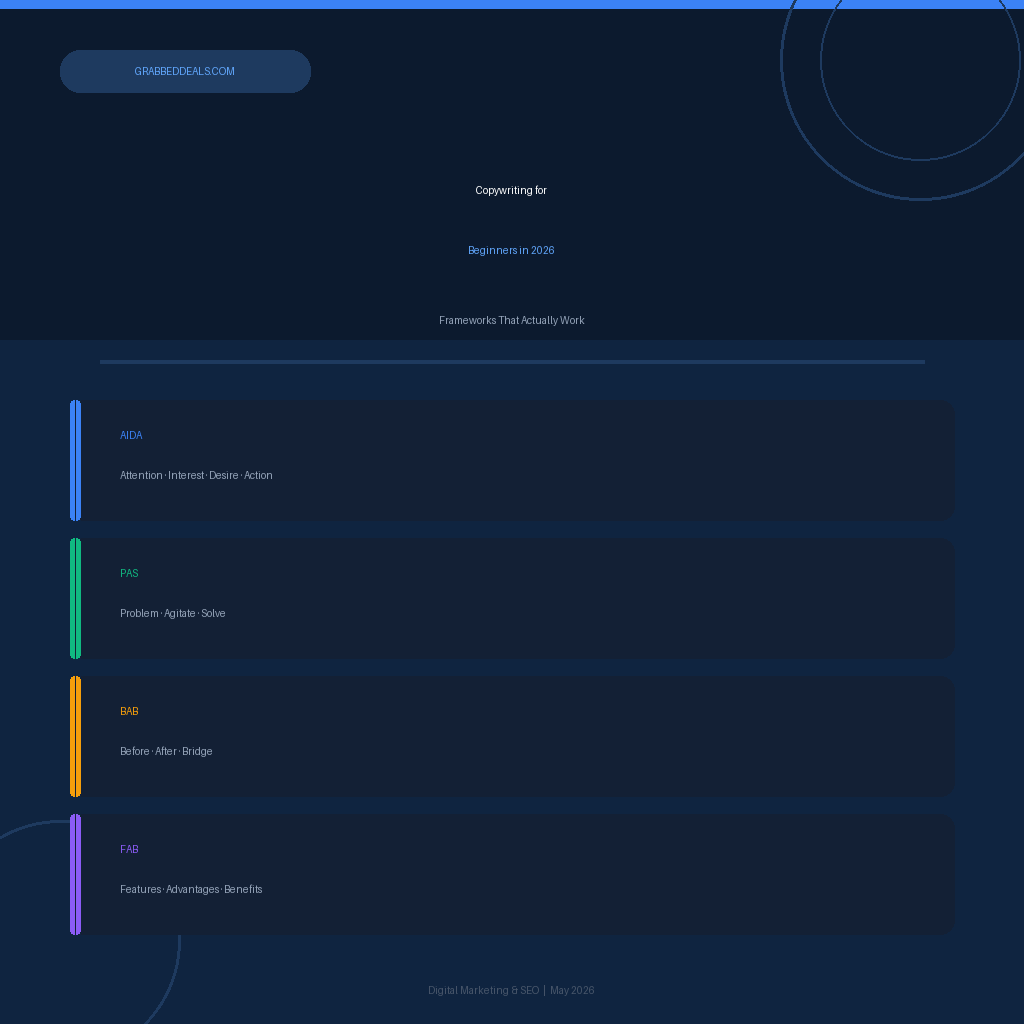
Good copywriting is one of the most in-demand skills of 2026, and most people learning it are starting in the wrong place. You don’t need to be a natural writer. You need a reliable framework. AIDA, PAS, and a handful of other proven structures have guided marketers, freelancers, and business owners to higher conversions for decades, and they work just as well today, whether you’re writing a landing page, a product description, or a social ad.
This guide covers the four most useful copywriting frameworks for beginners, how to apply each one in practice, and how AI tools have changed what it means to write copy well in 2026.
Key Takeaways
- AIDA (Attention, Interest, Desire, Action) is the best starting point for beginners because it mirrors how readers make decisions.
- PAS (Problem, Agitate, Solve) converts better for emotional buying decisions and works especially well for landing pages and ads.
- In 2026, the most effective copywriters use AI tools to draft and speed up the process, then apply frameworks to sharpen and direct the output.
- BAB (Before, After, Bridge) and FAB (Features, Advantages, Benefits) are two more frameworks worth adding once you’ve mastered the first two.
- Every framework is a thinking tool, not a rigid template. Understanding the psychology behind each one is more valuable than memorising the acronym.
What copywriting actually is (and isn’t)
Copywriting is the practice of writing text that prompts a specific action, typically a click, a sign-up, a purchase, or a conversion of some kind. It’s different from content writing, which is primarily aimed at informing or entertaining. Copy sells. Content educates. Both matter, but the skills are distinct.
In 2026, copywriting formulas remain effective because they are grounded in timeless human psychology, not platforms or trends. The channels have changed from print ads to landing pages, emails, and social media, but the underlying decision-making process has not.
Most beginners try to write copy from instinct and wonder why it doesn’t convert. The answer is usually structured. The readers you’re writing for have a predictable emotional and logical journey, and the frameworks below map that journey precisely.
Framework 1: AIDA (the best place to start)
AIDA stands for Attention, Interest, Desire, Action. It’s the most widely used copywriting framework in the world, and AIDA is the best starting point for beginners because it mirrors the natural flow of how readers engage with persuasive content.
Here’s how each stage works in practice:
Attention
Your headline and opening line carry the full weight of this stage. If your first sentence doesn’t stop the scroll, nothing else matters. Strong attention hooks address a problem directly, make a bold claim, or surface a fact the reader didn’t expect. Keep it specific. “Most people spend twice as long on landing pages that don’t convert” is sharper than “Copywriting is important.”
Interest
Once you have the reader’s attention, you need to hold it. Writing a strong hook and an engaging first paragraph captures your readers’ interest and leads them through your copy. This paragraph is the bridge to the rest of your message. Use specifics, short anecdotes, or a clear articulation of the reader’s situation to maintain momentum.
Desire
This is where you shift from “this is relevant to me” to “I want this.” You’re connecting your product, service, or idea to something the reader already wants. Benefits, not features, drive this stage. A feature is what something does. A benefit is what it changes for the reader. “500MB storage” is a feature. “Keep five years of client work in one place” is a benefit.
Action
Start your call to action with a strong verb. Be direct, and if you can, address your reader using the second person. “Start your free trial” works better than “A free trial is available.” One CTA per piece of copy. Multiple options split attention and reduce conversions.
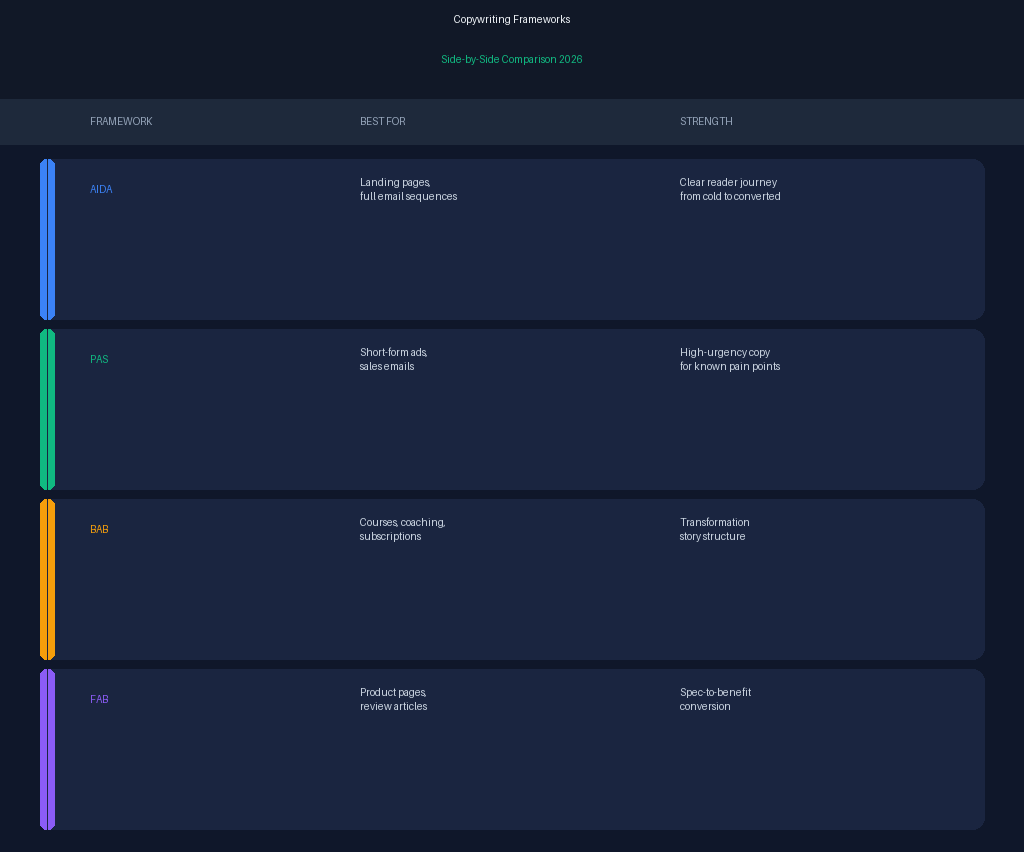
Where AIDA works best: Landing pages, email subject lines and body copy, Facebook and Google ads, and product pages.
Framework 2: PAS (for emotional buying decisions)
PAS stands for Problem, Agitate, Solve. PAS is a problem-focused framework that identifies a customer’s pain point, agitates it, and offers a solution. It’s more direct than AIDA and often converts better when your reader is actively experiencing the problem you’re solving.
Problem
Name the problem in your reader’s own language. The more specifically you mirror their internal monologue, the more they feel understood. “Writing copy takes hours and still doesn’t convert” lands harder than “marketing copy is difficult.”
Agitate
This is the step most beginners skip, and skipping it weakens the framework significantly. Agitate the problem by surfacing its consequences. What does it cost the reader in time, money, or opportunity? This isn’t about manipulation. It’s about confirming to the reader that the problem is worth solving.
Solve
Present your solution clearly and directly. PAS works at its best when the solution follows naturally from the pain you’ve just named. If the problem is “copy that doesn’t convert costs you clients every week,” the solution is the framework, tool, or skill that closes that gap.
Where PAS works best: Sales emails, social media ads targeting a specific pain point, short-form landing pages, product descriptions for problem-solving tools.
Framework 3: BAB (for transformation-led copy)
BAB stands for Before, After, Bridge. It’s a storytelling structure that works by painting two pictures: the reader’s current situation (Before), and the improved version of their life (After), followed by a Bridge that explains how to get from one to the other.
The Before stage should feel familiar and honest, not dramatised. The After stage should be specific and vivid enough that the reader can picture it. The Bridge is your product, service, or idea, explained as the route from one state to the other.
BAB is particularly effective for coaching, course, and subscription product copy because it grounds the value in transformation rather than features.
Where BAB works best: Course sales pages, coaching services, email sequences, LinkedIn posts, and social proof sections.
Framework 4: FAB (for product and e-commerce copy)
FAB stands for Features, Advantages, Benefits. FAB is used as a strong starting point for creating copy that resonates with your target audience, especially when you’re writing about a physical or digital product with clear specifications.
Most beginners default to writing feature-heavy copy: “12-hour battery life. Noise cancellation. USB-C charging.” Those are features. FAB asks you to go one level further each time.
The Feature is the fact. The Advantage is what the feature enables. The Benefit is what it means for the reader’s life. “12-hour battery life” (Feature) “means you can work all day without a charger” (Advantage), so you’re productive wherever you work, not just near a plug (Benefit).
FAB integrates cleanly with AIDA. Use FAB to build out the Desire stage of an AIDA structure, turning a list of specs into a sequence of reasons to buy.
Where FAB works best: Product descriptions, comparison tables, review articles, e-commerce category pages.
How AI has changed copywriting in 2026
AI writing tools haven’t replaced copywriters. They’ve changed what copywriters need to be good at. AI tools generate better output when given a clear structure. Treating frameworks as containers for AI prompts means AI can execute faster and more consistently while the human remains in control of strategy and tone.
In practical terms: if you understand AIDA, you can prompt an AI tool to draft an AIDA-structured landing page, then apply your judgment to the output. The frameworks become a quality filter as much as a writing guide. This is why copywriting skills are more searched and more valued in 2026, not less. The floor has risen, and knowing how persuasion actually works gives you an advantage over people who rely entirely on AI output.
Common mistakes beginners make
Writing features instead of benefits is the most common error, but there are a few others worth naming. Starting your copy with your company name or history rather than the reader’s problem, is the second. Burying the call to action at the bottom of a long page is the third.
The fourth is writing for too broad an audience. The sharpest copy speaks to one specific reader in one specific situation. “For marketers” is weak. “For freelance social media managers writing ads for the first time” is strong. The more specific your imagined reader, the more universally the copy tends to land. According to Copyblogger’s copywriting fundamentals resource, specificity is one of the most consistent differentiators between copy that converts and copy that doesn’t.
Final verdict
AIDA and PAS are the two frameworks every beginner should master first. Start with AIDA because it structures your thinking around the reader’s journey from attention to action. Add PAS once you’re writing for specific pain points or emotional buying decisions. BAB and FAB expand your range for transformation-led and product-specific copy, respectively.
The greater skill behind all four frameworks is understanding your reader: what they already believe, what they want, and what’s stopping them from acting. The frameworks give structure to that understanding. That’s something AI can’t replicate from scratch, which is why copywriting as a skill remains one of the most practical things you can learn in 2026.
Frequently asked questions
What is the best copywriting framework for beginners in 2026?
AIDA (Attention, Interest, Desire, Action) is the best starting point for beginners. It maps directly to the way readers engage with and respond to persuasive content, making it easier to diagnose why a piece of copy isn’t working. Most other frameworks are variations or extensions of the same core logic.
Is copywriting still worth learning if AI can write copy automatically?
Yes. AI tools have raised the baseline for written content, which makes human judgment more valuable at the strategic level. Knowing how persuasion works lets you direct AI output effectively, spot weak copy, and improve it. Copywriting skills are among the most searched marketing upskilling topics in 2026 for exactly this reason.
What is the difference between AIDA and PAS?
AIDA is a full journey from awareness to action and works best when the reader may not be aware of the problem yet. PAS assumes the reader already knows their problem and drives harder and faster to a solution. PAS tends to convert better in short-form ad copy; AIDA works better for longer landing pages and email sequences.
How long does it take to learn copywriting as a beginner?
You can write competent copy using AIDA or PAS within a few days of studying the frameworks. Consistent results at a professional level take three to six months of practising across different formats including ads, emails, and landing pages. The fastest path is to write copy, test it where possible, and study what worked and what didn’t.
Do I need to use a copywriting framework for every piece of content I write?
No. Frameworks are thinking tools, not mandatory templates. Once you’ve internalised what each one is designed to do psychologically, you apply them intuitively rather than rigidly. The goal is to understand why the structure works so you can adapt it to your specific situation rather than forcing every piece into an acronym.
Author: The GrabbedDeals editorial team tests and reviews tech across every major category, from smartphones and laptops to AI tools and smart home devices. Our buying guides are built on the latest real-world data, independent expert reviews, and current pricing.
Explore our more pages – AI Tools & Productivity | Education & Learning | Travel | Smartphone Ecosystems | Laptop & PCs | Audio & Sound Systems | Gaming & Photography | EV & Green Tech | Digital Marketing & SEO | Smart Tech Deal & Buying Guides